Hyundai Glovis is set to establish a management system for used electric vehicle batteries in Jeju Island. The company will foster the entire battery lifecycle industry within Jeju and participate in building a circular economy foundation.
On the 15th, Hyundai Glovis announced that it signed a Memorandum of Understanding (MOU) with Jeju Province and Jeju Technopark (TP) to promote the used electric vehicle battery industry. The signing ceremony held on the 14th at Jeju Provincial Office was attended by Hyundai Glovis CEO Lee Gyubok, Jeju Governor Oh Young-hoon, and Jeju TP Director Moon Yong-seok, among others.
Under this agreement, Hyundai Glovis will first promote the transportation business for used electric vehicle batteries generated in Jeju. According to the current Air Quality Preservation Act, owners who received government subsidies when purchasing electric vehicles must return the batteries to local governments when deregistering their vehicles.
In Jeju, 21,000 electric vehicles registered before the end of December 2020 are subject to battery return. Some of the returned batteries are currently stored at Jeju TP. The volume of returned batteries is expected to increase, necessitating the expansion of battery recycling infrastructure.
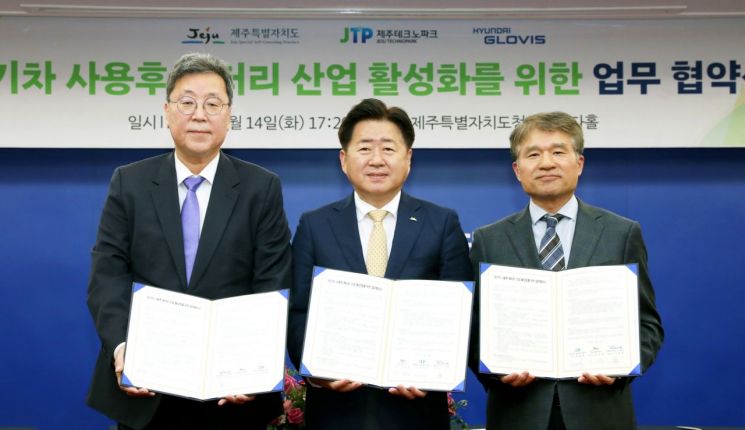 (From left) Lee Gyubok, CEO of Hyundai Glovis; Oh Younghoon, Governor of Jeju Province; Moon Yongsuk, President of Jeju Technopark, are posing for a commemorative photo at the "Business Agreement Ceremony for Revitalizing the Used Electric Vehicle Battery Industry" held at Jeju Provincial Office on the 14th.
 [Photo by Hyundai Glovis]
Until the battery recycling infrastructure in Jeju expands, Hyundai Glovis will place the batteries in specially designed collection containers and transport them by ship to the mainland. The company developed its own collection containers that allow multiple layers of batteries to be transported simultaneously.
The transported batteries undergo a pretreatment process at recycling hubs Hyundai Glovis has established in places like Gimhae, Gyeongnam. Pretreatment involves physically discharging the remaining power in used batteries, dismantling them, and removing impurities. This process also produces black powder, a separated cathode material.
Earlier this year, Hyundai Glovis invested in 'ER', a battery recycling specialist company, securing pretreatment technology and facilities. ER holds patents for technology and equipment that process waste lithium-ion batteries using a low-temperature vacuum system. Additionally, it has eco-friendly process technology that recovers electrolytes during pretreatment to prevent wastewater and carbon dioxide emissions.
Furthermore, Hyundai Glovis plans to introduce the first used battery pretreatment facility in Jeju. Once installed, used batteries generated in Jeju can be recycled locally without the need for transportation to the mainland.
Hyundai Glovis also plans to implement a management system for Jeju TP’s battery logistics center and local scrapyards. The system will enable real-time monitoring of the volume of used batteries entering 11 scrapyards in Jeju and the vehicle dispatch status required for their collection.
Moreover, Hyundai Glovis intends to produce energy storage systems (UBESS) using used batteries generated in Jeju, which will be utilized for local solar or wind power equipment and electric vehicle chargers. Jeju Province will provide administrative and policy support to activate the recycling and reuse industry of used batteries promoted jointly with Hyundai Glovis, while Jeju TP will be responsible for strengthening testing and evaluation functions and managing the industrial system.
A Hyundai Glovis official stated, "Hyundai Glovis has strengthened its competitiveness by establishing an integrated system from collection to pretreatment in the battery recycling business. Based on this, we will contribute to revitalizing the used electric vehicle battery industry in the Jeju region."
© The Asia Business Daily(www.asiae.co.kr). All rights reserved.

















