Samsung Unveils First Mask for Next-Gen QD and RGB OLED Deposition
LG Debuts 1.3-Inch OLEDs for VR and Smartwatches
Samsung Display and LG Display announced on the 15th that they unveiled a large number of new technologies related to organic light-emitting diodes (OLED) at 'SID 2024,' the world's largest exhibition held from the 14th to 16th (local time) at the McEnery Convention Center in San Jose, California, USA. They also showcased OLEDOS-related technologies, which are attracting attention as next-generation displays for augmented reality (AR), virtual reality (VR), and extended reality (XR).
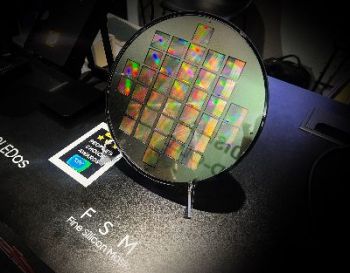 Fine Silicon Mask (FSM) for OLEDs showcased by Samsung Display at SID 2024. [Photo by Samsung Display]
First, Samsung Display introduced next-generation quantum dot (QD) technology that implements RGB (red, green, blue) pixels using only ultra-fine semiconductor particles QD.
Samsung Display explained that the QD-LED (Quantum Dot Light Emitting Diode Display), unveiled for the first time in the industry, is a next-generation self-emitting technology that implements RGB pixels using quantum dots. The currently commercialized QD-OLED creates colors by passing light emitted from blue OLED through the QD emission layer. QD-LED emits light directly from QD RGB pixels through current driving without OLED. It offers high manufacturing efficiency due to QD's characteristic wide color gamut, high color accuracy, and stable material properties of quantum dots.
The newly revealed 18.2-inch QD-LED, sized like a notebook, features a resolution of 3200×1800. It achieves a high pixel density of 202 ppi (pixels per inch), comparable to high-definition premium monitors, and a brightness of 250 nits. The QD-LED product was developed using environmentally friendly Cd Free (cadmium-free) quantum dots with advanced technology. The related paper won the 'Best Paper Award of the Year' selected by SID.
They also showcased the latest QD-OLED products in their third year since launch. Exhibits included gaming monitor products such as the world’s first developed 4K 31.5-inch and 360Hz 27-inch models, as well as a 2024 model 65-inch TV panel with a peak brightness of 3000 nits.
Autostereoscopic 3D that automatically switches between 2D and 3D depending on the user's gaze, and fine silicon masks (FSM) for RGB OLEDOS deposition were also introduced. Regarding FSM, they revealed the actual 3500 ppi FSM for the first time in collaboration with eMagin, a micro OLED specialized subsidiary acquired last year.
OLEDOS refers to OLED deposited on silicon wafers used in semiconductor manufacturing, enabling high-definition in small sizes, making it a promising display for AR, VR, and XR applications. To realize ultra-high-resolution displays, RGB subpixel sizes must be deposited at the micrometer (μm) level. Samsung Display explained that they produced FSM based on 8-inch silicon wafers for this purpose.
To demonstrate the durability of foldable OLEDs to visitors, they brought the 'OLED Bot' from the production line and tested its durability. The 'OLED Bot' placed a 7.6-inch foldable panel in a water-filled tank, shook it, sprinkled salt and pepper, scrubbed it with a steel scouring pad, and poured dozens of steel balls onto the panel at once, yet it remained unaffected.
A Samsung Display official said, "We are pleased to showcase Samsung Display's overwhelming foldable competitiveness and innovative next-generation technologies that will lead the IT and XR era at the world's largest academic exhibition."
 At the 'SID 2024' exhibition, an LG Display model is introducing a 1.3-inch OLEDoS product.
 [Photo by LG Display]
LG Display also introduced a comprehensive lineup of new OLEDOS technologies for VR, large OLED panels, and display solutions for SDV (software-defined vehicles) under the theme 'A Better Future' at SID 2024.
LG Display unveiled for the first time a new OLEDOS technology for VR that dramatically increases screen brightness and resolution compared to existing products. It features a 1.3-inch size, about the size of a 500-won coin, with ▲ ultra-high brightness of 10,000 nits (1 nit equals the brightness of one candle) ▲ ultra-high resolution of 4000 ppi at 4K level ▲ accurate color expression meeting over 97% of the Digital Cinema Initiatives (DCI) standard color gamut DCI-P3.
The OLEDOS revealed by LG Display this time combines newly developed high-performance OLED elements with the light emission maximization technology 'MLA,' increasing brightness by about 40% compared to existing products.
They also unveiled the industry's first OLEDOS for smartwatches. It has a 1.3-inch size with 4K resolution that clearly displays content and is equipped with autostereoscopic 3D technology called 'Light Field Display,' producing hologram-like effects.
Additionally, they showcased an 83-inch ultra-large OLED TV panel and gaming OLED panels featuring their proprietary technology 'Meta Technology 2.0.'
They exhibited vehicle display solutions optimized for SDV with differentiated technologies such as high-definition vehicle OLED and LTPS (low-temperature polycrystalline silicon) LCD.
Yoon Soo-young, CTO of LG Display, said, "We will continue to solidify our technological leadership by continuously introducing innovative products that provide differentiated customer value through relentless research and development."
© The Asia Business Daily(www.asiae.co.kr). All rights reserved.


















