IMW 2024 Reveals MAC Operation Enhancement Technology
Memory Industry Accelerates Competition in 'CIM Semiconductor'
SK Hynix unveiled a technology on the 14th at an international conference that enhances the accuracy of MAC (Multiply Accumulate) operations in analog computing in-memory (A-CIM) semiconductors through oxygen diffusion barrier technology. MAC operations refer to high-speed multiply-accumulate calculations necessary for artificial intelligence (AI) inference and learning processes. SK Hynix has distinguished itself in the crucial technology competition to create the 'dream memory semiconductor' that overcomes the limitations of memory semiconductors, which can only store information but cannot perform calculations.
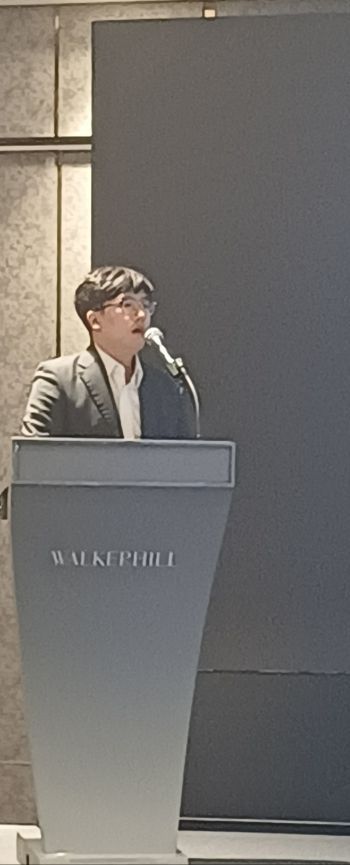 Kwon Young-jae, TL of SK Hynix, is giving a keynote presentation at the 'International Memory Workshop (IMW 2024)' on the 14th.
 [Photo by Moon Chae-seok]
On the third day of the 'International Memory Workshop (IMW 2024)' held from the 12th to the 15th at the Walkerhill Hotel in Gwangjin-gu, Seoul, Youngjae Kwon, TL of SK Hynix, disclosed the technology in a presentation titled "Improving MAC Operation Accuracy Using Oxygen Diffusion Barriers." He explained that by enhancing MAC operation accuracy through oxygen diffusion barriers, the efficiency of AI semiconductors can be improved.
The semiconductor manufacturing process involves removing unnecessary materials and applying materials where needed to build uniform layers. During this process, the use of chemicals can degrade semiconductor performance. Barriers to prevent this degradation are essential. TL Kwon stated, "By blocking oxygen diffusion, semiconductors can operate stably, which increases MAC operation accuracy. This is an indispensable technology for producing CIM semiconductors." He added, "If MAC operation accuracy improves through oxygen diffusion barrier technology, memory semiconductors will take a step closer to becoming 'calculation-capable' semiconductors."
Memory semiconductors excel at information storage but have the limitation of not being able to perform calculations independently. This is why memory semiconductors only serve as auxiliary components that enhance the performance of CPUs (Central Processing Units) or GPUs (Graphics Processing Units). Even the HBM (High Bandwidth Memory) semiconductors, which have recently gained attention due to AI growth, ultimately function as auxiliary devices that improve the efficiency of GPUs like Nvidia's 'H100.' HBM semiconductors have not yet reached the level of independently thinking and computing without GPUs or AI accelerators.
Creating CIM that can perform calculations is the longstanding aspiration and dream of the memory semiconductor industry. Once CIM semiconductors are developed, the method of transferring data from memory semiconductors to CPUs for computation will disappear. This will save energy and maximize speed. A future could emerge where memory semiconductor companies receive orders from big tech firms like Apple and Microsoft while operating like foundries (contract manufacturers) such as Samsung Electronics and TSMC. It would truly be a 'game changer.'
After the presentation, TL Kwon met with reporters and was asked whether the advent of CIM semiconductors would bring a world where AI deep learning data processing is done by a single memory semiconductor without the need for AI accelerators or GPUs. He replied, "It could be possible in the very distant future," and explained, "Although it is not easy, memory companies are also fighting for their lives to develop CIM semiconductors and related technologies."
At this event, TL Kwon did not disclose the expected commercialization timeline or target technology development milestones. He also did not mention rival companies such as Samsung Electronics or Micron. However, he stated that SK Hynix's A-CIM semiconductor technology is not behind its competitors. When asked if Samsung Electronics and Micron are not researching CIM semiconductor technology, he said, "They are, but their policy is not to announce anything until their technology matures," adding, "The technology SK Hynix showed today is only a part of what we have."
IMW is an annual international memory semiconductor conference hosted by the IEEE Electron Devices Society. This year, it was held in Korea for the first time in 14 years. Additionally, on the second day of IMW, the previous day, Kwiwook Kim, head of SK Hynix's HBM Advanced Technology Team, attracted industry attention by stating that the development of the 7th generation HBM semiconductor 'HBM4E' could be completed as early as 2026.
© The Asia Business Daily(www.asiae.co.kr). All rights reserved.

















