Cement Prices Up 42.1% Over 3 Years Due to Raw Material Cost Increases
"Must Tighten Belts Amid Declining Rebar Demand"
"Considering Expanding and Diversifying Supply Sources for Material Procurement"
Over the past three years, prices of major construction materials such as cement, aggregates, and ready-mixed concrete have risen by 30-40%, increasing difficulties in the materials industry. This is due to the overall stagnation in the construction industry, with construction projects being halted amid rising construction costs.
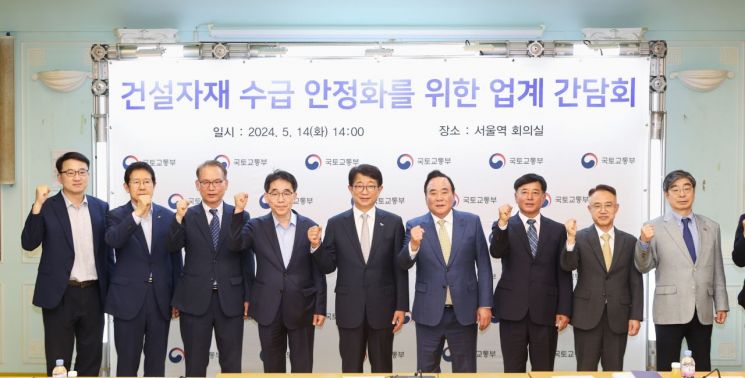 On the 14th, the 11th Land, Infrastructure and Transport Industry Relay Meeting was held, where the Ministry of Land, Infrastructure and Transport, the Ministry of Economy and Finance, the Ministry of Trade, Industry and Energy, and related departments met with the cement, concrete, and other material industries to discuss measures to stabilize material supply.
 [Photo by Ministry of Land, Infrastructure and Transport]
On the 14th, the Ministry of Land, Infrastructure and Transport held the 11th annual Land and Transport Industry Relay Meeting at the KTX conference room in Yongsan-gu, Seoul, where they discussed measures to stabilize the supply and demand of materials with the aggregates, ready-mixed concrete, cement, and steel industries, as well as related ministries including the Ministry of Trade, Industry and Energy and the Ministry of Economy and Finance.
Minister Park Sang-woo of the Ministry of Land, Infrastructure and Transport stated, "The combination of high interest rates and high inflation is causing pain not only to the construction industry but also to the materials industry, which is inseparable from construction." He added, "Due to global supply chain issues caused by overseas factors such as the Russia-Ukraine war and US-originated high interest rates, prices of construction materials continue to rise."
According to the Ministry, cement prices have increased by 42.1% over the past three years. This is due to rising prices of key raw materials such as bituminous coal and electricity costs, as well as additional expenses for installing eco-friendly facilities within factories. In addition, prices of major materials such as aggregates (36.5%) and ready-mixed concrete (32%) have also continued to rise.
On the same day, Lee Kwang-young, head of the Korea Iron and Steel Association, said, "Demand for rebar decreased by more than 10% compared to 2022, forcing us to tighten our belts," and requested, "Please help the domestic steel industry maintain a production base suitable for future construction steel demand." He especially emphasized, "To protect the domestic steel industry, imported products used in domestic civil engineering and architectural works should also obtain Korean Industrial Standards (KS) certification to safeguard the domestic steel industry."
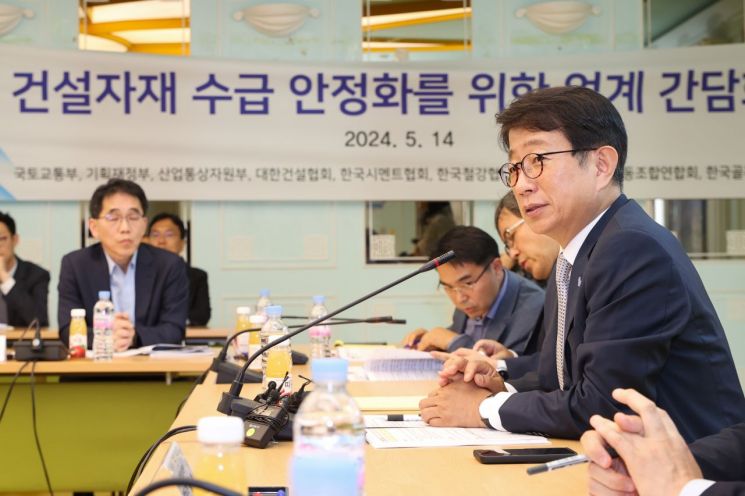 Minister of Land, Infrastructure and Transport Park Sang-woo is speaking at the 11th Land, Infrastructure and Transport Industry Relay Meeting held on the 14th.
 [Photo by Ministry of Land, Infrastructure and Transport]
Bae Pan-sul, Executive Director of the Korea Cement Association, said, "In the first quarter of this year, cement shipments fell by 13% due to the construction downturn, putting the industry in a management crisis caused by a decrease in domestic volume." He added, "Cement volume, which was 14.59 million tons in 2010, has continuously declined to 7.4 million tons last year, raising concerns about supply disruptions." He further requested, "Please expand railway transportation support necessary for cement supply and ease environmental regulations on the cement industry."
On the same day, structural issues in the materials industry were also pointed out. Bae Jo-ung, Chairman of the Korea Ready-Mixed Concrete Industry Cooperative Federation, said, "The Ministry of Land, Infrastructure and Transport is conducting nationwide verification work because the quality of ready-mixed concrete is considered poor," and added, "To verify the quality of ready-mixed concrete, the quality of cement, which is the raw material for ready-mixed concrete, must be verified first." Cement is a major raw material for ready-mixed concrete but unlike ready-mixed concrete, it does not have chloride standards. Therefore, he suggested verifying the quality of cement without chloride standards first, then verifying the quality of ready-mixed concrete.
At the meeting, Minister Park said, "The most concerning part about construction materials is the price," and explained, "Due to rising material costs, construction costs increase, and even if projects are ordered, sometimes construction cannot start because the unit price cannot be met." He continued, "Even if reconstruction regulations are eased, projects do not proceed well due to rising construction costs, and even if SOC budgets are increased, the unit price rises too much, preventing planned investments from being properly executed." He emphasized, "To prevent this vicious cycle of economic downturn, consistent and steady measures must be established."
He stated, "We will consider expanding and diversifying supply sources to ensure stable supply of major materials." The Ministry plans to operate a consultative body composed of related ministries such as the Ministry of Economy and Finance and the Ministry of Trade, Industry and Energy, as well as the materials and construction industries, to respond to supply and demand issues.
© The Asia Business Daily(www.asiae.co.kr). All rights reserved.


















