Itaewon Special Act Passed by National Assembly with Bipartisan Agreement
Kim Geon-hee Special Prosecutor Act Fails to Pass Due to Ruling Party Opposition
Chae Sang-byeong Special Prosecutor Act Faces Possible Defections from Ruling Party
The government and opposition parties are clashing over the Special Prosecutor Act on the investigation pressure allegations in the case of Corporal Chae (Chae Sang-byeong Special Prosecutor Act), entering a 'veto standoff' phase. However, unlike the Special Prosecutor Act on the stock manipulation allegations involving First Lady Kim Geon-hee (Kim Geon-hee Special Prosecutor Act), if there are dissenting votes from the People Power Party, it is expected to move beyond the veto standoff into a 'special prosecutor standoff.'
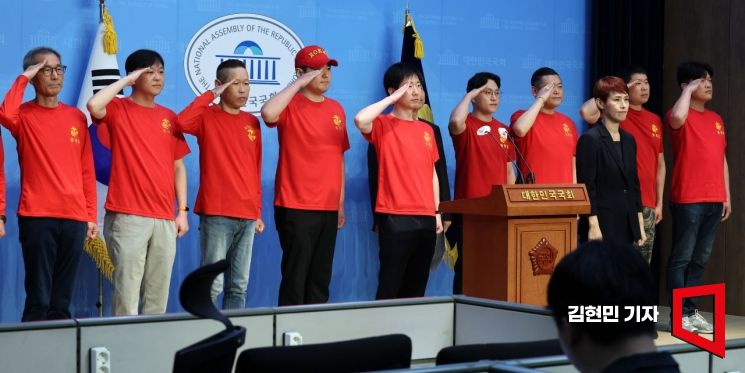 A Marine Corps reserve regiment is holding a press conference on the 17th at the National Assembly to urge the passage of the "Special Prosecutor Act for Representative Chae Sang-byeong of the 21st National Assembly." Photo by Kim Hyun-min kimhyun81@
President Yoon Seok-yeol is expected to pass a request for reconsideration (veto) on the Chae Sang-byeong Special Prosecutor Act at the Cabinet meeting on the 21st and send it back to the National Assembly. The Chae Sang-byeong Special Prosecutor Act passed the plenary session of the National Assembly on the 2nd, and the deadline for exercising the veto is the 22nd. At a press conference on the 9th, President Yoon hinted at exercising the veto, saying, "Even considering the purpose of the special prosecutor, it is right to observe the ongoing investigation and judicial procedures and trust the mindset and attitude of the investigators for now."
If the veto is exercised, scenarios to refer to include the Special Act on the Truth-finding of the Itaewon Disaster (Itaewon Disaster Special Act) and the Kim Geon-hee Special Prosecutor Act. The Itaewon Disaster Special Act was proposed last April under the leadership of opposition parties and was processed in the National Assembly in January this year, but President Yoon exercised the veto. However, since both ruling and opposition parties agreed on the necessity of handling the Itaewon Disaster Special Act, after coordination, it passed the plenary session of the National Assembly on the 2nd of this month. The ruling party set the activity period of the special investigation committee for the Itaewon disaster from 9 months to 15 months, while the opposition party deleted provisions related to the committee's authority for ex officio investigations and requests for search warrants, making mutual concessions. It took about 1 year and 1 month from the proposal to the passage of the Itaewon Disaster Special Act.
However, the matter could get bogged down like the Kim Geon-hee Special Prosecutor Act. The Kim Geon-hee Special Prosecutor Act was proposed in March last year but was not reviewed by the Legislation and Judiciary Committee, and the following month it was designated as a fast-track bill. In December of the same year, the Kim Geon-hee Special Prosecutor Act passed the plenary session of the National Assembly, but President Yoon exercised the veto. For a law vetoed by the president to pass again in the National Assembly, a majority of the total members must be present, and two-thirds of the members present must approve. In other words, out of 300 members, 200 must agree, but the People Power Party, holding 113 seats, decided to cast opposing votes. In March this year, the Kim Geon-hee Special Prosecutor Act was re-voted in the plenary session, but with 281 members present, 171 in favor, 109 against, and 1 abstention, it was rejected. There were no dissenting votes from the People Power Party.
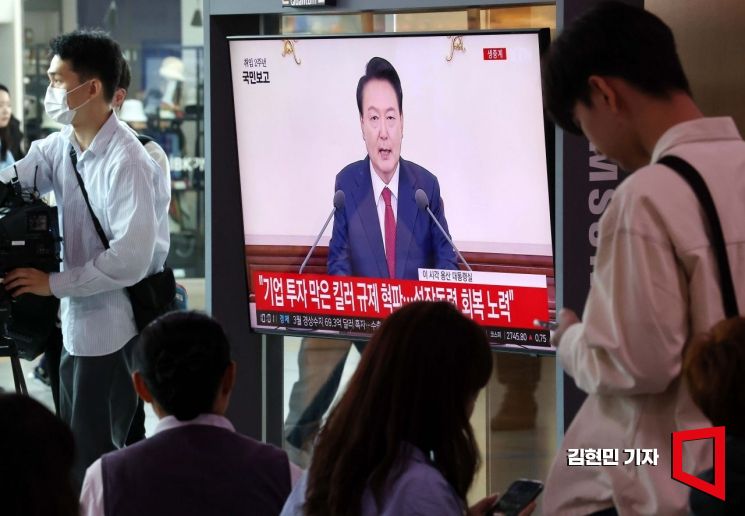 On the 9th, citizens at Seoul Station are watching the live broadcast of President Yoon Suk-yeol's 2nd anniversary inauguration press conference. Photo by Hyunmin Kim kimhyun81@
However, unlike the Kim Geon-hee Special Prosecutor Act, there is speculation that dissenting votes may emerge from the ruling party. Given the strong sentiment for judgment against the Yoon Seok-yeol administration, including the general election defeat, it is said that public opinion cannot be ignored. On the 13th, Cheon Ha-ram, a member of the Reform New Party, responded to a question on SBS Radio's 'Kim Tae-hyun's Political Show' asking, "Do you think there will be 8 dissenting votes in the 22nd National Assembly's re-vote on the Chae Sang-byeong Special Prosecutor Act?" by saying, "That is quite possible." He added, "If President Yoon continues to exercise the veto, there will come a point when the People Power Party judges that it can no longer bear the burden of the president."
The opposition parties define the exercise of the veto as a 'rejection of public sentiment' and are increasing pressure. The Democratic Party of Korea has stated that it will consider joint actions such as outdoor rallies with six opposition parties if necessary during the veto standoff. The National Innovation Party has prepared a specific 'action plan' around the 21st, when the veto is expected to be exercised. National Innovation Party leader Jo Guk will hold a press conference at 9 a.m. on the 20th in front of the Yongsan Presidential Office. The following day, an 'emergency forum' will be held at the National Assembly Members' Office Building, addressing the issue that the president exercising the veto based on private interests may be unconstitutional.
© The Asia Business Daily(www.asiae.co.kr). All rights reserved.


















