Soaring Wedding Costs Deepen After COVID-19
Guests Feel Pressured Even to Give 100,000 Won Gifts
"Rule That 50,000 Won Gifts Should Not Receive Meal Tickets"
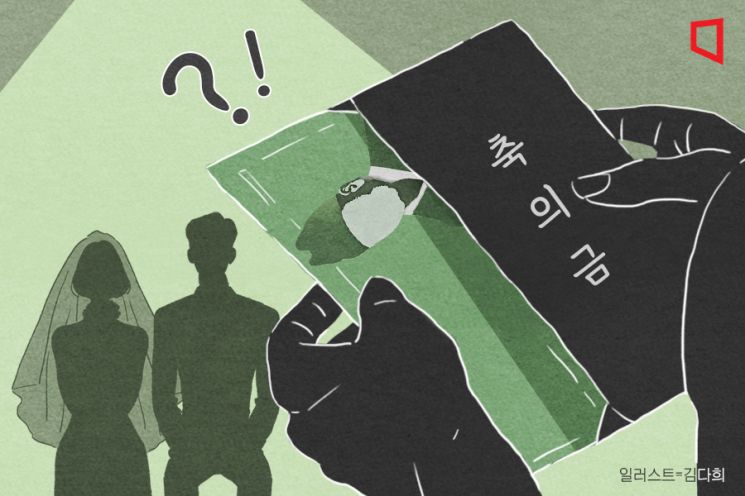
Recently, with rising prices, the costs associated with weddings, such as venue rental fees and meal expenses, have also soared, causing wedding guests to worry about the amount of congratulatory money to give. The term 'chug-uigeum inflation' (congratulatory money + inflation) has even emerged to describe the increase in the amount of congratulatory money.
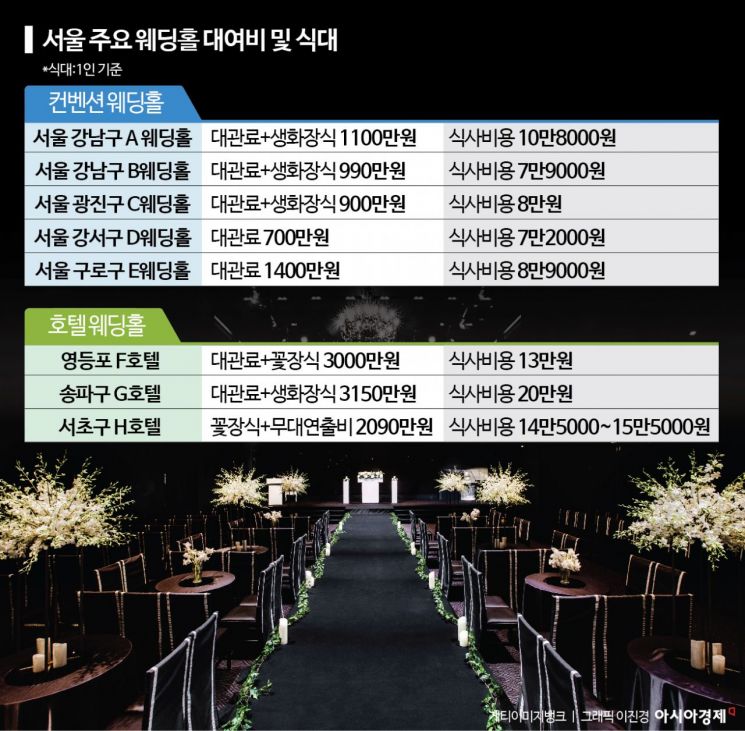
On the 14th, a check of wedding costs at six wedding halls in Seoul revealed that the average meal cost per person was 82,000 won. Prices varied widely by provider, ranging from a minimum of 66,000 won to a maximum of 108,000 won, with about a 17% price difference between peak seasons (typically March to June, September to November) and off-seasons (December to February, July to August).
When inquiring about meal costs at hotel wedding halls, expenses were found to have risen significantly. The average meal cost per person at three hotel wedding halls in Seoul was 160,000 won, with some charging as low as 130,000 won and others as high as 200,000 won.
Venue rental fees also ranged from several million won to tens of millions of won. For convention wedding halls, including fresh flower decoration costs, prices ranged from a minimum of 6 million won to around 14 million won. Hotel wedding halls charged rental fees ranging from the low 20 million won range to the 30 million won range, including fresh flower decorations, venue rental, and stage production costs.
Compared to 10 years ago, these wedding costs have nearly doubled. According to the 'Wedding Cost Status Report' published by the Korea Consumer Agency in 2013, the average meal cost per person at that time was 33,000 won, and the rental fee (including flower decorations) was 3 million won.
The sharp increase in wedding costs is largely attributed to the closure of many wedding halls around the COVID-19 pandemic period. Due to the mass closure of small and medium-sized wedding halls during the pandemic, a small number of wedding halls attracted many prospective couples, causing rental fees to skyrocket. The rise in dining prices also contributed to the increase in wedding costs. A wedding hall official stated, "Wedding costs vary greatly depending on peak and off-peak seasons," adding, "Reservations for Sunday time slots in January and February next year are already fully booked."
As wedding costs soar, the burden on guests regarding the amount of congratulatory money has intensified. Many feel awkward giving the traditional 50,000 to 100,000 won. Park, a 35-year-old office worker, said, "These days, meal costs are close to 100,000 won, and I've heard from others that even after receiving congratulatory money, there's nothing left," adding, "People say 100,000 won 10 years ago is not the same as 100,000 won now, so it's confusing whether congratulatory money should also be adjusted according to inflation."
Considering the steep meal costs, there is even a growing sentiment that it is a form of etiquette not to attend a wedding if one plans to give less than 100,000 won as congratulatory money. Choi Ji-young, a 30-year-old office worker, said, "There used to be an unspoken rule of 100,000 won among colleagues, but recently, with meal costs rising, even that amount feels ambiguous," adding, "Now, there's a rule that if you're going to give 50,000 won as congratulatory money, you shouldn't even accept a meal ticket."
As congratulatory money has become a topic of debate, posts setting appropriate amounts have appeared in online communities frequented by office workers. According to these, close friends should give more than 200,000 won, colleagues 100,000 to 150,000 won, and acquaintances 50,000 won but should not attend the wedding.
This debate is analyzed to stem from the fact that in Korean society, congratulatory money carries more of an exchange meaning than a celebratory one. Professor Lee Young-ae of the Department of Consumer Studies at Incheon National University explained, "Our congratulatory money culture originates from the social etiquette of expecting to receive as much as one gives," adding, "Because it has a strong reciprocal nature, in difficult economic times like now, people tend to think about it in proportion to inflation."
© The Asia Business Daily(www.asiae.co.kr). All rights reserved.


















