Construction of the President's Second Office and National Assembly Sejong Assembly Hall by 2027
Supply of 200,000 Housing Units by 2030
The Saejeong City Construction Agency (Happy Agency) is preparing a blueprint to complete Sejong City Administrative Complex City (Happy City) as a practical administrative capital like Washington D.C. in the United States. Anticipating population growth due to the construction of the President's Second Office and the National Assembly Sejong Assembly Hall, the supply of 200,000 housing units will be steadily promoted by 2030.
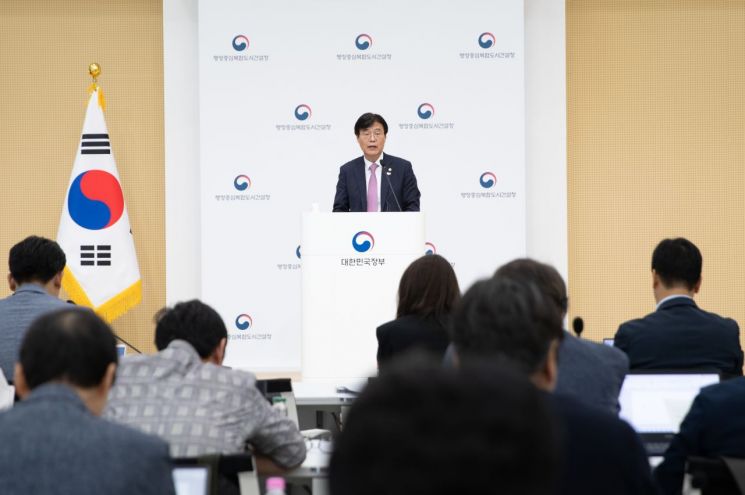
On the 14th, Kim Hyung-ryeol, head of the Happy Agency, held a press briefing at the Government Sejong Complex and stated, "We will develop the S-1 Living Zone (Sejong-dong) in the center of Happy City, where the President's Second Office and the National Assembly Sejong Assembly Hall will be located, into a national symbolic area by linking it with nearby parks and cultural facilities."
In this regard, the Happy Agency is preparing an international design competition to be announced in the second half of this year. Currently, the President's Second Office has established the legal basis for installation through amendments to the Happy City Act, completed the construction plan, and finished procedures related to the preliminary feasibility study. The target completion year is 2027. The National Assembly Sejong Assembly Hall requires the National Assembly Secretariat to form a construction committee according to the National Assembly rules and confirm the construction plan after reporting to the National Assembly Steering Committee. Once these procedures are completed, the Happy Agency will allocate the total project cost, proceed with land acquisition, and support the construction.
Additionally, the Happy Agency will designate the Sejong-dong area, where the national core facilities will be located, as a special management zone to support the stable construction, systematic operation, and early activation of major facilities. The northern part of the national core facilities (Nuri-dong, 6-1 Living Zone) will be developed as a complex hinterland with residential, commercial, office, hotel, media complex, and convention center functions.
Kim said, "Due to increased traffic volume in the city center, the Geumgang Cross Bridge construction project, which is underway, started a preliminary feasibility study last month and plans to complete it by the end of the year," adding, "We will also promote demand management policies to reduce dependence on private cars and improve traffic congestion."
The city’s growth engines will continue to be expanded. The Happy Agency will open the first rental-type joint campus in Happy City this September and support the opening of sale-type joint campuses sequentially from 2026. In the second half of this year, the 10th sale of Sejong Technovalley will attract high-tech companies, and plans to expand office and industrial land will be reviewed considering corporate demand. Based on this, a plan to create a complex campus where anchor companies’ research and development (R&D) and on-site education are conducted in one place, linking the joint campus and Sejong Technovalley to build an industrial ecosystem, will be prepared within the year.
Regarding housing supply, the agency said it will respond proactively by monitoring population trends. The Happy Agency has supplied about 123,000 housing units (based on construction starts) in Happy City until last year. This year, the cumulative supply will reach about 127,900 units. By 2030, it plans to build an average of 5,000 units annually, totaling 200,000 units.
Kim said, "Through systematic planning, we will enhance the completeness of Happy City and create a vibrant Happy City by constructing national core facilities and expanding urban functions."
© The Asia Business Daily(www.asiae.co.kr). All rights reserved.

















