Civil Complaint Response Team and Separation Measures Perceived as Insufficient
Baek Seung-a "Promoting Seoicho Special Act as First Bill"
Teachers Divided Over Student Rights Ordinance Abolition
On May 15, Teachers' Day, teachers raised their voices as usual. This was to protect teachers' rights, which they have been advocating for since the Seoicho incident last year. Although the so-called 'Five Teachers' Rights Acts' were amended in the National Assembly, the problems persist. In the 22nd National Assembly, which will open next month, a 'Seoicho Special Act' reflecting these aspirations is also expected to be proposed.
According to a survey conducted by teachers' organizations ahead of Teachers' Day, the effectiveness of the amended laws for protecting teachers' rights was found to be limited. Last year, the National Assembly amended five laws known as the Five Teachers' Rights Acts: the Framework Act on Education, the Elementary and Secondary Education Act, the Early Childhood Education Act, the Teachers' Status Act, and the Child Abuse Punishment Act. The education authorities prepared policy measures such as comprehensive plans to restore and strengthen teachers' rights. To reduce the burden caused by malicious complaints from parents, schools were instructed to form separate complaint response teams, and provisions were made for separating students who violate teachers' rights.
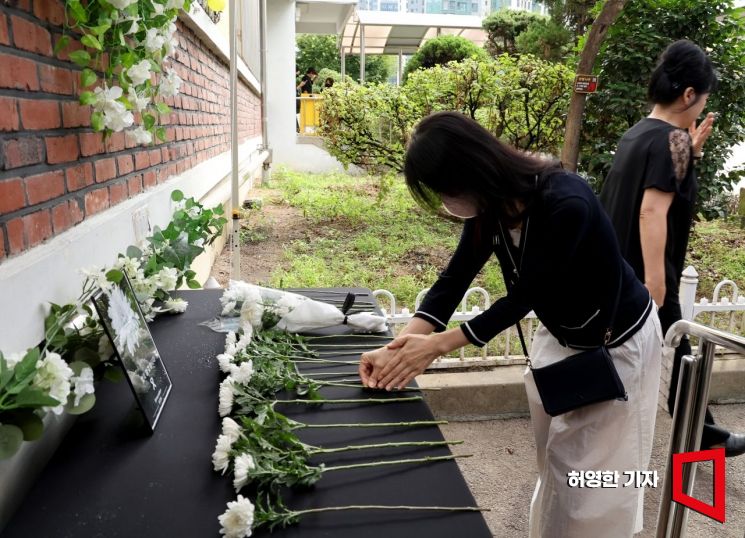 On September 4 last year, the 49th day memorial of the late Seo-i Elementary School teacher, a citizen placed flowers at the flower altar set up at Seo-i Elementary School in Seoul. Photo by Huh Younghan younghan@
However, according to a survey conducted by the Korean Teachers and Education Workers Union (Jeon-gyo-jo) from April 30 to May 8 targeting 1,471 teachers, only 38.8% responded that a complaint response team had been formed at their school. 22.1% said no such team was formed, and 39% did not know whether such a team existed. Even when a complaint response team was formed, it was found that in about one out of five schools (22.5%), teachers were responsible for handling the practical work.
The Korea Federation of Teachers' Associations (KFTA) also conducted a survey from April 26 to May 6 targeting 11,320 teachers, which showed that 67.5% of teachers did not feel any change in the field after the enactment of the teachers' rights protection laws. Moreover, 5.9% responded that they felt less protected than before. Positive perceptions of the teaching profession itself also noticeably declined. Only 19.7% of teachers said they would choose the teaching profession again if they were reborn, marking an all-time low.
'Calls for Additional Legislation... 'Seoicho Special Act'
Teachers' organizations emphasize the need for additional legislation to protect teachers' rights in the field. They argue that student separation measures, defined by the Student Life Guidance Regulations, and the operation of complaint response teams included in the comprehensive plan for restoring teachers' rights must be legally mandated to ensure effectiveness.
Baek Seung-a, who entered the National Assembly as a proportional representative of the Democratic Party of Korea in the 22nd general election and was formerly an elementary school teacher, is preparing the 'Seoicho Special Act' as her first bill. The bill focuses on legalizing teachers' essential duties such as academic and behavioral guidance, student separation guidance, and the school complaint response system. Baek said, "Although laws related to teachers' rights were amended last year, there are many shortcomings in changing the school field. Since budgets and personnel are not legally guaranteed and only declarative content exists, schools still suffer from malicious complaints, and many teachers are sued for emotional child abuse."
At a forum held the previous day at the National Assembly to promote the Seoicho Special Act, Lee Na-yeon, a lawyer at the law firm Gonggan, said, "Most of the recent child abuse reports against teachers occurred in situations where teachers gave guidance or advice to students who needed discipline," adding, "It is essential to explicitly reflect in the law amendments that teachers' guidance through advice, caution, discipline, and reprimand is an essential part of teachers' duties."
Lee Jang-won, secretary-general of the Teachers' Labor Union Federation, also emphasized the need to enact the Seoicho Special Act at the forum, saying, "Although a complaint response system reflecting the characteristics of the school field has begun to be established, guidelines differ by metropolitan and provincial offices of education, and responsibility is often shifted to individual schools, failing to fully reflect the demands of teachers in the field."
Restoring Teachers' Rights = Abolishing Student Human Rights Ordinances? ... Divided Opinions Among Teachers
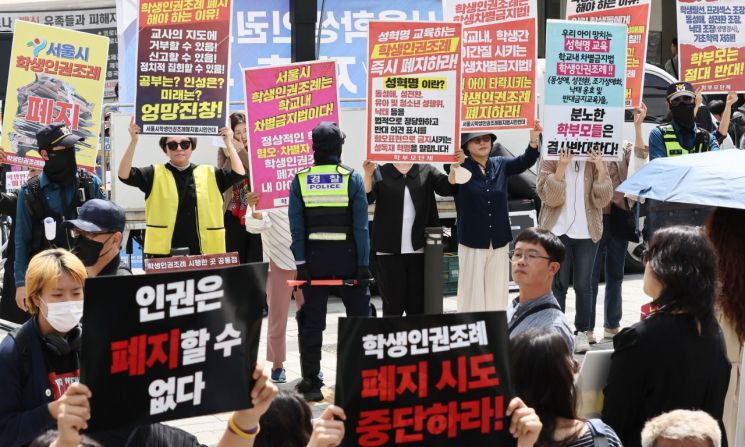
As calls for restoring teachers' rights grow louder, another issue has come to the forefront: the abolition of student human rights ordinances. Last year, the government pointed to student human rights ordinances as a cause of teachers' rights violations, prompting metropolitan and provincial offices of education nationwide to move toward abolishing them. On April 24 and 26, student human rights ordinances were abolished in Chungnam and Seoul, respectively.
Teachers' organizations show subtle differences in their stance on abolishing student human rights ordinances. Teachers affiliated with teacher organizations such as the National Student Human Rights Solidarity held a press conference in front of the Seoul Metropolitan Council on May 13, stating, "Teachers' rights and students' rights are not opposing forces," and "Ordinances that guarantee students' rights to be free from discrimination do not restrict any teachers' rights." They held signs saying, "Teachers also need student human rights."
On the other hand, there are claims that student human rights ordinances have contributed to the decline of teachers' rights. The KFTA announced that according to its own survey, 79.1% opposed the enactment of a 'Student Human Rights Act,' which has been demanded mainly by opposition parties after the abolition of student human rights ordinances. The KFTA said, "According to a survey of 32,925 teachers conducted last year, 84.1% responded that student human rights ordinances affected the decline of teachers' rights," and requested, "Stop attempts to legally entrench student human rights ordinances that excessively emphasize rights, and start legislative efforts to protect teachers' rights."
© The Asia Business Daily(www.asiae.co.kr). All rights reserved.


















