'Current Status of Business Using Generative AI' Report
Overseas Monetization Cases like JP Morgan "Low Domestic Utilization"
With the rapid growth of the generative artificial intelligence (AI) market, companies are expected to actively embark on building generative AI-based business models and monetization strategies starting this year. Among industries, the adoption rates of AI were relatively high in the financial and healthcare sectors.
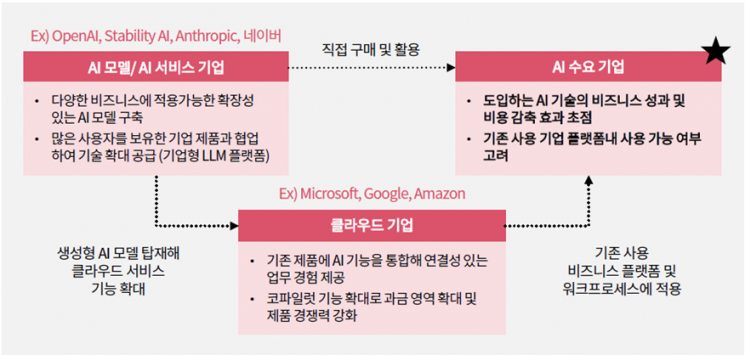 Business Strategies by Participants in the Artificial Intelligence (AI) Ecosystem [Data provided by Samil PwC]
On the 14th, Samil PwC announced the publication of a report titled “The Current Status of Business Utilizing Generative AI” containing these insights.
The report categorizes the generative AI ecosystem structure into three participants: ▲AI model and AI service companies ▲cloud companies ▲AI demand companies, explaining that “each has differentiated business strategies based on the common goal of either cost reduction or revenue maximization.” AI model and AI service companies supply AI models with high scalability and accuracy, cloud companies provide AI platforms with high connectivity, and AI demand companies expand AI adoption processes for high applicability and productivity.
According to the report, more than 60% of corporate executives expressed willingness to adopt generative AI, but only 9% had fully adopted AI. Between 60% and 75% of companies were in pilot testing or initial verification stages. According to one survey, among key decision-makers in over 800 global companies, 75% regarded generative AI as a factor directly linked to business competitive advantage and showed strong investment intentions. The report forecasted, “While companies focused on developing and stabilizing generative AI last year, from this year onward, businesses will focus on productivity improvement and revenue generation through the widespread adoption and full-scale implementation of generative AI.”
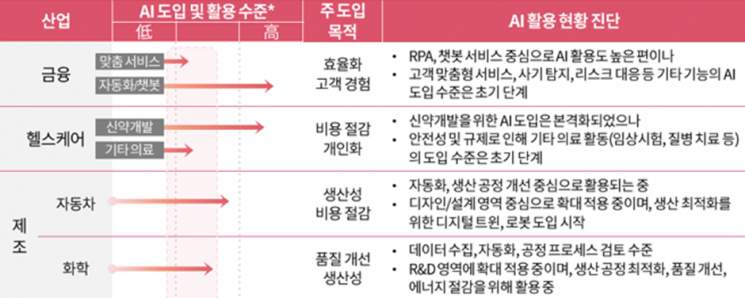 Level of Artificial Intelligence (AI) Adoption and Utilization by Industry [Data Provided by Samil PwC]
The report analyzed and presented AI adoption status and utilization levels across 10 major industries. Among these, the financial and healthcare industries were found to have relatively high AI adoption rates. Global investment bank JP Morgan has achieved profitability by introducing AI not only within internal organizations but also in monetization channels and customer touchpoints, and continues to develop generative AI services through external partnerships such as with Microsoft. AI utilization business models of global leading companies such as the global pharmaceutical company Roche, chemical company BASF, and logistics company DHL were also included.
Furthermore, the report pointed out that the level of AI utilization in Korea is relatively lower than overseas, resulting in minimal concrete outcomes. This is due to a lack of workforce, shared data, platform infrastructure, investment, and policy support, which slows AI activation within industries. In particular, in manufacturing, AI utilization is low due to the conservative nature of domestic manufacturing and high dependence on specialized personnel.
Jae-guk Jeong, IT Industry Leader (Partner) at Samil PwC, said, “Overall, the level of AI adoption and utilization across industries is still low, but there is much room for growth not only in terms of increased sales and profit contributions by industry through AI but also in technological advancement. Korea requires not only corporate efforts but also active roles from the government in policies and infrastructure.”
© The Asia Business Daily(www.asiae.co.kr). All rights reserved.


















