Owner's nephew managed on their behalf, resulting in incorrect fee setting
Jeju-do "Resolving misunderstandings between owner and customers"
The issue of a 'electricity bill bomb' at an accommodation in Jeju was resolved as a mere mishap caused by a simple mistake of the accommodation staff.
On the 12th, an online community FM Korea posted a thread titled 'Jeju Island 2 nights 3 days Airbnb accommodation electricity bill (a typo of 'electricity fee') Is this correct?' The author, Mr. A, who identified himself as a soldier, traveled to Jeju Island from April 22 to 24 with four soldier friends including himself.
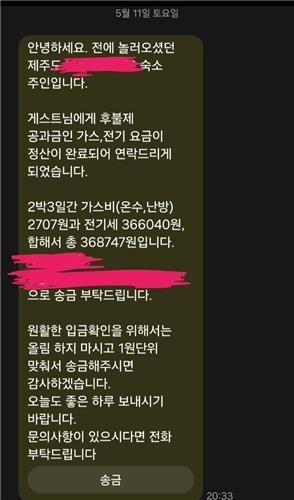 An Airbnb accommodation in Jeju sent a message to its guests
[Image source=Social Networking Service (SNS) capture]
Mr. A booked the accommodation through the shared lodging platform 'Airbnb,' where only the accommodation fee was paid upfront, and electricity and gas fees were paid separately afterward. Later, Mr. A was shocked by a text message he received from the accommodation. The message from the host read, "We are contacting you to inform that the postpaid utility bills for gas and electricity have been settled," and stated, "The gas fee (hot water, heating) for 2 nights and 3 days is 2,707 KRW, and the electricity fee is 366,040 KRW, totaling 368,747 KRW. Please transfer the exact amount without rounding off to confirm the payment."
Mr. A claimed, "We did not plug in any devices or do anything, and we did not turn on the air conditioner because it was cold and rainy at the time. We also made sure to turn off the lights when going out," adding, "We did not use electricity excessively." He continued, "Those familiar with Jeju Island travel or Airbnb, is this price normal?" and ended his post with the question, "All of us are soldiers in our early 20s with little work experience, and this is our first time encountering such a case. What should we do?"
Netizens who read this story expressed outrage. Moreover, following the recent controversy over some restaurants in Jeju tourist spots serving 'fatty pork belly' with much more fat than meat, the excessive electricity bill claim further fueled their anger. Comments included, "A 360,000 KRW electricity bill is like the tail wagging the dog," "No wonder no one wants to go to Jeju," "Even if strong men used electricity for 3 days, is a 360,000 KRW electricity bill possible?" and "Isn't it a mistake for 36,000 KRW?"
The accommodation company stated in an Airbnb notice, "Electricity and gas fees average about 8,000 KRW per day in December, about 10,000 KRW per day in January and February, and about 5,000 KRW per day in March. Other periods generally incur less than these amounts." They added, "There may be variations such as rooms where previous guests used heating leaving residual warmth resulting in slightly lower heating costs, or rooms that were vacant the previous day incurring slightly higher costs, but charges are based solely on meter readings."
As the controversy grew, Jeju Province, Jeju City, and the Jeju Tourism Association stepped in to verify the facts. The investigation revealed that the problematic message was a simple mistake by the business registered as a rural lodging facility. A Jeju official stated, "The owner temporarily entrusted the operation to a nephew, and during that process, the electricity fee was mistakenly calculated and sent," adding, "The business is currently resolving misunderstandings with the tourists." Jeju Province plans to conduct further investigations to ensure the business complies with rural lodging operator regulations.
© The Asia Business Daily(www.asiae.co.kr). All rights reserved.

















