Save the Children 'Silent Emergency: Women Dying' Report
Due to conflicts and climate change, one in five children worldwide is born without medical support. The risks of maternal preterm birth, stillbirth, and pregnancy complications are also increasing.
On the 13th, Yonhap News cited the global report "Silent Emergency: Women Dying" published by the international child rights NGO Save the Children. The report highlights the impact of conflict and climate change on maternal protection.
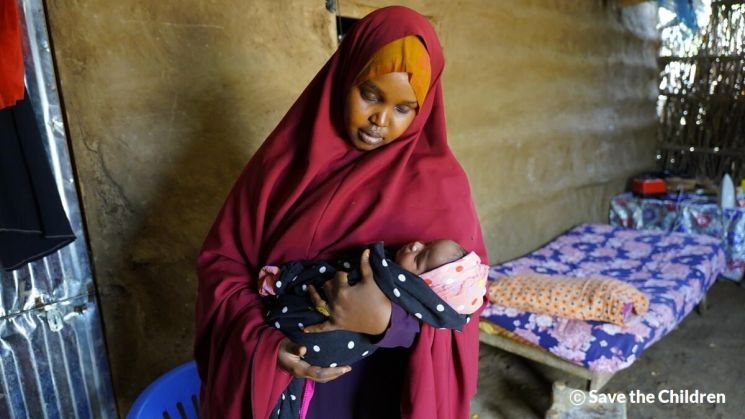 Somali woman who gave birth in a hospital with support from Save the Children
 [Photo by Save the Children]
Save the Children estimated, based on the United Nations World Population Prospects and other data, that this year, 28 million babies, or 22.2% of all births, occur outside medical facilities.
The number of babies born without the assistance of doctors, nurses, or midwives reached 24 million (17.9%). The involvement of skilled birth attendants such as doctors, nurses, and midwives during childbirth ensures safe delivery and reduces potential complications. Additionally, giving birth in medical facilities is a key maternal protection service that improves survival rates for both mothers and newborns.
However, Save the Children points out that conflicts, climate disasters, and humanitarian emergencies are hindering efforts to protect maternal health. In particular, in conflict zones, the probability of pregnant women giving birth without medical personnel is 37%, about three times higher than in non-conflict areas (12%), and the likelihood of delivering outside medical facilities is 44%.
The Gaza Strip, where at least 435 attacks on related facilities and personnel occurred from October 7 last year to early April this year due to war, is a representative example. The health system there is reported to be destroyed.
Furthermore, as climate change increases the intensity and frequency of heatwaves and wildfires, the risks of preterm birth, stillbirth, and pregnancy complications have risen. Somalia is facing the worst climate crisis, ranking among the top 10 countries most affected by child conflict globally, and has the lowest rate of access to childbirth medical services worldwide. Ultimately, only 31.9% of Somali women give birth with the help of medical personnel.
Recently, Rama (a pseudonym), a 32-year-old woman who gave birth at a local hospital through Save the Children, said, "I had several hours of labor, but I gave birth to a healthy baby, and before discharge, I received guidance on breastfeeding and other necessary information through consultation with a nurse."
Last year, the World Health Organization announced that approximately 287,000 women worldwide died from preventable causes during pregnancy and childbirth in 2020.
In response, the expert group involved in the Save the Children report emphasized that governments worldwide must provide effective and sustainable financing, offer basic health services and comprehensive sexual and reproductive services, and protect the lives of children and women through education.
Marionka Paul, Global Health Policy Advocacy Lead at Save the Children, stated, "Children suffer from the moment they take their first breath in conflict zones and the heart of climate change. Mothers and babies are more likely to be at risk, and there are more mothers experiencing the pain of losing newborns and raising children without their mothers."
She added, "Every woman, including those living in the world's most marginalized and dangerous areas, has the right to access medical services and education. If we give up the progress made over the past decades, women and children will pay the price. It is crucial to act now."
Meanwhile, a recent survey found that 80% of 380 leading climate scientists believe that Earth's temperature will rise by at least 2.5 degrees Celsius above pre-industrial levels this century, leading to catastrophic conditions. More than 40% responded that the increase will exceed 3 degrees.
In contrast, only 6% of climate scientists believe that countries worldwide will meet the warming limit of 1.5 degrees Celsius set to combat climate change. The 1.5-degree increase is considered by scientists as a kind of "red line" to avoid future climate disasters. The international community agreed through the 2015 Paris Agreement to limit the average global surface temperature rise to within 2 degrees Celsius above pre-industrial levels by 2100, and ideally below 1.5 degrees.
© The Asia Business Daily(www.asiae.co.kr). All rights reserved.


















