Targeting Europe Amid Regulatory Risks and Growth Slowdown
Google Loses Status as Largest Advertiser Last Year
Temu is shifting its business priorities from the United States to other countries due to regulatory concerns and slowing growth, the Wall Street Journal (WSJ) reported on the 13th.
According to sources, Temu recently wants to limit regulatory risks while seeking new growth engines. This is because the U.S. government's passage of a bill forcing the forced sale of TikTok has made growth within the U.S. difficult.
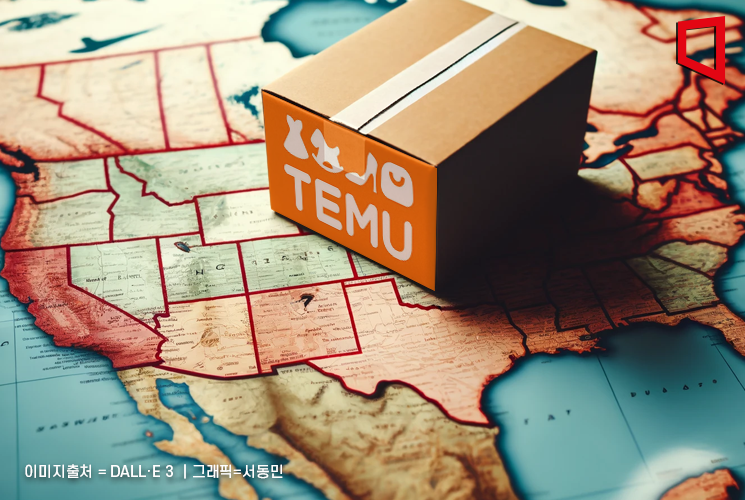
Temu has recently been focusing on gathering subscribers in Europe and other countries instead of the U.S. According to Deinformation, less than one-third of Temu's revenue this year is expected to come from the U.S. Last year, 60% of its revenue came from the U.S.
WSJ described this change in Temu as "a remarkable strategic shift for a company that attracted customers with $5 water dispensers and $3 T-shirts and became the second most popular shopping application in the U.S. by monthly users, after Amazon, in less than two years."
Temu told WSJ that expanding into new markets is not because the importance of the U.S. market has decreased. It is part of efforts to build a global e-commerce platform, and this decision was not influenced by other companies.
Recently, the U.S. government passed a bill requiring ByteDance, the Chinese parent company of TikTok, to sell its U.S. business rights within 270 days. According to WSJ sources, the passage of the TikTok forced sale bill served as a wake-up call for Temu and its parent company, Chinese Pinduoduo (PDD) Holdings. Since late 2022, concerns have arisen among PDD management that they could face a crisis similar to TikTok’s, accelerating expansion into markets outside the U.S.
Moreover, with recent slowing growth in the U.S., the incentive to discover new growth opportunities has increased. According to Earnest Analytics, Temu’s U.S. revenue is growing but at a slower pace. WSJ also reported that Temu’s advertising spending in the U.S. focuses more on user retention than on acquiring new users.
According to WSJ, Temu paid about $2 billion in advertising costs to Meta last year and was also Google’s top advertiser. This year is different. While it still spends heavily on social media like Facebook, it is concentrating advertising expenditures in Europe and other markets.
Shima Shah, Vice President of Sensor Tower, stated that as of April this year, only 38% of Temu’s total advertising spending was in the U.S. In contrast, in the fourth quarter of last year, 63% of total advertising spending targeted the U.S. market. Also, the number of people using Temu at least once a month in the U.S. was 50 million in the first quarter of this year, down about 10% from 55.6 million in the third quarter of last year. During the same period, monthly users in the rest of the world surged by 128%.
WSJ analyzed Temu’s strategy as taking a less aggressive approach compared to TikTok and Shein. ByteDance, TikTok’s parent company, spent $16.4 million lobbying U.S. policymakers since 2022. Shein spent $3.4 million on lobbying as its U.S. stock market listing plans were delayed. In contrast, according to OpenSecrets, a platform tracking political donations, Temu did not spend money on lobbying. Unlike TikTok and Shein, which chose lobbying amid regulatory concerns, Temu sought other markets.
According to sources close to Temu, the company still considers the U.S. an important market but takes a more cautious approach to U.S. investments. For example, instead of establishing fulfillment centers in the U.S., it sets them up in Mexico and ships packages to U.S. consumers from there.
© The Asia Business Daily(www.asiae.co.kr). All rights reserved.
![Clutching a Stolen Dior Bag, Saying "I Hate Being Poor but Real"... The Grotesque Con of a "Human Knockoff" [Slate]](https://cwcontent.asiae.co.kr/asiaresize/183/2026021902243444107_1771435474.jpg)
















