Ministry of Science and ICT Selects 10 Major Tasks for 'Global TOP Strategy Team'
Final Support Confirmed After Second Review at the End of This Month
1 Billion KRW Support Through Convergent Research Among Government-Funded Research Institutes
Ten final projects for the 'Global TOP Strategic Research Groups,' which support a budget of 100 billion KRW for convergence research among government-funded research institutes (GFRIs) in science and technology, have been selected. Since receiving budget support requires top-tier evaluations, competition among GFRIs to secure both pride and practical benefits in the final project selection is expected to intensify.
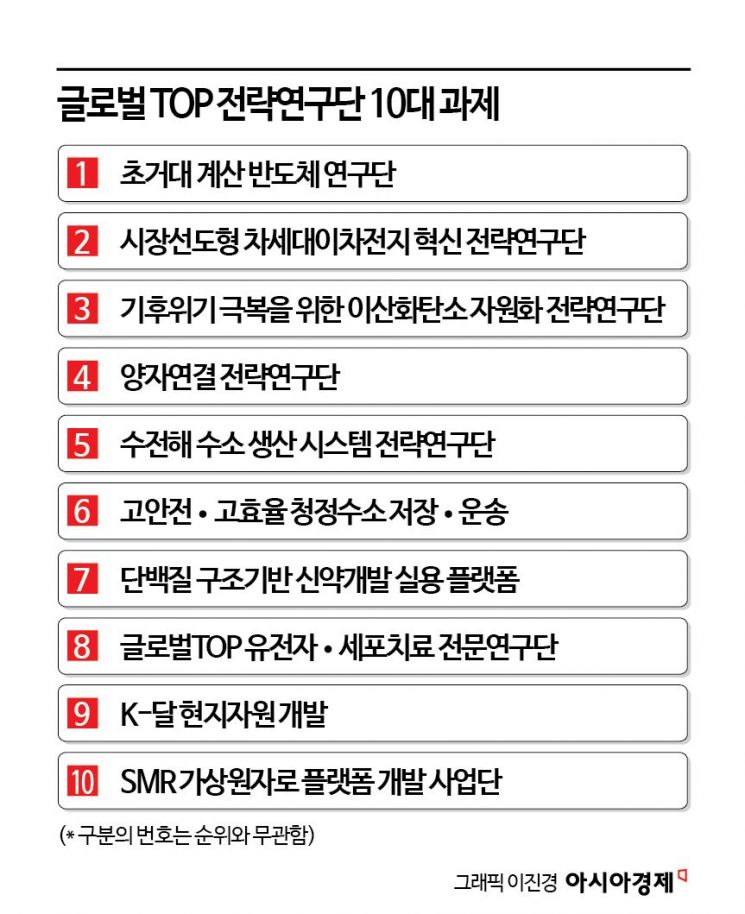
The Ministry of Science and ICT and the National Science and Technology Council (NST) announced on the 13th that 10 projects were selected in the first evaluation of the research and development plans for the 'Global TOP Strategic Research Groups' program and that the second evaluation has commenced. The final second evaluation is scheduled for the end of May.
The selected projects cover the fields of semiconductors, secondary batteries, quantum technology, hydrogen, carbon, bio, space, and nuclear power, with hydrogen and bio each having two projects selected. Previously, the Ministry of Science and ICT selected a total of 14 projects from 51 proposals, then formed expert evaluation committees of 8 to 10 members per project and excluded four strategic research groups. During the first evaluation process, some strategic groups underwent changes such as name modifications. The Small Modular Reactor (SMR) was not included in the initial proposal but was added after the first review.
The Ministry of Science and ICT is encouraging GFRIs, which had previously focused only on individual research, to form alliances and establish an open, mission-centered cooperative system for large, nationally important specific missions through this program.
While GFRIs have been struggling due to cuts in research and development (R&D) budgets, they have pinned their hopes on this program, which offers large-scale new funding, but outcomes have been mixed. GFRIs less related to the 12 major national strategic technologies were mostly eliminated at the proposal stage. One GFRI that was rejected from all projects has been perceived to be keeping this fact under wraps to avoid external exposure.
In the first evaluation, four strategic groups?Materials (Materials Industry Innovation AI Strategic Research Group), Robotics (Artificial Intelligence Humanoid Strategic Research Group), Space (Satellite-based Korean Smart Space Network Development Research Group), and Nuclear Power (Next-generation Nuclear Structures Strategic Research Group)?were eliminated. On the other hand, KIST and the Korea Research Institute of Chemical Technology included two strategic research groups as lead institutions in the second evaluation, drawing envy from other GFRIs.
Even GFRIs that passed the first evaluation cannot be complacent. According to the Ministry of Science and ICT, the second evaluation is known to prioritize among the first selected projects. If projects with large budget allocations are selected first and the 100 billion KRW budget is exhausted, lower-priority projects will be eliminated in the final second evaluation due to lack of funds. A Ministry of Science and ICT official stated, "During the consulting process, adjustments will be made to the budgets requested by each strategic group. For projects that are rejected this time, we will consult with the financial authorities to include them in next year’s budget."
Hwang Pan-sik, Director of the R&D Policy Office at the Ministry of Science and ICT, said, "Through supplementary consulting and final evaluation, we will select national representative GFRI research groups that need to consolidate national capabilities, lead innovation in GFRIs, and produce outcomes that the public can feel, and we will do our best to manage them."
© The Asia Business Daily(www.asiae.co.kr). All rights reserved.

















