Establishment of New Departments Including External Cooperation Headquarters, Corporate Support Bureau, and Education Policy Strategy Bureau
Reorganization from 3 Offices, 8 Bureaus, 2 Headquarters to 3 Offices, 13 Bureaus, 2 Headquarters
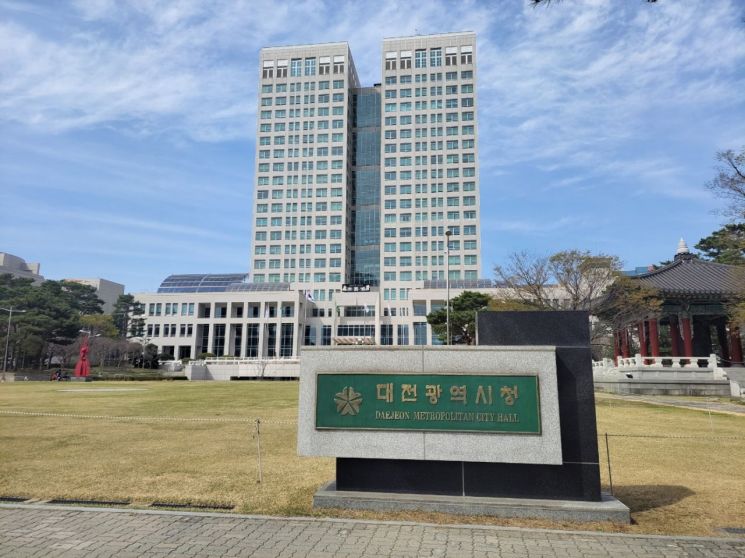 Daejeon City will implement the third organizational restructuring of the 8th elected administration. Photo by Park Jongmyeong
Starting this July, the number of director positions at Daejeon City Hall will increase by five.
Daejeon City announced that, beginning July 1, it will transition from the current structure of 3 offices, 8 bureaus, and 2 headquarters to a new structure of 3 offices, 13 bureaus, and 2 headquarters, aiming to build an organization with greater responsibility and expertise in the second year of the 8th elected administration.
The organizational restructuring plan focuses on establishing five new bureaus: the External Cooperation Headquarters to strengthen government and National Assembly relations; the Corporate Support Bureau responsible for supporting companies throughout their entire lifecycle; the Education Policy Strategy Bureau to enhance regional university competitiveness and lifelong education; the Greenery Bureau to cultivate a green and sustainable city; and the Urban Railway Construction Bureau, a temporary organization dedicated to constructing the Urban Railway Line 2 tram. This is the third organizational restructuring under the 8th elected administration through ordinance amendments and the fifth including rule amendments.
The External Cooperation Headquarters will be repositioned as an office directly under the mayor and upgraded from a level 4 director of a business office to a level 3 bureau chief. This reflects the determination to actively resolve regional long-standing projects such as the relocation of Daejeon Correctional Institution and the undergrounding of the Honam Expressway, and to fully commit to securing national funding amid a political environment where cooperation with the National Assembly is crucial.
The Strategic Industry Promotion Office and the Economic Science Bureau will be reorganized into the Future Strategic Industry Office, Corporate Support Bureau, and Economic Bureau. The Corporate Support Bureau will handle policies and support for the entire corporate lifecycle, including corporate financing, demonstration projects, startup and business growth support, and investment attraction. The Future Strategic Industry Office will focus on Daejeon's four major strategic industries: semiconductors, bio, defense, and aerospace. The Economic Bureau will be responsible for economic policy, jobs, small business owners and traditional markets, and energy supply, covering the daily economy sector.
The Transportation Construction Bureau and the Metropolitan Railway Transportation Headquarters will be divided into the Transportation Bureau, Railway Construction Bureau, and Urban Railway Construction Bureau. The Transportation Bureau will focus on minimizing transportation inconveniences by managing transportation policies, bus operations, and transportation facilities in line with the commencement of construction for Urban Railway Line 2 in the second half of the year. The Railway Construction Bureau will perform comprehensive railway policy functions for Daejeon, the central city of the Chungcheong region megacity, including the metropolitan railway network and the construction of Urban Railway Lines 3, 4, and 5. The Urban Railway Construction Bureau, a temporary organization, will be solely responsible for constructing the Urban Railway Line 2 tram, with plans to convert it into a project headquarters by 2025.
The Education Policy Strategy Bureau will lead university innovation for regional co-prosperity, including the Regional Innovation-Centered University Support System (RISE) and fostering glocal universities. It will also handle lifelong education functions linked to children, youth, and women, develop lifecycle education policies, nurture talent, and manage employment, entrepreneurship, and regional settlement.
The Greenery Bureau will also be newly established. It will be responsible for green policies such as Bomunsan Forest Recreation Complex, Gyejoksan Natural Recreation Forest, premium garden city projects, and the second arboretum, which are key projects of the 8th elected administration. Additionally, it will explore advanced smart farms connected to residential green spaces and pet-friendly policies.
Mayor Lee Jang-woo of Daejeon said, "This restructuring plan is the cornerstone for creating a first-class economic city, which we have emphasized so far. We focused on operating an efficient and strong organization so that bureau chiefs and staff can take responsibility and demonstrate expertise to realize Daejeon's development and the happy lives of its citizens."
Meanwhile, the organizational restructuring plan will undergo legislative notice from the 14th to the 24th, be submitted to the Daejeon City Council on the 31st, and upon approval, will be implemented on July 1 after amendments to the administrative organization and staffing enforcement rules and staffing regulations.
© The Asia Business Daily(www.asiae.co.kr). All rights reserved.
![User Who Sold Erroneously Deposited Bitcoins to Repay Debt and Fund Entertainment... What Did the Supreme Court Decide in 2021? [Legal Issue Check]](https://cwcontent.asiae.co.kr/asiaresize/183/2026020910431234020_1770601391.png)















