Court ruling expected between 13th and 17th
Medical licensing exam postponement, consultation with Ministry of Health if necessary
The Ministry of Education referred to this week, when the court's ruling on the increase in medical school quotas is expected, as a "critical moment" and stated that it will discuss the retention prevention measures submitted by each university, including the postponement of the medical licensing examination.
At the regular briefing of the Ministry of Education on the 13th, spokesperson Koo Yeon-hee said, "This week seems to be a bit of a critical moment," adding, "Once the court makes a decision in any form, it is highly likely that the decision will be binding. The decision this week holds very important significance in many aspects." This week, from the 13th to the 17th, is expected to be the period when the court will issue its ruling on the injunction request against the increase in medical school quotas.
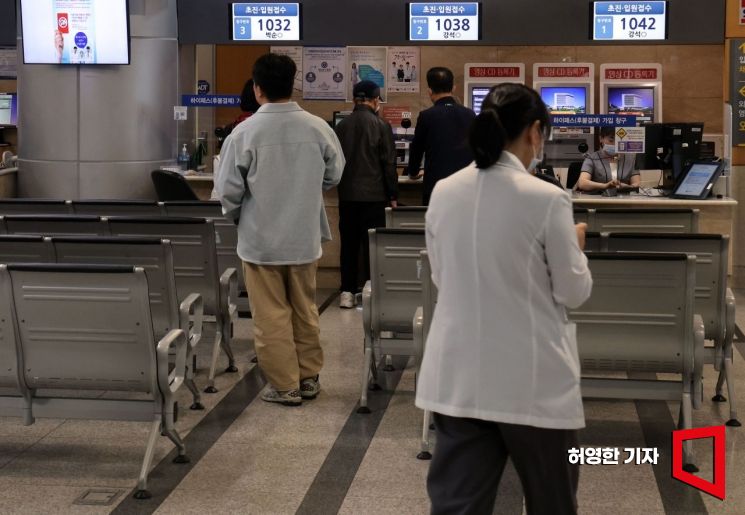 On the morning of the 10th, when medical school professors nationwide decided to stop working, patients and their guardians are registering for medical treatment at a large hospital in Seoul. Photo by Younghan Heo younghan@
The Ministry of Education expressed its position to devise various measures to prevent medical students from repeating a year. Spokesperson Koo said, "So far, 37 universities have submitted (academic operation plans to prevent medical student retention)," and added, "Some of these universities have proposed postponing the medical licensing examination, and if necessary, we will consult with the Ministry of Health and Welfare."
However, she explained that since the academic operation aspects to prevent medical student retention are governed by each university's regulations, it is difficult for the ministry to create uniform guidelines. Koo said, "The law only stipulates that the school year must be at least 30 weeks, and everything else is delegated to the school regulations, which vary by school and by grade," adding, "There are limits to the Ministry of Education issuing uniform guidelines."
Regarding concerns that flexible academic operations to prevent medical student retention might lead to a decline in the quality of education, she responded, "It is difficult to definitively say that the quality of classes will decline." Spokesperson Koo added, "It is true that students' class burdens will increase because classes are likely to be held intensively without vacations or weekends," and said, "It would be good if students return to school quickly and express their opinions."
Regarding the criticism of "special treatment" raised by some about easing academic operations only for medical schools, spokesperson Koo emphasized, "It has nothing to do with special treatment." He said, "This is not a normal situation, and there are students who want to attend classes but cannot. Because those students should not suffer, we are devising various measures within the scope of the law to help students as much as possible," adding, "There was also a case in 2003 at Dongduk Women's University where the government and the university flexibly operated academic affairs to prevent retention during a retention crisis."
© The Asia Business Daily(www.asiae.co.kr). All rights reserved.

![Clutching a Stolen Dior Bag, Saying "I Hate Being Poor but Real"... The Grotesque Con of a "Human Knockoff" [Slate]](https://cwcontent.asiae.co.kr/asiaresize/183/2026021902243444107_1771435474.jpg)















