"Unauthorized Phone Activation, Unfair Penalty Fees"
Increase in Telecommunications Dispute Mediation Applications Every Year
No Enforcement Without Mutual Agreement
Increase in Committee Members... Introduction of Ex Officio Mediation Decision System
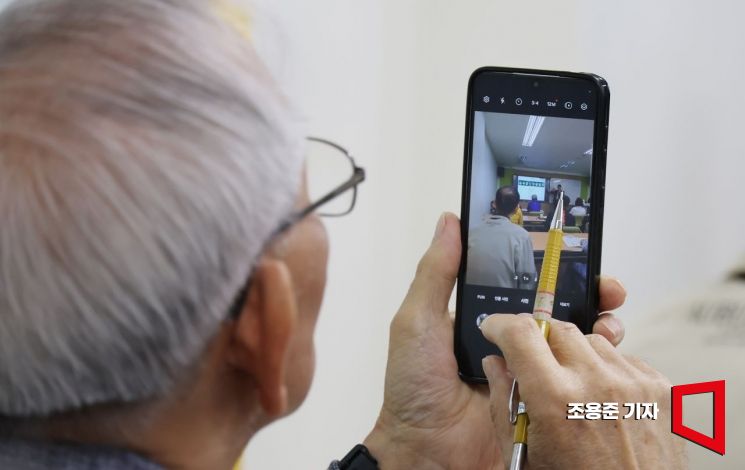
#. Mr. A, a person with severe disabilities suffering from autism, met Mr. B through internet chatting. After learning about A’s disability, Mr. B contacted the owner of a mobile phone store he knew and requested phone activation. Following Mr. B’s instructions, Mr. A newly activated two phone lines at the store. However, Mr. A never received the purchased phones and only came back with the SIM cards. This case involved deceiving a cognitively impaired disabled person to activate phones and then confiscating the devices. The telecommunications company investigated the incident and canceled the activations. However, Mr. A was not able to be relieved from the installment payments and fees for the phones. Consequently, Mr. A applied for dispute mediation to seek relief for the phone installment payments and fees through the telecommunications dispute mediation system.
#. Mr. C, in his 80s, was struggling financially to the extent of relying on free meal services and collecting scrap paper. Mr. D, an employee at a mobile phone agency, persuaded Mr. C to change devices three times over a year starting from December 2020, promising to reduce his fees. Despite Mr. C’s low data usage, he was signed up for expensive plans. In response, the Telecommunications Dispute Mediation Committee (hereinafter referred to as the Mediation Committee) mediated the case by canceling all activated mobile phone services without penalty fees and exempting the remaining installment payments for the devices.
With the popularization of 5G smartphones, overall quality of life has improved, but cases of harm targeting socially vulnerable groups have increased. Particularly at mobile phone sales sites, unscrupulous sales practices continue, such as forcing customers to use expensive plans by offering cheaper device prices or failing to properly inform customers about penalty fees when changing plans.
Continuous Increase in Dispute Mediation Applications
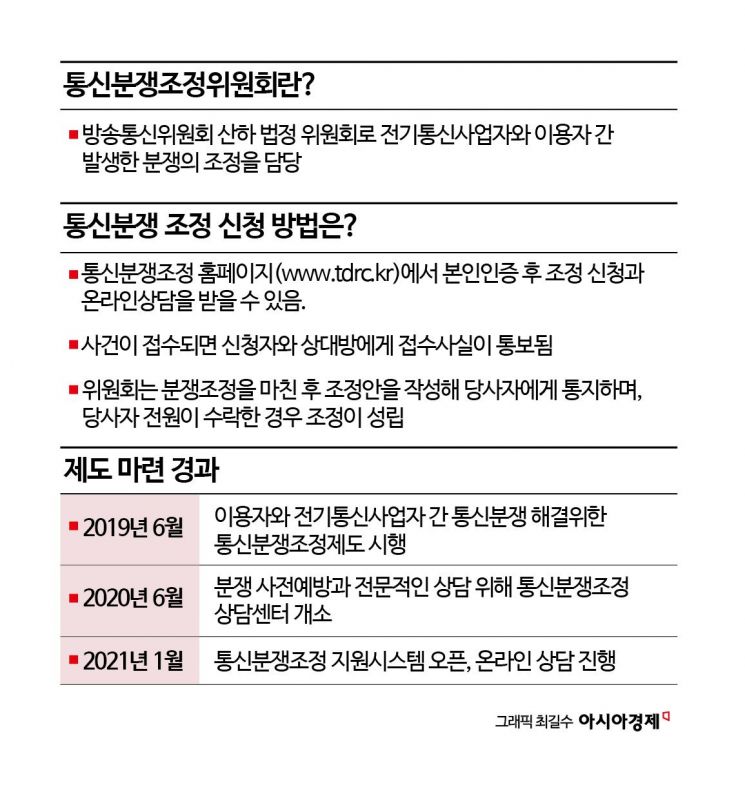
The Korea Communications Commission established the telecommunications dispute mediation system in 2019 to prevent and resolve disputes between telecom operators and users, and formed the Mediation Committee with a two-year term the following year to serve as a resolver of telecom disputes.
The number of applications received by the Mediation Committee has steadily increased: 155 cases in 2019, 572 in 2020, 1,170 in 2021, 1,060 in 2022, and 1,259 last year. By type of reason for application, requests related to speed or call quality have continuously decreased as telecommunications technology advanced. In particular, call quality-related cases dropped from 173 in 2021 to 84 in 2022 and 64 last year.
However, many disputes arose due to users experiencing unfair treatment or insufficient explanation of important terms such as contract conditions when entering into telecommunications service agreements. Applications related to contract conditions were 277 in 2021, 321 in 2022, and 314 in 2023. Among last year’s dispute mediation applications, 7 out of 10 demanded compensation such as fee reductions and refunds, penalty fee waivers, and damage compensation.
KT Tops in Refusal of Telecommunications Disputes
Since statistics began in 2019, KT has been the telecom operator with the most disputes over the past five years.
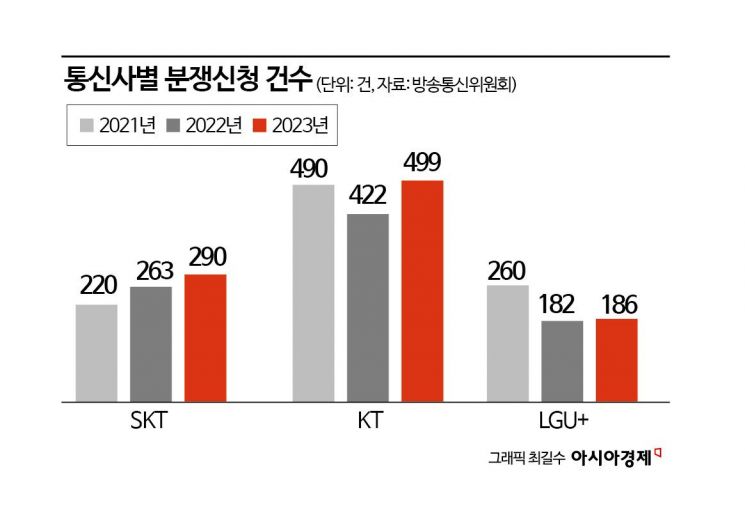
Last year, KT received 499 telecommunications dispute mediation applications, overwhelmingly more than SK Telecom’s 290 and LG Uplus’s 186. Considering only wireless services such as smartphones, KT had 389 cases, SK Telecom 246, and LG Uplus 114. Typical disputes in the wireless communication sector included inducing phone activations by falsely or misleadingly informing customers about device prices, forcing the use of expensive plans and subscription to additional services, and insufficient notification about penalty fees when changing plans.
In disputes related to wired services such as internet and landline phones, KT also led with 110 cases (34.7%). Disputes arose from issues such as improper processing of internet cancellations leading to prolonged billing, inducing subscriptions by promising benefits but failing to deliver, and charging penalty fees when canceling services due to installation impossibility. Last year, dispute cases involving budget phone operators also ranked KT M Mobile (53 cases) and KT Skylife (42 cases) as the top two.
Settlement Proposals Require Agreement from Both Parties to Take Effect
So, are telecommunications disputes being properly handled? The Mediation Committee, composed of 10 members including a chairperson appointed by the chairman of the Korea Communications Commission, prepares settlement proposals. These proposals are not binding. Ideally, parties reach an agreement before the committee issues a proposal. However, if the respondent (the operator) does not accept the proposal, the case is closed unresolved. Last year, 95 cases were rejected, accounting for 1 in 10 of all applications.
To enhance the effectiveness of mediation, a new system was recently introduced. The “Ex Officio Mediation Decision System” allows the committee to replace mediation with a decision through a resolution even if parties do not reach an agreement. This system can not only order damage relief measures such as compensation but also stop the acts causing disputes and take measures to prevent recurrence. Although still not mandatory, it signifies a deeper examination of cases. This year, the ex officio mediation decision was applied for the first time in a case where a mobile phone store changed the device of an elderly user in their 80s without consent and confiscated the device. This considered circumstances such as the store’s closure and inability to contact the owner. A Korea Communications Commission official said, “Following last year’s legal amendment, the number of committee members increased to a maximum of 30, and the ex officio mediation decision system was established. We expect dispute mediation work to proceed more efficiently.”
© The Asia Business Daily(www.asiae.co.kr). All rights reserved.



















