US and Key Allies Inject Support Funds Against China
"Tech War to Intensify After US Election"
As the United States and its major allies invest approximately $81 billion (about 111 trillion won) in advanced semiconductors, the US-China semiconductor rivalry is intensifying, Bloomberg reported on the 12th (local time).
The US Department of Commerce and the White House announced on the 25th of last month that they would provide $6.1 billion in subsidies to Micron Technology, the largest US memory semiconductor manufacturer, under the Semiconductor Act. Previously, subsidies were provided to Intel ($8.5 billion), TSMC ($6.6 billion), and Samsung Electronics ($6.4 billion).
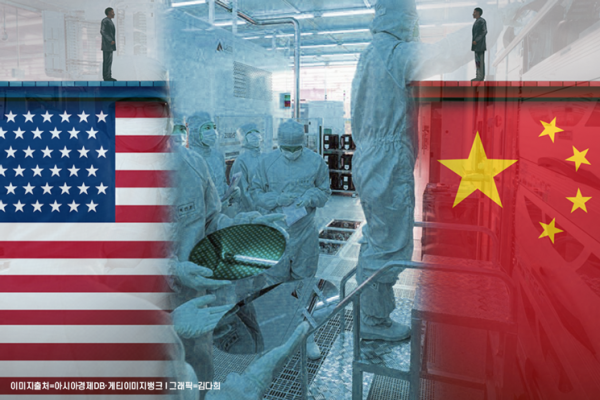
The US government plans to provide a total of $52.7 billion over five years under the Semiconductor Act, including $39 billion in production subsidies and $13.2 billion in research and development (R&D) support. Bloomberg reported that production subsidies amounting to $33 billion have already been provided to companies such as Intel. Additionally, there are low-interest loans worth $75 billion and tax credit benefits of up to 25%.
Jimmy Goodrich, Senior China Strategy Advisor at the RAND Corporation, said, "There is no doubt that we have crossed the Rubicon in the technological competition with China, especially in the semiconductor field," adding, "Both sides have made semiconductors one of their top national strategic priorities."
Bloomberg explained, "This US investment is more than just a response to China," noting, "China is several generations behind in advanced semiconductor technology. The US also aims to reduce the gap caused by state-led subsidies that made Taiwan and South Korea the centers of the semiconductor industry." It added that such subsidies are promoting competition among the US, Europe, and Asian allies amid the global artificial intelligence (AI) boom.
Europe has set a plan worth about $46.3 billion to expand semiconductor manufacturing capabilities within the continent. The European Union (EU) Commission estimated that public and private investments exceeding $108 billion will be injected to strengthen semiconductor manufacturing capabilities.
Intel plans to establish a $36 billion fab in Magdeburg, Germany, receiving $11 billion in subsidies. TSMC is making a joint investment of about $11 billion in Germany, with half expected to be covered by government subsidies. However, the EU Commission has not yet given final approval for such support.
The Japanese government has prepared about $25.3 billion in support funds to foster the semiconductor industry. Of this, $16.7 billion will be allocated to two TSMC foundries in southern Kumamoto and to the Hokkaido plant of domestic venture company Rapidus. Rapidus aims to mass-produce 2nm (1nm = one billionth of a meter) chips by 2027. Japanese Prime Minister Fumio Kishida aims to triple Japan's chip production sales to $96.3 billion by 2030 by investing a total of $64.2 billion, including private investments.
On the 12th, South Korea announced that the government plans to promote a support program worth 10 trillion won to strengthen semiconductor competitiveness.
Emerging countries are also entering the semiconductor hegemony competition. India approved a $10 billion government fund investment in February to build its first semiconductor manufacturing facility. Saudi Arabia's Public Investment Fund is expected to make large-scale investments this year to enter the semiconductor sector.
China is accelerating its semiconductor capability enhancement amid the investment expansion centered on the US. Bloomberg said, "China is building more semiconductor factories than anywhere else in the world, producing legacy chips while researching alternatives for advanced semiconductors such as Nvidia's AI chips," adding, "Some experts argue that China is several years behind, but others claim China is on the verge of catching up."
China's semiconductor investment is estimated to be larger than that of the US. The Semiconductor Industry Association recently estimated that China is investing more than $142 billion in semiconductors. It also recently established a chip fund worth a record $27 billion.
The US is imposing strong semiconductor sanctions to protect national security and suppress China's technological capabilities. Paul Triolo, China and Technology Policy Partner at Albright Stonebridge Group, said, "US sanctions motivate Chinese companies to improve capabilities, enhance the value chain, collaborate, and mobilize more government support for companies like Huawei."
Political interests are also intertwined with the massive US semiconductor support. With the US presidential election coming up in November, the revival of manufacturing, including semiconductors, is a key pledge of President Biden's re-election campaign. Former President Donald Trump has not yet disclosed specific semiconductor-related pledges but has announced a 60% tariff on Chinese products.
However, the US-China semiconductor rivalry is expected to continue even after the election. Triolo said that a Trump victory could trigger stronger Chinese responses, such as targeting US companies in China or restricting exports of raw materials needed for strategic technologies like semiconductors. John Lee, director of East West Futures Consulting, said, "Who becomes president in the future does not matter; the US-China tech war will not improve but rather intensify."
© The Asia Business Daily(www.asiae.co.kr). All rights reserved.

















