UNIST announced on the 13th that Professor Daesik Kim, Distinguished Professor of Physics, has been selected as the recipient of the Humboldt Research Award.
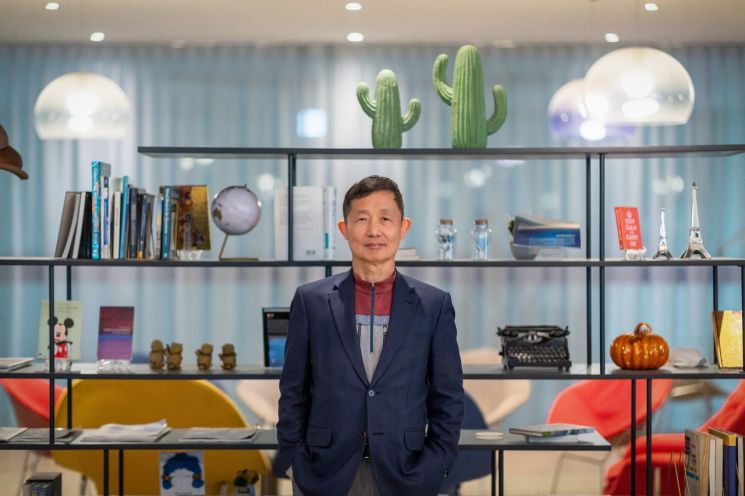
The Humboldt Research Award is given annually by the Alexander von Humboldt Foundation in Germany to researchers who have achieved world-class research accomplishments in the fields of humanities, social sciences, natural sciences, and engineering. Among the scholars supported by the Humboldt Foundation, 61 have been awarded the Nobel Prize.
The Humboldt Foundation recognized Professor Kim's contributions to the field of nano-optics over the past 30 years. The foundation also noted that Professor Kim has trained many female scientists, including Dr. Mina Seo from KIST, Professor Youngmi Park from Incheon National University, and Dr. Jineun Kim from Samsung Advanced Institute of Technology.
During his doctoral studies, Professor Kim was the first in the world to measure 'femtosecond Raman scattering,' observable in the femtosecond (one quadrillionth of a second) range. He has researched terahertz nano-optics and developed flexible wafer-sized nanogaps controllable at the atomic level by combining plasmonics?which involves interactions of electrons inside metals with light?and polymer nanotechnology.
Known as an eccentric physicist, Professor Kim has led the movement opposing circumcision, which rapidly increased in South Korea, and has published several books on the subject. For these efforts, he received an international human rights award from the International Circumcision Education Center, a non-governmental organization under the United Nations.
Professor Kim expressed, “I am very pleased that receiving the Humboldt Research Award feels like recognition of my 30 years as a researcher,” and added, “I will continue to devote myself to various studies for the advancement of the nano-optics field.”
Meanwhile, the Humboldt Foundation awards the Humboldt Research Award to up to 100 recipients annually. Awardees receive a total prize of 60,000 euros and have the opportunity to stay in Germany for six months to one year to conduct research in their fields of interest.
© The Asia Business Daily(www.asiae.co.kr). All rights reserved.

















