The national technology protection network is becoming more robust. The aim is to create an environment where crimes involving the leakage of national technology are prevented from being attempted in the first place through multiple safety measures. Over the past seven years, a total of 140 cases of industrial technology have been leaked overseas from Korea, with the estimated damage amounting to 33 trillion won.
On the 13th, the Korean Intellectual Property Office (KIPO) announced that it has completed and will fully implement the ‘Four-layer Safety Device for Technology Protection’ to prevent technology leakage from domestic companies.
The four-layer safety device consists of ▲ designation of KIPO as a counterintelligence agency ▲ expansion of the investigative scope of technology police ▲ increased criminal penalties for overseas leakage of national technology ▲ and raising the cap on punitive damages corresponding to trade secret infringement.
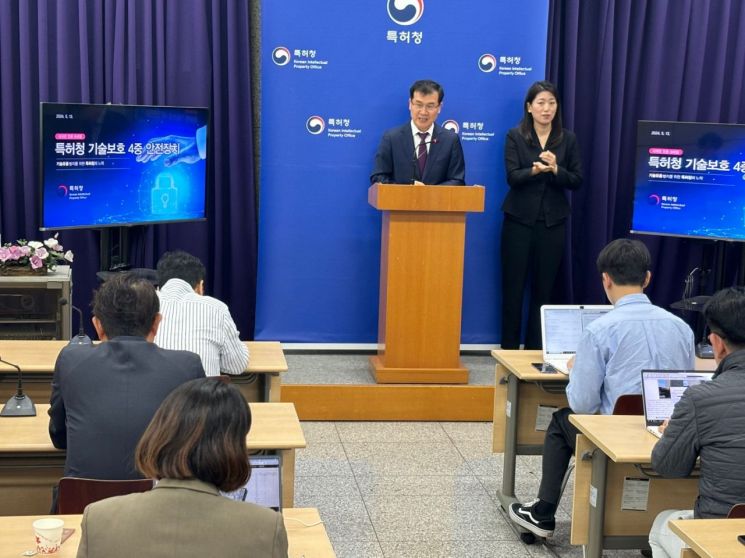 Kim Si-hyung, Acting Commissioner of the Korean Intellectual Property Office, is announcing the implementation plan for the "Four-layer Safety Device for Technology Protection" to prevent technology leakage from domestic companies at the Government Complex Daejeon on the 13th. Photo by Jeong Il-woong jiw3061@
Recently, following the enforcement of the revised ‘Counterintelligence Work Regulations (Presidential Decree),’ KIPO was newly designated as a counterintelligence agency. With this designation, KIPO will collaborate with the existing six counterintelligence agencies?the National Intelligence Service, Ministry of Justice, Korea Customs Service, National Police Agency, Korea Coast Guard, and the Military Counterintelligence Command?to monitor industrial spies.
Due to the nature of its patent examination work, KIPO possesses over 1,300 experts including PhDs in engineering, patent attorneys, and technical specialists across various technical fields, and has secured a big data repository of more than 58 million patent information records. This foundation allows KIPO to continuously monitor and analyze the latest technological information developed worldwide. Through this, KIPO can select and protect key domestic technologies that are likely targets for overseas interest.
Going forward, KIPO plans to provide domestic key technology classification information to the ‘Counterintelligence Information Sharing Center’ under the National Intelligence Service and cooperate in apprehending industrial spies by linking intelligence on technology leakage collected by other counterintelligence agencies.
Expanding the investigative scope of technology police to enhance both post-penalty enforcement and preemptive prevention of national technology leakage crimes is another pillar of the safety measures prepared by KIPO. Previously, the investigative scope of technology police did not cover all trade secret infringement crimes. If trade secrets were not actually disclosed to competitors or others, technology police lacked the authority to investigate acts of conspiracy or preparation alone.
However, with the revision of the ‘Judicial Police Duties Act,’ the investigative scope of technology police will now expand to cover all trade secret infringement crimes, including preparatory and conspiracy acts and unlawful possession. This enables preemptive investigations to prevent trade secret leakage in addition to post-penalty enforcement. Given that technology police have achieved results such as blocking the overseas leakage of national core semiconductor technologies through a triangular cooperation system with the National Intelligence Service and prosecutors, KIPO expects significant effects from the expanded investigative scope.
KIPO will also increase the criminal penalties and punitive damages caps for overseas leakage offenders. Starting July this year, the maximum sentencing guidelines for offenders leaking trade secrets overseas will increase from 9 years to 12 years, and for domestic leakage from 6 years to 7 years and 6 months. Notably, even first-time offenders may receive actual imprisonment as the probation criteria are strengthened.
This measure reflects the intensifying global competition for technological supremacy and the increasing attempts by foreign companies to leak core technologies of domestic firms. For example, the National Intelligence Service detected a total of 140 cases of industrial technology leakage overseas from 2017 to last year. The estimated damage from the detected overseas leakage cases is 33 trillion won.
From August, KIPO will also raise the cap on punitive damages for trade secret infringement crimes from three times to five times. Currently, China is the only country that sets the punitive damages cap at five times, while the United States, which has strong technology protection, allows up to twice the damages. KIPO emphasized that the fivefold punitive damages cap will be the highest level of technology leakage prevention measure both domestically and internationally.
Kim Si-hyung, Acting Commissioner of KIPO, stated, “Advanced technology is a nationally important strategic asset, and acts of leaking it constitute serious crimes that threaten economic security. The four-layer safety device will be implemented with equal emphasis on preventing technology leakage and strictly punishing detected crimes.”
© The Asia Business Daily(www.asiae.co.kr). All rights reserved.

















