Ministry of Oceans and Fisheries Develops 'Plan to Revitalize Fishing Villages and Coastal Areas'
Attracting Over 1 Trillion Won Investment in Complex Marine Tourism Cities
Package Support of Housing, Jobs, and Fishing Cooperatives for Young Returning Fishermen
The Ministry of Oceans and Fisheries is creating a 'Fisheries Village-type Opportunity Development Zone' by utilizing 58 million pyeong of national and public land in fishing villages and fishing port areas, and introducing various tax incentives to attract corporate investment. While promoting investments exceeding 1 trillion won by developing a complex marine tourism city, it will also provide a package of housing, jobs, and fisheries cooperative membership to young people returning to fishing villages.
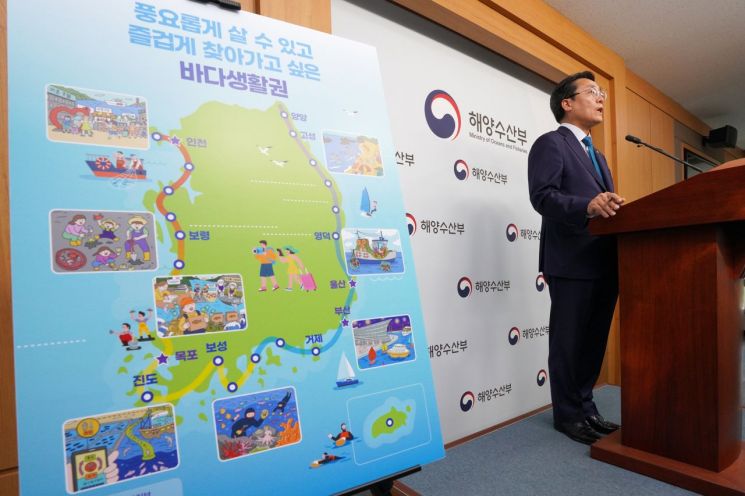 Kang Do-hyung, Minister of Oceans and Fisheries, announced on the 13th at the Economic Ministers' Meeting a joint plan with related ministries titled "Measures to Revitalize Fishing Villages and Coastal Areas" to overcome the extinction crisis of fishing villages and inject new vitality.
The Ministry of Oceans and Fisheries announced the 'Plan to Revitalize Fishing Villages and Coastal Areas' with these details at the Economic Ministers' Meeting on the 13th. Since early this year, the ministry has been preparing the 'Plan to Revitalize Fishing Villages and Coastal Areas' as the first task of the 'Marine Fisheries Livelihood Reform Task Force (TF).' Minister Kang Do-hyung held talk concerts by region with fishing village residents, fisheries workers, and experts to discover policy ideas. Based on this, a field-oriented comprehensive plan to revitalize fishing villages and coastal areas was prepared.
The ministry will amend the Special Act on Support for Fisheries Village Specialized Development to introduce opportunity development zones in fishing village areas as well. It plans to develop sites by utilizing 58 million pyeong of idle national and public land in fishing villages. The plan includes using national and public land located in 19 fishing village areas such as Goseong Gonghyeonjin Port and Seocheon Hongwon Port. The established zones will provide tax benefits to encourage active corporate investment, and support permits and approvals at the level of opportunity development zones.
The Fisheries Village-type Opportunity Development Zones will be developed in ways that reflect the characteristics of each fishing village. Yeongdeok Ganggu Port, a major snow crab production area, will be developed as a fisheries distribution and processing complex, while Yangyang Susan Port in Gangwon, which has nearby yacht mooring facilities, may be developed as a comprehensive marine fisheries leisure complex. In addition, fisheries and leisure equipment complexes, fisheries product distribution and sales complexes, and others will be established to promote corporate investment.
 Gang Do-hyeong, Minister of Oceans and Fisheries, announced the 'Plan to Revitalize Fishing Villages and Coastal Areas' on the 13th at the Economic Ministers' Meeting. This plan was prepared jointly with related ministries to overcome the extinction crisis of fishing villages and to inject new vitality.
A complex marine tourism city will be developed to attract large-scale investments exceeding 1 trillion won throughout fishing village areas. The policy scope, previously limited to fisheries and fishing villages, will be expanded to focus on the 'marine living zone' connecting fishing villages and coastal areas, aiming to create jobs and comprehensively improve living conditions. Currently, the ministry plans to attract large-scale investments exceeding 1 trillion won by combining over 800 billion won in private investment with national and local government funds.
Through this, urban-type marine living zones such as Busan and Incheon will strengthen marine fisheries convergence and complex functions. By redeveloping Busan Port North Port and Incheon Inner Port, they will be developed into marine tourism hubs, creating integrated marine leisure tourism cities that provide places to play and relax. Regional marine living zones will have customized specialization strategies prepared by next year according to local government development directions.
The ministry's decision to strengthen private investment attraction centered on fishing villages and coastal areas is based on the judgment that population decline in these areas is accelerating. The government has designated 89 out of 228 cities, counties, and districts nationwide as population decline areas, of which 31 are in fishing villages and coastal areas. In particular, fishing villages are experiencing rapid aging and population decline compared to urban and rural areas, and the risk of fishing village extinction is approaching quickly.
Minister Kang said, "Although the fishing household population continues to decrease, the coastal areas are spaces where people frequently visit with great interest to enjoy marine leisure and tourism," adding, "We will shift the paradigm to policies connecting fishing villages and coastal areas based on spatial connection points." According to a survey estimated by analyzing communication network information as big data, the fishing household population is only 90,000, but the number of people actually residing in fishing villages and coastal areas is estimated at 3.9 million. Therefore, the policy focus will shift to concentrating private investment on the marine living zone to supplement the insufficient income sources of fishing villages with marine tourists.
To this end, the ministry will also promote tourism activation by linking various contents of fishing villages and coastal areas. Experiential contents unique to fishing villages, such as mudflats and haenyeo (female divers), will be expanded. The number of 'Fish-cation' areas, where people can work and enjoy vacations simultaneously while viewing the sea by utilizing idle facilities, will be expanded from the current 11. Accommodations in 132 fishing village experience and healing villages will be branded or transformed into hotel-grade facilities to attract more tourists.
A comprehensive youth return-to-fishing town linking housing and fisheries jobs will also be established. It will be developed as a space where young people returning to fishing villages can receive not only housing but also jobs. Housing complexes will be built and rented to youth, while jobs such as new license aquaculture farms or youth aquaculture farm rentals will be preferentially provided, along with fisheries cooperative membership as a package. Additionally, ocean-view villas linked with second home tax benefits applied to population decline areas will be promoted.
Minister Kang stated, "The Plan to Revitalize Fishing Villages and Coastal Areas is the first step toward creating a marine living zone where people can live prosperously and want to visit joyfully," and added, "We will closely cooperate with other ministries and local governments to revitalize the regional economy and improve living conditions in fishing villages and coastal areas through the marine living zone."
© The Asia Business Daily(www.asiae.co.kr). All rights reserved.
![Clutching a Stolen Dior Bag, Saying "I Hate Being Poor but Real"... The Grotesque Con of a "Human Knockoff" [Slate]](https://cwcontent.asiae.co.kr/asiaresize/183/2026021902243444107_1771435474.jpg)

















