First Introduced in 1969, Overwhelming North Korean Air Force Power... Retiring Next Month
On the 9th, at the Air Force 10th Fighter Wing base in Suwon, Gyeonggi Province, the sky was clear without a single cloud or breeze. The F-4 Phantom fighter jet, known as the "Sky Goblin," which has guarded our airspace for over half a century, seemed to be cheering on its final flight.
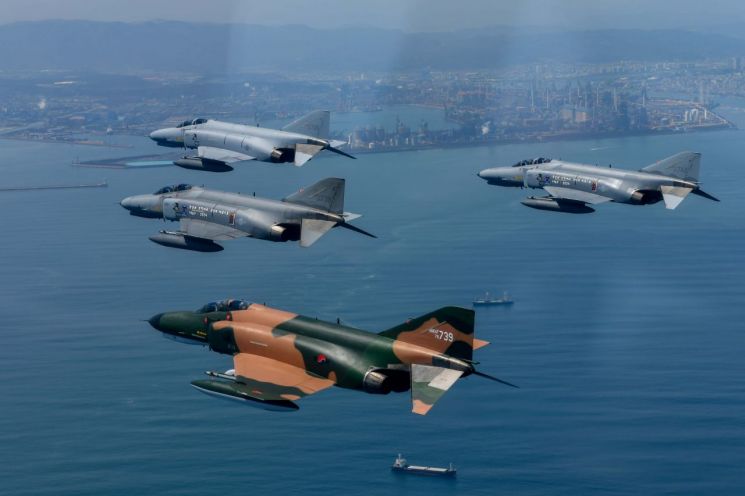
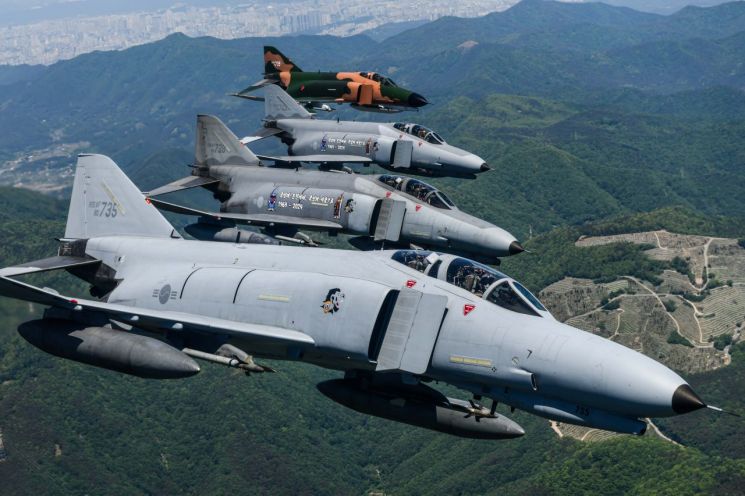
Hearing the roar of the F-4E engines, eight pilots and reporters walked side by side toward the hangar, reminiscent of a scene from the movie "Top Gun." On the runway, soldiers busily moved about for the final pre-flight checks. For the F-4E's farewell national tour flight, the reporters donned flight suits and gear and boarded the rear seat of the Phantom to experience the last flight. The four Phantoms that took to the sky were named the "Pilsung Squadron." This name was originally given by then-President Park Chung-hee to a squadron composed of five F-4D jets purchased in 1975 with defense funds.
Among the four fighter jets, two were painted with the past Korean Air Force Phantom liveries: jungle camouflage and light gray paint, adding significance, while the others flew in the current dark gray paint scheme. On the side of the fuselage was a commemorative phrase, "From the hands of the people, with the hearts of the people 1969-2024," along with the Phantom's symbol, the "Spook" (spook·ghost). The left Spook wore the Air Force symbol, the "Red Scarf," and had the Taegeuk pattern on its chest. The right Spook wore the Joseon Dynasty military officer's helmet (dujeonggap) and held the AGM-142 "Popeye" air-to-ground missile, which only the F-4E currently operated by the Air Force can carry. Even the dignified veteran could not hide his graying hair. Although the F-4E emitted a powerful engine sound, the layers of time settled in various places were palpable. The leather of the safety belt worn in the rear seat was worn, and the metal fasteners were worn down. The fighter's instrument panel and rearview mirrors were tarnished, revealing its age. The reality of the farewell flight truly sank in. The Pilsung Squadron took off from their home base, Suwon Air Base runway, and flew in a 'fingertip' formation shaped like an inverted V. Two F-15Ks also joined the formation for filming.
The Pilsung Squadron soon flew over Pyeongtaek, home to Camp Humphreys symbolizing the Korea-US alliance, and Cheonan, where the Independence Hall is located. Passing over the key Air Force bases of Chungju and Cheongju, the squadron headed south along the East Coast where the Phantom had once been active. During the Cold War, the Phantom had intercepted Soviet forces that violated airspace along the East Coast, including Tu-16 bombers in 1983 and Tu-95 bombers in 1984. The squadron passed over Pohang, Ulsan, Busan, and Geoje, which led the growth of Korean heavy industry and trade, and refueled at Daegu Air Base, the "hometown of the Phantom."
Daegu Air Base was where the F-4D handover ceremony took place on August 29, 1969, when the United States gifted the jets. Korea became the fourth operator of the then-world's most powerful fighter, the F-4D, enabling it to overwhelm North Korean air forces. After refueling, the squadron headed to the skies over Sacheon, home to Korea Aerospace Industries, which is developing the domestically produced supersonic fighter KF-21 "Boramae." Two KF-21s joined the formation over Sacheon, commemorating the generational shift in the Korean Air Force. A spectacular scene unfolded with the past (F-4E), present (F-15K), and future (KF-21) of Korean fighters flying together. The KF-21 flying at the rear of the formation moved forward from Yeosu airspace, showing its determination to fill the void left by the F-4. While accompanying the formation up to Wido Island, home to the Naro Space Center, a KF-21 pilot's message was heard: "Thank you for your hard work. Please return safely." This sentiment was felt not only by the F-4E occupants but also by the F-4s returning to Suwon Air Base after 55 years of service. The KF-21 made a sharp right turn and departed, firing flares to honor the F-4E.
The formation flew over Gageodo Island and along the west coast to Gunsan Air Base, home to the US 8th Fighter Wing, before safely returning to Suwon Air Base, concluding the three-hour national tour flight. Major Park Jong-heon of the 153rd Fighter Squadron, 10th Fighter Wing, who participated in the flight, said, "The patriotic spirit of the Pilsung Squadron, which took flight with the people's donations, will live forever in the hearts of Republic of Korea Air Force pilots even after the immortal Goblin Phantom retires." The Phantom served as the Air Force's main fighter from its introduction in 1969 until the KF-16 was operationalized in 1994. Most have now retired, with only about ten F-4Es remaining. The Phantom's retirement ceremony is scheduled to be held at Suwon Air Base on the 7th of next month.
© The Asia Business Daily(www.asiae.co.kr). All rights reserved.
![Clutching a Stolen Dior Bag, Saying "I Hate Being Poor but Real"... The Grotesque Con of a "Human Knockoff" [Slate]](https://cwcontent.asiae.co.kr/asiaresize/183/2026021902243444107_1771435474.jpg)












