"Improvement in Semiconductor-Centered Export Performance... Real GDP Recovery Trend"
The Korea Institute of Finance raised its annual growth rate forecast to 2.5%. On the 12th, the institute announced its "2024 Revised Economic Outlook," presenting this year's real Gross Domestic Product (GDP) growth rate forecast at 2.5%, up 0.4 percentage points from the forecast made in November last year.
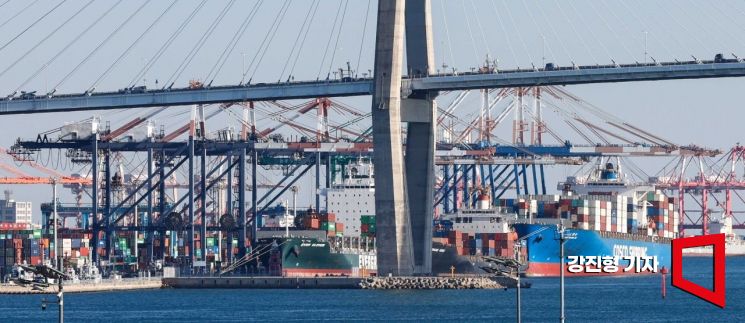 Export containers are being loaded onto a ship at Busan North Port. Photo by Kang Jin-hyung aymsdream@
The institute stated, "Due to the impact of high interest rates and high inflation, the recovery of private consumption is expected to be gradual, and construction investment is anticipated to be sluggish," but also predicted, "Real GDP recovery will emerge as export performance, centered on semiconductors, significantly improves and related facility investments increase."
In particular, the total export growth rate is expected to reach 5.3%, more than double the November forecast of last year (2.6%). As global trade gradually recovers, semiconductor demand is increasing, leading to a significant improvement in exports, according to the analysis.
The forecast for total import growth was also revised upward to 3.7%, compared to the November forecast of 2.4%. While demand for imports of export-related goods is increasing and service imports, especially travel services, are expected to rise, the slowdown in demand for consumer goods imports is likely to constrain the total import growth rate.
The institute forecasted a private consumption growth rate of 1.7%, down from the November forecast of 2.0%. Although private consumption grew by 0.8% quarter-on-quarter in the first quarter, showing a favorable growth rate, prolonged high inflation and high interest rates are expected to limit consumption capacity, resulting in a gradual increase in private consumption throughout the year.
Uncertainty regarding domestic and international economic conditions may also delay the recovery of consumer sentiment. The institute expects facility investment and construction investment growth rates to be 3.7% and -2.4%, respectively.
Facility investment was revised upward from the November forecast of 3.4%, but construction investment was revised downward from the November forecast of -1.6%. The institute expects semiconductor-related facility investment to lead the increase in facility investment due to a rebound in memory semiconductor demand and expansion of production facilities focused on high-bandwidth memory. Construction investment has deteriorated continuously since mid-2022 in key leading indicators such as orders, permits, and groundbreaking, due to rapid interest rate hikes, real estate project financing (PF) defaults, reverse lease issues, and housing market adjustments.
The institute analyzed that this negative trend in leading indicators will be fully reflected in this year's performance. The consumer price inflation rate is expected to gradually slow down to 2.9% in the first half and 2.4% in the second half, resulting in an annual rate of 2.7%. Consumer prices had been declining in the second half of last year, but geopolitical risks in the Middle East, instability in raw material prices, and sharp price increases in fresh foods such as fruits have pushed inflation back up to around 3% this year.
Consumer prices are expected to show a gradual downward trend this year. Weak domestic demand recovery and continued high interest rate burdens are expected to suppress demand. However, due to supply-side factors such as raw material price uncertainties caused by geopolitical risks and the sustained strong dollar, inflation is expected to remain above the target level of 2.0%.
The forecast for the average annual interest rate on 3-year government bonds was presented at 3.4%. The institute expects that the interest rate will remain in the mid-3% range until the stability of the U.S. core consumer price index is confirmed, and then, as expectations for the Federal Reserve's policy rate cuts strengthen in the second half of the year, domestic interest rates will also stabilize downward.
The institute expects this year's current account surplus to expand to $57.6 billion. The average annual won-dollar exchange rate is forecasted to be around 1,355 won. The institute added, "Considering the overall recent macroeconomic trends, it is desirable to maintain the current policy stance, improve the economic structure, and strive to create a macroeconomic environment that enhances growth potential."
© The Asia Business Daily(www.asiae.co.kr). All rights reserved.

















