New Committee Composition Finalized, Full Discussion to Begin at First Plenary Meeting on the 21st
Labor and Management Expected to Clash Over Public Interest Member Composition and Industry-Specific Classification
With the composition of the Minimum Wage Commission completed, the deliberations for next year's minimum wage are set to begin in earnest. Attention is focused on whether the minimum wage, currently 9,860 won per hour, will surpass 10,000 won for the first time, while the labor and management dispute over sector-specific application is expected to be more intense than ever. In particular, the inclusion of a public interest member opposed by the labor sector, who plays a key role in determining the minimum wage, may pose a stumbling block to discussions from the outset.
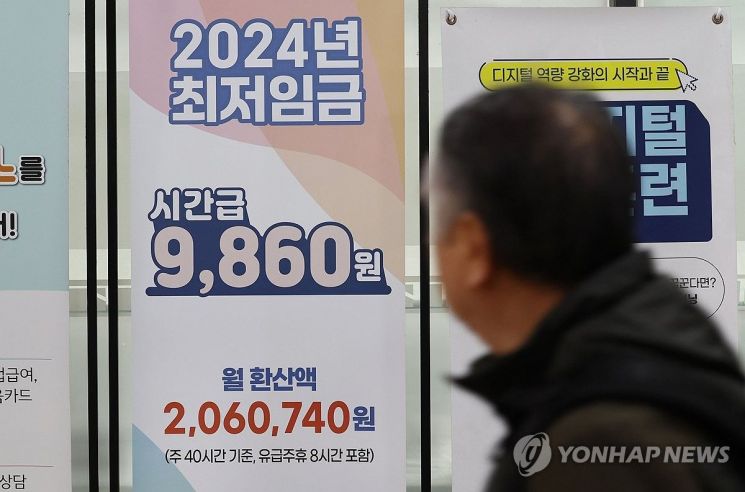
According to the government and labor groups on the 12th, the first plenary meeting of the Minimum Wage Commission for next year's minimum wage deliberations is scheduled to be held on the 21st at the Government Complex Sejong.
Prior to this, the Ministry of Employment and Labor appointed 26 members of the 13th Minimum Wage Commission, whose terms begin on the 14th of this month. Of the total 27 members (9 each from public interest, workers, and employers), 26 have changed except for Ha Heon-je, the standing member of the Minimum Wage Commission who began his term in January. The 27 members will gather for the first time on the 21st to elect the chairperson and officially commence deliberations by receiving the government's request for minimum wage review.
According to the Minimum Wage Act, if the Minister of Employment and Labor requests the next year's minimum wage deliberation by the end of March, the commission must submit the results to the minister within 90 days, and the minister must decide and announce the next year's minimum wage by August 5. Last year's deliberation, which decided this year's minimum wage, ended on July 19, well past the legal deadline of late June. It was the longest deliberation in history, lasting 110 days.
This year, due to member replacements, the first plenary meeting starts 19 days later than last year, and conflicts over the composition of public interest members and sector-specific differential application are expected to be fierce, making the process as challenging as last year. However, to meet the August 5 announcement deadline, a conclusion must be reached around July 20 at the latest, similar to last year.
Labor and management are also preparing their 'lines' ahead of the first plenary meeting. Worker members recommended by the Federation of Korean Trade Unions and the Korean Confederation of Trade Unions plan to hold a workshop on the 14th, which will also serve as a meet-and-greet, to discuss response strategies.
The biggest point of interest in this minimum wage deliberation is whether it will exceed 10,000 won for the first time in history. Last year's deliberation also anticipated surpassing 10,000 won, but after a vote, the increase rate was set at 2.5%, failing to cross the 10,000 won threshold. This year, an increase of just 140 won (about 1.4%) or more would push the minimum wage over 10,000 won.
The labor sector has not yet formalized its demands, but considering last year's consumer price inflation rate of 3.6% and that this year's minimum wage increase rate, decided last year, was the second lowest ever, it is expected to demand a figure well above 10,000 won. Last year, the labor sector's initial demand was 12,210 won. The management side proposed a 'freeze' as their initial demand last year.
South Korea's minimum wage system has been in place since 1988, with the first year's minimum wage in the 400 won range. Since then, it has maintained double-digit growth rates, surpassing 1,000 won for the first time in 1993 at 1,005 won, and exceeding 5,000 won in 2014 at 5,210 won, nearly 20 years later. If next year's minimum wage surpasses 10,000 won for the first time in 37 years since the system's implementation, it will carry significant symbolic meaning.
The gateway to setting the minimum wage amount is the decision on whether to apply sector-specific distinctions. The current Minimum Wage Act allows the commission to set minimum wages differentiated by business type after deliberation. However, except for the first year of implementation in 1988, when the minimum wage was divided into two groups, a single minimum wage has been applied continuously.
The management side has consistently demanded sector-specific application, citing the financial difficulties of small business owners. Last year, they argued that the minimum wage should be set lower for three sectors: chain convenience stores, taxi transportation, and some lodging and food service industries. The labor sector opposes sector-specific application, arguing that it is effectively a dormant provision, contrary to the purpose of the minimum wage, and causes stigmatization by sector. This year, the controversy over differential application flared even before deliberations began, following a report by the Bank of Korea in early March suggesting lowering the minimum wage for the care sector to alleviate labor shortages. In preparation, the two major trade unions have included two representatives of care workers among the worker members.
If the labor and management conflict over sector-specific application remains intense this year, a vote is expected around June to reach a conclusion. Since it is difficult to narrow differences between labor and management not only on sector-specific application but also on the minimum wage level, public interest members, mostly experts, play a key role. Interest in the appointment of public interest members has been high this time as well, with controversy expected as Professor Kwon Soon-won of Sookmyung Women's University, whom the labor sector demanded to resign during the 12th commission, is included in the publicly released list of the 13th commission members. The labor sector demanded his resignation, citing his leadership of the Future Labor Market Research Association, which drafted the labor reform blueprint of the Yoon Seok-yeol administration, accusing him of being "biased toward the government." This dispute led to the disruption of the first plenary meeting last year.
Jeon Ho-il, spokesperson for the Korean Confederation of Trade Unions, said on the day, "Most public interest members are conservative economists who participated in the Future Labor Market Research Association and the Win-Win Wage Commission, which designed anti-labor policies of the government," and especially stated, "The appointment of Kwon Soon-won as a minimum wage commissioner must be immediately canceled."
© The Asia Business Daily(www.asiae.co.kr). All rights reserved.

















