Industrial Research Report... "Red Light for Secondary Batteries and Automobiles, Green Light for Semiconductors and Bio under Trump Administration"
"A New National Trade Strategy Needed Amid International Division of Labor Restructuring Defining the Next 30 Years"
Regardless of who wins this year's U.S. presidential election, containing China has become a constant in American politics, prompting a national research institute to suggest that South Korea must devise new industrial and trade strategies amid a reorganization of the international division of labor that will shape the next 30 years.
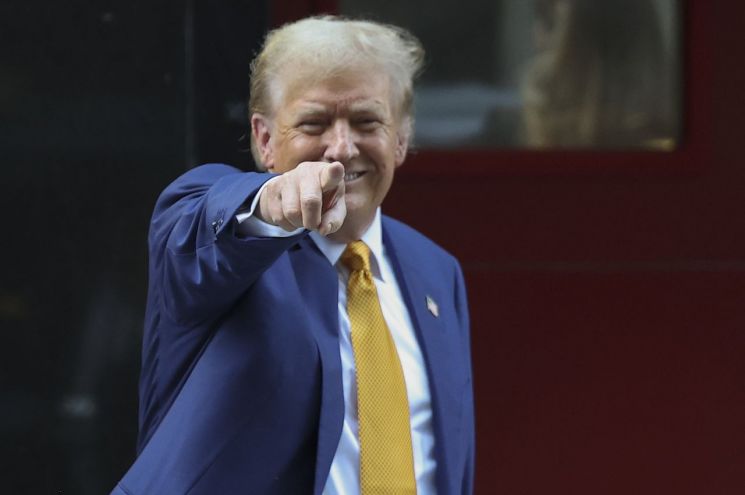
By industry, it is inevitable that South Korean secondary battery companies will have to reconsider their business plans if the Inflation Reduction Act (IRA) is repealed during former President Donald Trump's administration, and the automobile sector, which has seen a significant increase in exports to the U.S., is expected to face pressure for tariff hikes.
On the 12th, the Korea Institute for Industrial Economics and Trade (KIET) published a report titled "Impact of the U.S. Presidential Election Outcome on Korean Industries and Response Measures," defining this U.S. election as a key variable determining the scope and depth of the restructuring of the global manufacturing international division of labor caused by U.S.-China strategic competition. The report analyzed the potential impacts on seven major Korean industrial sectors, including semiconductors, automobiles, and secondary batteries, under different scenarios.
The report first noted that "although the Biden and Trump camps form a clear confrontation, there is a growing convergence on containing China," emphasizing that 'containing China' has become a constant in U.S. domestic politics.
KIET pointed out that "America's chronic large trade deficits are the fundamental cause of manufacturing outflows to Asia, including China, the collapse of the middle class in the 'Rust Belt' over more than 30 years, and the division and turmoil in U.S. domestic politics represented by Trump," adding, "Trump's rise reflects about half of American voters' demands for containing China and reviving domestic manufacturing, and the Democratic Party must also respond to these demands to win."
Regarding industry-specific impacts based on the U.S. election results, KIET expressed concerns that during a Trump administration, red lights would turn on for South Korea's automobile, secondary battery, and bio industries.
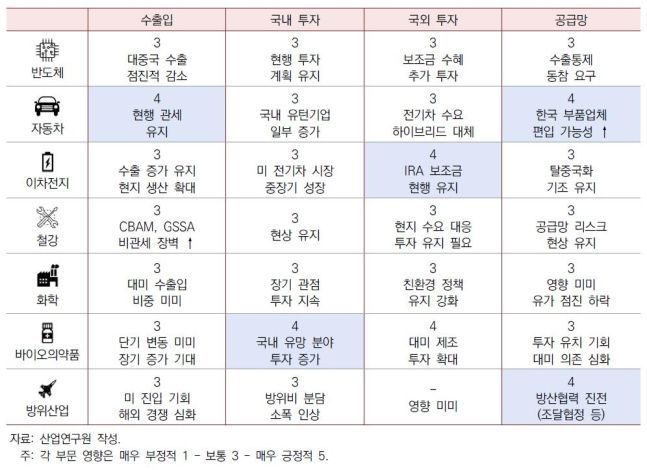
Although South Korean secondary battery companies have made large-scale investments in the U.S. to receive IRA subsidies, KIET predicted that if Trump, who has signaled a 'fossil fuel revival,' wins re-election, there is a high possibility that the IRA will be repealed or production and consumption subsidies reduced as promised, making it inevitable for major Korean secondary battery companies to reconsider their business plans.
KIET also anticipated that with South Korea's automobile exports to the U.S. surging since last year, there is a high likelihood that the U.S. would demand tariff increases on Korean imported cars if Trump is re-elected.
The defense industry, emerging as a new leading export sector in South Korea, is also expected to be affected if Trump returns to power, as an early end to the Ukraine war is likely. KIET stated, "The early conclusion of the Russia-Ukraine war and the Israel-Palestine conflict could lead to a sharp decline in defense industry demand and risks such as renegotiation of defense budgets."
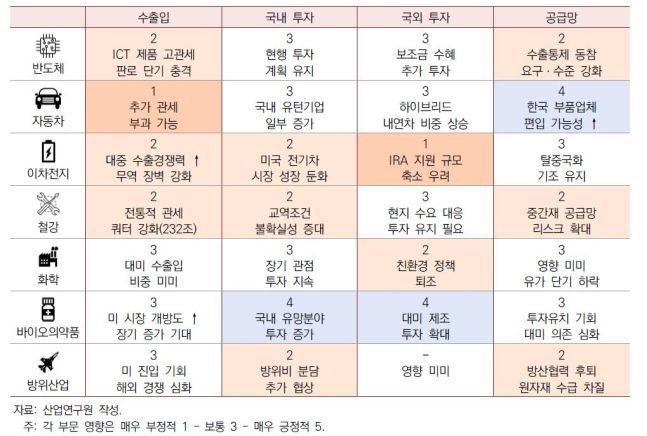
On the other hand, South Korea's largest export industry, semiconductors, is expected to continue receiving U.S. government support regardless of the election outcome. KIET noted, "From the U.S. perspective, China, Taiwan, South Korea, and Japan have all expanded semiconductor mass production capacity through unfair government support, so even the Republican Party generally agrees on semiconductor subsidies," evaluating that "semiconductors have bought time through bipartisan U.S. containment."
However, the report expressed concerns that although South Korea has gained time due to U.S. semiconductor restrictions on China, competition with U.S. and Japanese companies backed by U.S. support will intensify over time.
Additionally, the report mentioned that the U.S. stance against China is gradually strengthening in the biopharmaceutical sector as well, noting the presence of South Korean contract development and manufacturing organizations (CDMOs) and biosimilar companies such as Samsung Biologics and Celltrion.
In the steel sector, the report forecasted increased challenges regardless of whether the Democrats or Republicans win. It predicted, "Under President Joe Biden's re-election, the development of eco-friendly and decarbonization technologies in the steel and chemical industries will become important as non-tariff barriers could be used as a foundational logic," and "If Trump returns to power, traditional trade barriers such as tariff hikes and reduced import quotas by country will be strengthened." The report particularly warned that if former President Trump enacts aggressive restrictions on Chinese steel imports, cheap Chinese steel products could flood the Korean market, emphasizing the need for preemptive countermeasures.
KIET advised that ahead of the U.S. election, South Korea needs to proactively prepare measures to respond to structural global environmental changes. The report stressed, "South Korea, which has developed through an export-driven manufacturing growth strategy, is inherently linked to international politics, so it must hasten to establish a national strategy for the new trade order," and "New competitive advantage strategies by region and major industries must be devised." KIET added, "The past 30 years were a phase of supply chain expansion based on 'economic logic' such as cost and efficiency, but the next 30 years will be a period of restructuring the international division of labor based on 'strategic logic' such as security and sovereignty," concluding that "government organizations and functions must also evolve accordingly."
© The Asia Business Daily(www.asiae.co.kr). All rights reserved.



















