If National Pension Support Increases by 1% of GDP, Income Replacement Rate Can Rise to 50%
Fund Depletion Extended to 2100... Achieving Both Income Security and Fiscal Stability Simultaneously
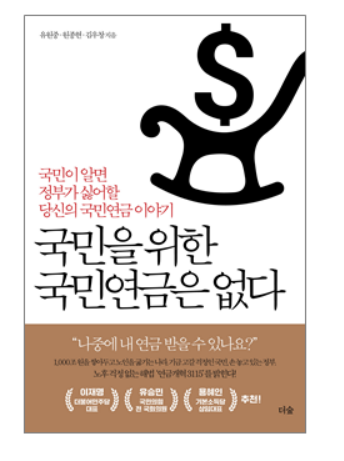
Policy experts, engineering professors, and active journalists who authored 'There Is No National Pension for the People' will hold a book concert on the 13th at the Daishin Finance Center in Jung-gu, Seoul.
The co-authors, KBS reporter Yoo Won-jung, Won Jong-hyun, a specialist member of the National Pension Fund Management Committee, and KAIST professor Kim Woo-chang (former private advisor to the National Assembly Pension Special Committee), will serve as speakers at the book concert to propose pension reform measures that prevent fund depletion, guarantee national income, and achieve fiscal stability.
Pension Reform Measures Proposed by the Authors of 'There Is No National Pension for the People'
The National Assembly Pension Special Committee recently announced the results of a survey conducted on 500 citizen representatives of the Pension Reform Public Deliberation Committee. The main findings show that Koreans prefer a national pension parameter reform plan involving a '13% contribution rate (a 4%p increase) and a 50% income replacement rate (a 10%p increase).' For structural reform measures to enhance intergenerational equity, there was strong support for 'legislating the state's guarantee of national pension payments (92.1%),' 'alleviating excessive pension burdens on future generations through proactive state budget input (80.5%),' and 'strengthening governance expertise and independence to improve fund management returns (91.6%).'
The survey results from 500 citizen representatives conducted by the National Assembly Pension Special Committee's Public Deliberation Committee closely align with the pension reform proposals presented by the authors in the book 'There Is No National Pension for the People,' published earlier this year. To address elderly poverty and ease the burden on future generations simultaneously, the state must play a role by strengthening public pensions through proactive fiscal investment and preemptively mitigating social instability.
Korea’s Pension Support Falls Far Short of OECD Average... Should Not Rely Solely on Citizens
The authors point out that the time to achieve financial stability of the national pension by merely adjusting contribution rates and income replacement rates has already passed. It is no longer appropriate to focus solely on how much citizens pay or receive. They emphasize that pension reform can only be hopeful if fund returns improve alongside proactive government fiscal input.
Korea is virtually the only country that finances its public pension solely through contributors’ premiums and the fund itself. The Korean government’s fiscal input into public pensions accounts for 9.7% of annual government expenditure (as of 2019), which is about half the OECD average of 18.1%. Except for Iceland, Korea has the lowest public pension expenditure ratio among OECD countries. Moreover, most of the expenditure is spent on basic pensions and occupational pension preservation, with only about 0.2% of government expenditure (approximately 1 trillion won) annually allocated to the National Pension.
Analysis Suggests Using 1% of GDP for National Pension Could Prevent Fund Depletion
The pension reform plan proposed by the authors centers on rapid government fiscal input called '3115.' Here, '3115' means increasing the national pension contribution rate by '3%' (from 9% to 12%), injecting fiscal resources equivalent to '1%' of GDP into the national pension, and improving fund management returns by '1.5%p' (from 4.5% to 6% annually).
The authors analyzed that if the national pension contribution rate and income replacement rate are gradually raised to 13% (an increase of 4%p) by 2030, and government fiscal input is increased to 1% of GDP, the national pension fund can be maintained until 2100 even if the income replacement rate is targeted at 50%, which is 10%p higher than the current level.
They argue that if the income replacement rate is raised to 50% and the government decides to increase fiscal input to about 1.5% of GDP, the depletion of the national pension fund could be prevented indefinitely. This offers a clue to resolving the intergenerational equity issue, which has been a core point in pension reform discussions.
The key is to start government budget support before the fund is depleted. For example, the government pension fund for public officials, whose contributors number about one-twentieth of the national pension, is expected to require about 10 trillion won in pension benefit subsidies from the state treasury next year. If government support begins after the fund is already depleted, the national budget will be used directly for retirees’ pension benefits, resulting in a much greater fiscal burden than preparing in advance.
In the case of the national pension, the fund already exceeded 1,000 trillion won this year and continues to grow. The government’s fiscal input is used not for pension benefits but to increase the size of the fund. The earlier the fiscal input is made, the greater the effect can be maximized.

© The Asia Business Daily(www.asiae.co.kr). All rights reserved.
![Clutching a Stolen Dior Bag, Saying "I Hate Being Poor but Real"... The Grotesque Con of a "Human Knockoff" [Slate]](https://cwcontent.asiae.co.kr/asiaresize/183/2026021902243444107_1771435474.jpg)

















