Seongbulsa, Junheungsa, Okryongsaji, Unamsa, and more
Serene Sounds of Scenery at Millennium-Old Temples
Gwangyang City in Jeollanam-do announced that it is proposing a Gwangyang temple trip to explore a thousand years of history and culture in celebration of Buddha's Birthday in the upcoming Buddhist year 2568.
According to the city, Gwangyang has many serene mountain temples and temple sites such as Seongbulsa, Junghungsa, Okryongsaji, and Unamsa, where visitors can enjoy beautiful scenery while purifying and healing their minds.
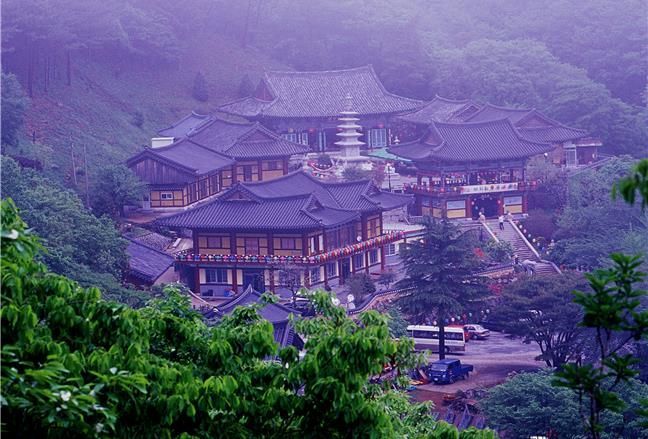
In particular, most temples in Gwangyang have a deep connection with Seongak Guksa Doseon, including Okryongsaji, where he resided and passed away after 35 years.
Seongbulsa, designated as a traditional temple in 2022, was founded by Doseon Guksa. It was destroyed during the Imjin War and only the site remained, but in 1965, Muhyeon Seonsa built a small hermitage with three rooms to practice asceticism, leading to its current state.
Seongbulsa, which can be reached by following the 2km-long Seongbul Valley, has main halls such as Daeungjeon, Gwaneumjeon, Geungnakjeon, a five-story stone pagoda, and a bell pavilion, with the tranquil sounds of nature providing peace of mind.
Junghungsa, a branch temple of Hwaeomsa, was founded by Doseon at Unamsa. It is located within Junghungsanseong Fortress, which has a circumference of 4km, and thus came to be called Junghungsa.
Junghungsa is a historic temple housing great cultural heritage such as the Twin Lion Stone Lantern (National Treasure No. 103), the Three-story Stone Pagoda (Treasure No. 112), and the Stone Jizo Bodhisattva Banjasang (Jeollanam-do Tangible Cultural Property No. 142).
Especially, the Twin Lion Stone Lantern depicts two lions, male and female, pressing their chests together, holding a heavy stone lantern with their front paws and mouths, showcasing dynamic sculptural form and a sense of balance as a masterpiece.
The Twin Lion Stone Lantern was taken out during the Japanese colonial period and moved among Gyeongbokgung Palace, Gyeongmudae, Deoksugung Palace, and the National Museum of Korea, and is currently exhibited at the National Gwangju Museum.
The city has selected the ‘National Treasure Gwangyang Junghungsanseong Twin Lion Stone Lantern Returning to Its Place Project’ as the first fund project of the Hometown Love Donation System and is conducting a signature campaign nationwide to help the lantern return to its original place and shine.
Okryongsaji, which remains only a few foundation stones, is also worth visiting on Buddha's Birthday. Okryongsa was restored by Seongak Guksa Doseon, who trained disciples there for 35 years and passed away, and now only the site remains, showing the aesthetics of emptiness and fullness alongside dense camellia trees.
Unamsa, located at the end of the Okryongsa Camellia Forest trail, is said to have been rebuilt in 1993 by Monk Jonggyeon after being lost without any founding records. In the temple yard stands a majestic 40-meter tall brass Medicine Buddha statue, radiating a mysterious aura.
Other traditional temples designated include Baegunsa and Bogwangsa of the Jogye Order of Korean Buddhism, which are also good temples to visit on Buddha's Birthday.
Kim Seongsu, head of the Tourism Division, said, “The path to temples deep in the mountains is a philosophical journey into the unseen inner self, and these spaces hold history and culture beyond religion,” adding, “Through the colorful lantern parades held on Buddha's Birthday and the beautiful scenery, we hope that the Gwangyang temple trip, each with its own story, will heal the inner selves weary from daily life.”
© The Asia Business Daily(www.asiae.co.kr). All rights reserved.
![Clutching a Stolen Dior Bag, Saying "I Hate Being Poor but Real"... The Grotesque Con of a "Human Knockoff" [Slate]](https://cwcontent.asiae.co.kr/asiaresize/183/2026021902243444107_1771435474.jpg)
















