Nation's First Implementation in 300 Semi-Basement Units Nationwide
Prevented 9 Fire and Flood Accidents in 6 Months
District Mayor Lee Seongheon: "Will Expand Further This Year"
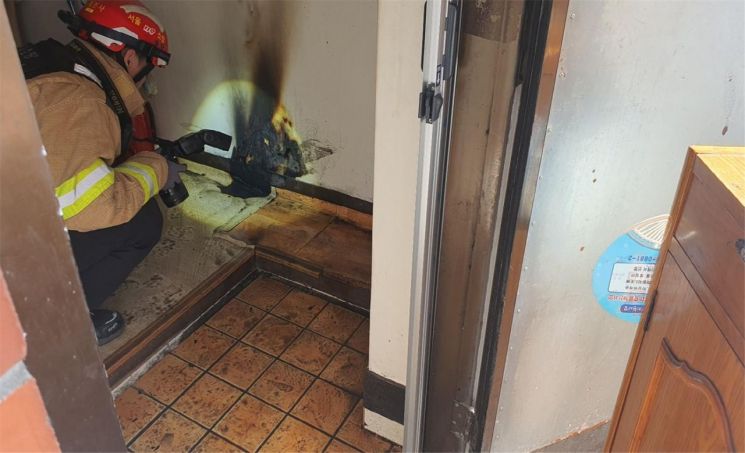 A firefighter dispatched through Seodaemun-gu's Smart Safety Management Service is conducting an on-site investigation of a fire accident. Provided by Seodaemun-gu Office.
#On the 25th of last month, a fire broke out in the shoe cabinet of a 76-year-old dementia patient’s home in Hongje-dong. Fortunately, the sensor detection alerted the district office control center, and after a confirmation call to the homeowner, the control officer reported it to 119, enabling an initial response that prevented the fire from spreading into a major blaze.
On the 4th of last month, a sink malfunction in the home of a 78-year-old resident in Yeonhui-dong caused water to accumulate on the floor, which was detected by a flood sensor, preventing further damage. Earlier, on March 14th, a fire sensor detected smoke caused by burnt fish during cooking at the home of an 85-year-old resident in Hongje-dong. Upon receiving the disaster alert message, the elderly resident quickly went to the kitchen and promptly turned off the gas stove flame.
Seodaemun-gu, Seoul (District Mayor Lee Seongheon) announced on the 10th that the ‘IoT Sensor-Based Smart Safety Management Service,’ implemented for 300 semi-basement households in the district for the first time nationwide, achieved 7 fire prevention cases and 2 flood prevention cases by last month. These results cover a six-month period since November last year.
In households where the Smart Safety Management Service is applied, voice warning broadcasts are issued inside the home through sensor system equipment when disasters such as fire, flooding, or carbon monoxide occurrence happen.
Simultaneously, disaster alert messages are automatically sent to the resident’s mobile phone through the district office control system. Additionally, the district office control officer makes confirmation calls to the affected residents based on disaster information recognized through the ‘Semi-basement Household Control System,’ and if necessary, checks nearby closed-circuit television (CCTV) footage in real time to request response from disaster-related agencies such as 119.
Major fire prevention cases included situations where food was burnt while the resident was distracted during cooking, or smoke was generated by discarded cigarette butts left in indoor trash bins. Major flood prevention cases involved water accumulating inside semi-basement homes due to pump or sink malfunctions, according to the district office.
The district office explained, “Through the implementation of this service, real-time response by the district office and fire department is possible even without resident reports during various disasters, significantly preventing escalation into large-scale disasters.”
District Mayor Lee Seongheon stated, “Based on smart technologies of the Fourth Industrial Revolution, we plan to expand the Smart Safety Management Service this year to enable rapid and effective response to disasters in semi-basement households.”
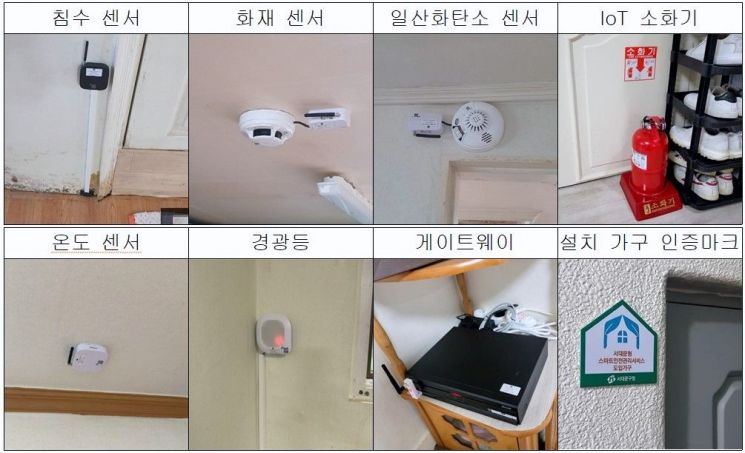 Equipment installed in semi-basement households for the 'Smart Safety Management Service.' Provided by Seodaemun-gu Office.
© The Asia Business Daily(www.asiae.co.kr). All rights reserved.
![Clutching a Stolen Dior Bag, Saying "I Hate Being Poor but Real"... The Grotesque Con of a "Human Knockoff" [Slate]](https://cwcontent.asiae.co.kr/asiaresize/183/2026021902243444107_1771435474.jpg)

















