West Sea Undersea Tunnel Section Fishing Damage Livelihood Rights Guarantee Rally
"53% Decrease Before and After 2022 Blasting Work... Demand for Measures as Fish Stocks Dry Up This Year"
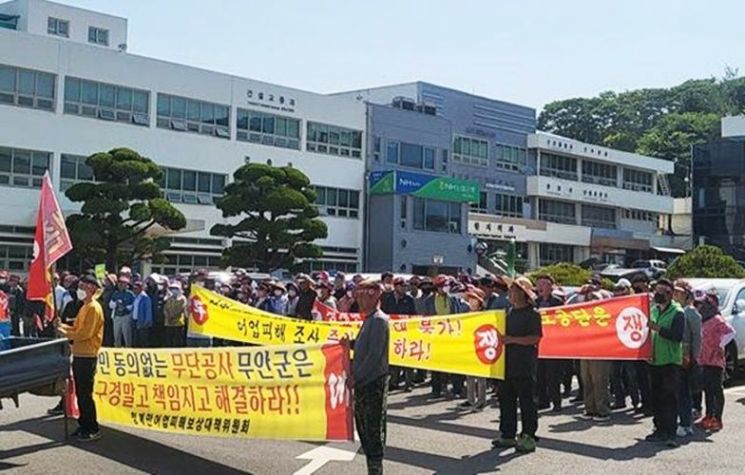
The Cheonggyeman Fisheries Damage Compensation Countermeasures Committee (hereinafter referred to as the Countermeasures Committee) in Muan-gun, Jeollanam-do, held a rally on the 8th, claiming that fish catches have decreased by 70% since the start of the second phase tunnel construction of the Honam High-Speed Railway, demanding guarantees for their right to livelihood.
According to the affected fishermen on the 9th, the sales performance issued by the Fisheries Cooperative Federation (Suhyup), presented by the Cheonggyeman Fisheries Damage Compensation Countermeasures Committee, shows an average sales decrease of about 53% before and after the full-scale underwater blasting construction.
This figure compares the fishing performance of 259 fishermen in Cheonggyeman between last year and the previous three years. In particular, the claim that "there is no catch this year" is expected to spark controversy.
The average annual sales of the fishermen who consigned sales to Suhyup, cited by the Countermeasures Committee as evidence, reached 2.45 billion KRW from 2020 to 2022, but in 2023, it remained at only about 1.15 billion KRW.
The fishermen lamented, "The decrease in auction performance figures is limited to the performance reports of consigned sales through Suhyup, but if we estimate the damage including the barehanded fishing by the majority of fishermen excluded from the reports and the decrease this year, the damage will exceed 70%."
They added, "Regarding noise and vibration caused by the construction, there is research showing that more than 80% of benthic organisms exhibited recognition responses to underwater noise," and argued, "It is common sense that the impact radius exceeds 1 km from the habitat of underwater organisms and that it is fatal to their growth."
They also questioned, "No matter how much it is a national project, fishermen cannot be sacrificed and die," and complained, "Despite the severe fishing damage, the Korea Rail Network Authority and Muan-gun are remaining passive."
They emphasized, "What good is it to release fish? Can fish live in noisy places? It is useless," and added, "Even if the railway opens, noise and vibration will remain. Fundamental countermeasures are urgently needed."
The acceptance of the claim to cancel the shared water surface usage permit consultation, proposed by the fishermen as a fundamental solution, has emerged as a key to resolving the conflict.
In response, a Muan-gun official explained, "Although there is a cancellation clause in the shared water surface usage permit, efforts such as the damage investigation service on noise and vibration conducted by the Korea Rail Network Authority in January have been recognized," and added, "Rather than stopping construction through cancellation, we are striving to find a compromise."
Meanwhile, the second phase of the Honam High-Speed Railway project, commissioned by the Korea Rail Network Authority, connects from Gomakwon in Naju to Imseong in Mokpo City. It is a large-scale national project passing through Muan Airport, spanning 45 km, with a total investment of about 2.28 trillion KRW, running from 2018 to 2025.
Muan = Asia Economy Honam Reporting Headquarters, Reporter Oh Hwan-ju just8440@asiae.co.kr
© The Asia Business Daily(www.asiae.co.kr). All rights reserved.

















