UNIST Professor Kim Ji-yoon's Team Develops World's First Paper-Type Wireless Electrical Stimulation Material
Maintains Functionality When Folded or Cut and Is Biodegradable… Published in Adv. Mater.
A wireless electrical stimulation material that can be folded and cut in real time like paper and customized for individual use has been developed.
 From the top row, left to right: Ji-yoon Kim, Professor Chae-nyeong Cha, first author Researcher Jun-gyu Choi; from the bottom row, left to right: Ah-young Lee, Researcher Sun-tae Kim.
The research team led by Professors Kim Ji-yoon, Cha Chae-nyeong, and Song Myung-hoon from the Department of Materials Science and Engineering at UNIST has discovered the world’s first flexible and biodegradable ‘paper-like electrical stimulation material’ with wireless electrical stimulation functionality. Using nanomaterials, it can be cut or folded without losing its function.
Implantable electrical stimulation devices promote nerve cell activity and tissue regeneration through electrical stimulation. They are useful for treating various diseases such as Parkinson’s disease, Alzheimer’s disease, and neurodegenerative disorders.
However, existing devices rely on rigid electronic components connected in complex ways, making it difficult to freely change their shape and size in real time. They also cause foreign body reactions with soft body tissues, requiring complicated procedures such as removal surgery after treatment.
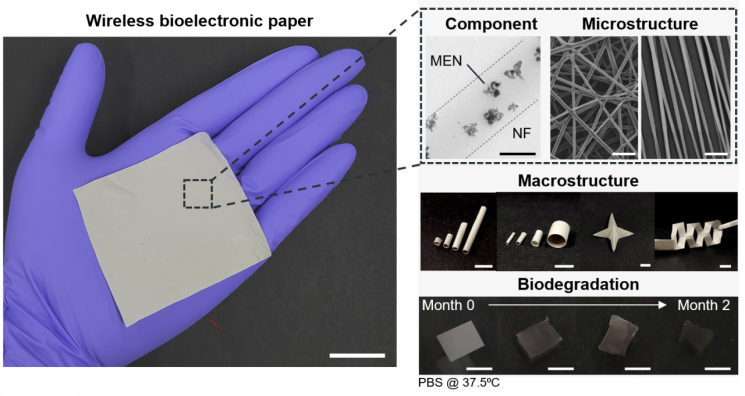
The research team succeeded in developing a ‘paper-like wireless electrical stimulation material’ that can change shape into various forms in real time using functional nanomaterials.
First, they synthesized magnetoelectric nanoparticles that can generate electrical stimulation in response to an external magnetic field. These are ‘core@shell’ type nanocrystals synthesized in a form where cores and shells made of different materials are bonded together.
The synthesized nanoparticles consist of a magnetostrictive core that deforms (strain) in response to an external magnetic field and a piezoelectric shell that converts this deformation into electrical stimulation. Utilizing this characteristic allows wireless electrical stimulation inside the body without a battery.
The research team incorporated the developed nanoparticles into biodegradable nanofibers that decompose easily. This created a paper-like biodegradable porous wireless electrical stimulation material. In vitro experiments simultaneously verified the wireless electrical stimulation effect and the promotion of nerve cell activity.
Dr. Choi Jun-gyu, the first author and postdoctoral researcher, explained, “The developed wireless electrical stimulation material enables precise treatment tailored to each individual’s needs and body characteristics,” adding, “It will simplify treatment processes and provide greater flexibility and versatility in electrical stimulation-based medical applications.”
The produced material is soft and flexible like paper. It can closely adhere to uneven and curved surfaces such as brain models. Even when cut to the required shape, it does not lose its function.
It also demonstrated excellent processability, allowing the production of cylindrical nerve guide conduits with a radius of 400 micrometers to regenerate damaged nerves.
The material can be customized according to the direction of cells that require regeneration. The produced material controls the regeneration direction of nearby neuron cells, aiding more effective treatment depending on the situation.
The biodegradation rate is also adjustable. Its properties can be set according to the required period of electrical stimulation, and it naturally biodegrades after the period ends.
Professor Kim Ji-yoon of the Department of Materials Science and Engineering stated, “The developed material maintains its inherent functions and can freely adjust its size from tens of centimeters, the size of organs, to micrometers, the size of nerve cells,” adding, “It will accelerate the development of effective customized electrical stimulation treatment solutions along with rapid prototype production across a wide range of medical fields.”
This study involved Drs. Choi Jun-gyu, Kim Seon-tae, and Lee Ah-young as first authors. The research results were officially published on May 2 in the internationally renowned journal Advanced Materials and were selected as a cover paper (Inside Back Cover).
The research was supported by the Ministry of Science and ICT and the National Research Foundation of Korea (NRF).
© The Asia Business Daily(www.asiae.co.kr). All rights reserved.


















