Reporter Kang Mijeong Spokesperson Tensions Over Witness Adoption
"Violation of Principle of Non Bis In Idem" Claim Cites Constitutional Court Precedent
At the first hearing of the impeachment trial against Prosecutor Lee Jeong-seop of the Daejeon High Prosecutors' Office (age 53, Judicial Research and Training Institute class 32), Lee's defense argued that "under current law, prosecutors are not subject to impeachment."
Both the petitioner and the respondent fiercely contested whether to admit as a witness Kang Mi-jung, spokesperson for the Party for Justice and Innovation, who is the spouse of Lee's brother-in-law, the whistleblower of Lee's alleged misconduct.
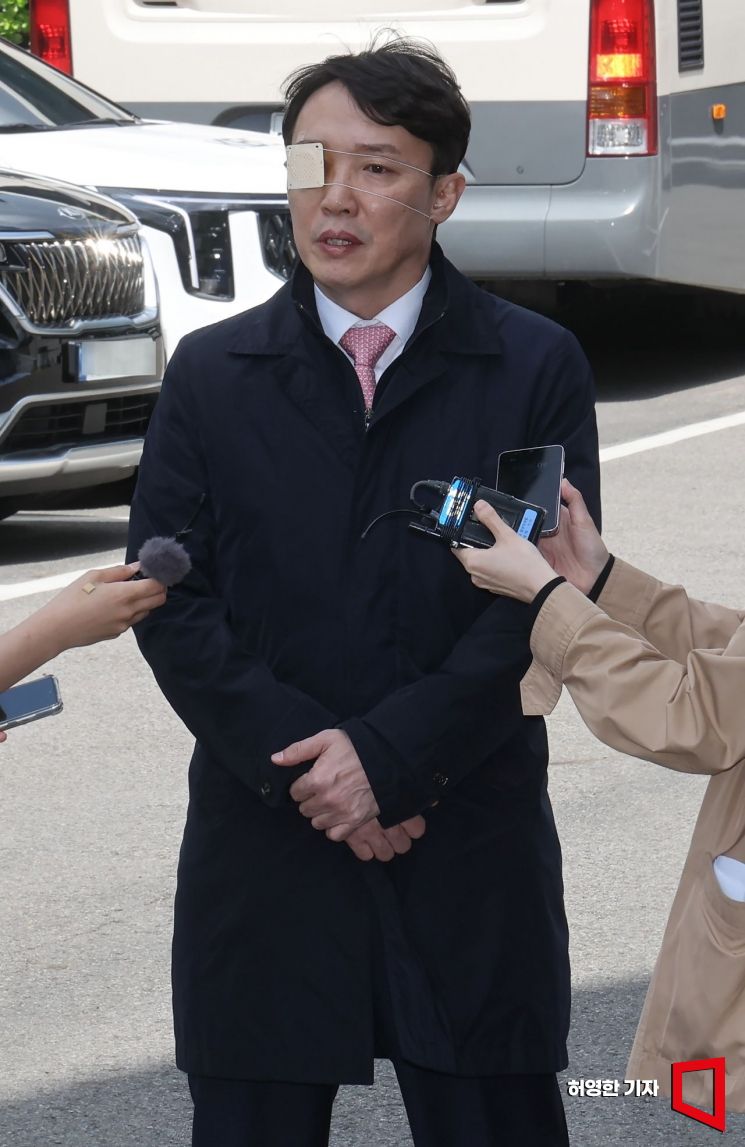 Prosecutor Lee Jeong-seop of the Daejeon High Prosecutors' Office is entering the Constitutional Court in Jongno-gu, Seoul, on the afternoon of the 8th, when the first hearing of the impeachment trial petition case was held, and is stating his position to the press. Photo by Heo Young-han younghan@
On the afternoon of the 8th, the first hearing of the impeachment trial against Prosecutor Lee was held at the Grand Bench of the Constitutional Court in Jaedong, Jongno-gu, Seoul. The hearing proceeded under the direction of Chief Justice Lee Jong-seok of the Constitutional Court, following the order of ▲statement of the gist of the charges by the petitioner ▲response by the respondent ▲presentation of the results of the preparatory hearing and confirmation of the parties' opinions ▲review of written submissions made before the hearing ▲detailed arguments and opinions on the issues based on the preparatory hearing and written submissions ▲decision on the admission of evidence requested before the hearing ▲and examination of the admitted evidence.
First, the petitioner (the National Assembly) presented the gist of the charges, explaining six main allegations against Prosecutor Lee: ▲unauthorized inquiry into the criminal records of ordinary citizens through junior prosecutors ▲receiving favors related to the use of Gangchon Elysian Resort and violation of the Infectious Disease Control and Prevention Act ▲preferential reservations at Yongin Country Club operated by his in-laws and providing favors to senior and junior prosecutors ▲involvement in the investigation of a drug case involving his brother-in-law Jo ▲pre-interviewing witnesses in the Kim Hak-eui bribery case ▲and false address registration for his children, along with specific legal violations.
Next, the respondent's side (Prosecutor Lee) devoted most of their time to arguing that impeachment of a prosecutor under current law is not permitted, rather than addressing each charge in detail.
Seo Hyung-seok, a lawyer from Yulchon Law Firm representing the respondent, stated, "Before specifically responding to the impeachment petition, I would like to briefly explain the uniqueness of this impeachment case."
Lawyer Seo pointed out, "First, the public officials who have been impeached and judged by the Constitutional Court so far are those with constitutional criminal prosecution immunity such as the president, judges who cannot be dismissed through disciplinary procedures, and heads of administrative departments appointed by the president. However, the respondent in this case is a prosecutor who has no criminal immunity and can be removed from office through disciplinary action. Therefore, the extraordinary constitutional measure of impeachment is not necessarily required to remove him from office."
He continued, "Second, the impeachment system aims to restore the damaged constitutional order, and impeachment has been discussed only after the facts regarding the violation of the constitutional order have been somewhat confirmed. However, this impeachment was pushed forward just one day after the allegations were raised."
Lawyer Seo added, "Third, the respondent was in charge of investigating various allegations related to the opposition party leader until his duties were suspended by this impeachment decision. For this reason, there is criticism that impeachment was pushed simultaneously with the allegations against the respondent."
He explained, "I mention these special circumstances first to point out that this impeachment does not align with the essence of the impeachment system established by our constitution from the perspective of constitutional protection."
Lawyer Seo then addressed whether a prosecutor's status can be revoked through impeachment, stating, "The impeachment system is designed to protect the constitutional order and to deprive public officials of their right to hold office, and there must be clear legal grounds specifying which public officials are subject to impeachment." He added, "Unlike judges, there is no provision allowing prosecutors to be removed from office through impeachment."
He noted, "The only relevant provision is Article 37 of the Prosecutors' Office Act (Status Protection), which states that 'prosecutors shall not be dismissed except in cases of impeachment or sentencing to imprisonment or higher,' and that they cannot be dismissed, discharged, suspended, demoted, reprimanded, or retired without disciplinary action or suitability review. However, the existence of impeachment in this status protection provision does not imply that prosecutors can be impeached without explicit provisions on removal of status."
The provision Lawyer Seo referred to is Article 37 (Status Protection) of the Prosecutors' Office Act.
Article 65, Paragraph 1 of the Constitution states, "When the President, Prime Minister, State Council members, heads of administrative departments, Constitutional Court justices, judges, members of the Central Election Commission, the Chairperson and members of the Board of Audit and Inspection, or other public officials as prescribed by law violate the Constitution or laws in the execution of their duties, the National Assembly may pass a resolution to impeach them."
Article 48 of the Constitutional Court Act (Impeachment) enumerates the subjects of impeachment as ▲the President, Prime Minister, State Council members, and heads of administrative departments (Item 1) ▲Constitutional Court justices, judges, and members of the Central Election Commission (Item 2) ▲the Chairperson and members of the Board of Audit and Inspection (Item 3) ▲and other public officials prescribed by law (Item 4).
Unlike judges, prosecutors are not explicitly listed as subjects of impeachment in the Constitution or the Constitutional Court Act, leading to differing views between the petitioner and respondent on whether prosecutors can be considered "other public officials prescribed by law" under Article 48, Item 4 of the Constitutional Court Act.
In other words, the issue is whether Article 37 of the Prosecutors' Office Act (Status Protection), which states that "prosecutors shall not be dismissed except in cases of impeachment or sentencing to imprisonment or higher," can be interpreted as "other laws" under which prosecutors are subject to impeachment.
Until now, constitutional scholars have interpreted that since the Prosecutors' Office Act explicitly regulates impeachment of prosecutors, prosecutors are naturally subject to impeachment. However, on this day, Prosecutor Lee's side argued that the above provision of the Prosecutors' Office Act concerning status protection cannot serve as a legal basis for including prosecutors as subjects of impeachment. They argued that the "status protection" provision and the "status removal" provision should be viewed separately.
Lawyer Seo said, "Similar discussions have occurred in our constitutional history," and argued that even when examining the historical enactment process of the Judges' Disciplinary Act and the Constitutional Court Act, prosecutors cannot be subject to impeachment.
He explained, "The original constitution had a status protection provision for judges stating that 'judges shall not be dismissed, suspended, or demoted except by impeachment, criminal punishment, or disciplinary action.' However, when the Judges' Disciplinary Act was enacted, dismissal, which is stipulated in the constitution, was excluded from the types of disciplinary actions."
Lawyer Seo added, "During the enactment of the Judges' Disciplinary Act, the National Assembly discussed that even if the status protection provision includes impeachment, it may or may not be included when defining types of disciplinary actions, meaning that status protection and status removal provisions are clearly distinct concepts."
He emphasized, "'The argument that there is no need to distinguish between status protection and status removal provisions' is linguistically and legally untenable."
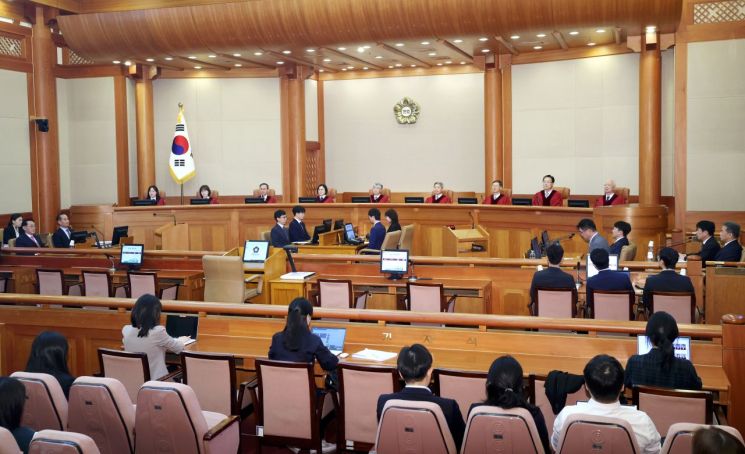 On the afternoon of the 8th, the first hearing of the impeachment trial against Prosecutor Lee Jeong-seop of the Daejeon High Prosecutors' Office was held at the Grand Bench of the Constitutional Court in Jaedong, Jongno-gu, Seoul. Photo by the Constitutional Court
Lawyer Seo argued that the perception that prosecutors are naturally subject to impeachment despite the Constitution and the Constitutional Court Act not explicitly listing prosecutors as subjects of impeachment is a result of indiscriminate political impeachment efforts against prosecutors, which he called a "constitutional distortion."
He stated, "Moreover, when the Constitutional Court Act was enacted in 1988, there was discussion about whether to include the Prosecutor General among those subject to impeachment, but our legislators did not explicitly adopt this."
He continued, "In 1989, the Peace Democratic Party attempted to impeach the then Prosecutor General, but since the current law did not allow the Prosecutor General to be subject to impeachment, they tried to amend the Constitutional Court Act, but this also failed."
He added, "Since then, during the administrations of Kim Young-sam, Kim Dae-jung, and Roh Moo-hyun, impeachment resolutions against several Prosecutor Generals and high-ranking prosecutors have been indiscriminately pushed regardless of political affiliation. As a result, whether prosecutors are subject to impeachment has not been properly examined, and the focus has been only on whether a majority vote in the National Assembly can be secured on the assumption that they are subject to impeachment."
Lawyer Seo said, "Just because impeachment of prosecutors has been pursued indiscriminately over a long period in the National Assembly regardless of political camps does not mean that such accumulated political acts can be equated with normative establishment. The argument that facts and necessity can replace norms is not constitutional interpretation but constitutional distortion."
He appealed, "If the Constitutional Court allows such constitutional distortion, facts and power will be able to replace norms. From this perspective, I hope this court will thoroughly examine this issue."
On this day, Lawyer Seo also raised procedural defects in the process of the National Assembly's impeachment proposal against Prosecutor Lee.
According to the National Assembly Act, an impeachment proposal must be voted on within 72 hours after being reported to the plenary session, and if not voted within this period, it is deemed discarded. However, Prosecutor Lee's impeachment proposal was voted on after approximately 480 hours, according to his defense.
Lawyer Seo explained, "An impeachment resolution is intended to restore a serious constitutional order violation, meaning that members of the National Assembly should deliberate for at least one day and vote within three days at the latest. This impeachment proposal was reported to the plenary session on November 10, 2023, but was not voted on within 72 hours."
He pointed out, "Regarding this, the Constitutional Court has ruled in a jurisdictional dispute case that 'the impeachment proposal was withdrawn before becoming an agenda item after being reported to the plenary session, so it does not violate the principle of non bis in idem,' and we respect this, but the fact remains that it was not voted on within 72 hours after being reported to the plenary session."
Lawyer Seo emphasized, "However, adopting the same content as the withdrawn and discarded impeachment proposal and passing it after 20 days, 480 hours beyond the 72-hour limit, cannot be seen as faithfully fulfilling the constitutional mandate to carefully yet promptly decide on impeachment to uphold the constitutional order and prevent political confusion."
However, Chief Justice Lee mentioned that the Constitutional Court had already dismissed a similar jurisdictional dispute case, ruling that it did not violate the principle of non bis in idem, and asked whether the defense was willing to withdraw their claim that it violated this principle. Lawyer Seo replied that he would clarify his position by the next hearing.
Meanwhile, both sides engaged in a sharp dispute over whether to admit Kang, the spokesperson and spouse of Prosecutor Lee's brother-in-law, as a witness, as requested by the National Assembly.
The petitioner had submitted a witness application to the Constitutional Court on the 2nd, stating, "Ms. Kang directly experienced and witnessed a significant portion of the grounds for impeachment," and "we intend to prove the grounds for impeachment through her testimony."
On this day, petitioner’s counsel Kim Yoo-jung argued, "Based on Kang's statements, there is sufficient possibility that the drug case involving the brother-in-law was covered up due to external influence," and insisted on the necessity of witness examination.
Kim also emphasized that Kang should testify regarding allegations such as "unauthorized inquiry into ordinary citizens' criminal records" and "entertainment of executives of large corporations," as she directly received information about criminal records or attended group meetings.
On the other hand, Lawyer Seo for Prosecutor Lee said, "The procedure needs to proceed swiftly. The court has allowed sufficient time to discuss methods of proof during three preparatory procedures," and questioned whether the petitioner’s witness application after the preparatory procedures had concluded was procedurally appropriate.
He added, "The purpose of the preparatory procedures was likely to conclude discussions on methods of evidence, so this late witness application is questionable."
Lawyer Seo also said, "A witness application is intended to prove facts related to the charges, but since the charges do not specify concrete facts, it is unclear what facts are intended to be proven."
He further stated, "Regarding Kang's status, I will not elaborate on her personal relationship with the respondent, but she is not in a position to have direct contact or experience related to the respondent's official duties. Therefore, we ask that this be taken into consideration as stated in our written opinion."
Lawyer Seo expressed concerns about the credibility of Kang's testimony, noting, "As you know, Kang is already active as a party spokesperson, which raises concerns about the reliability of her testimony. If there are parts that must be proven, submitting a written statement or detailed interrogatories should suffice, especially since she has already given many interviews to the media."
Chief Justice Lee stated that the court would discuss and decide on Kang's witness admission after the hearing.
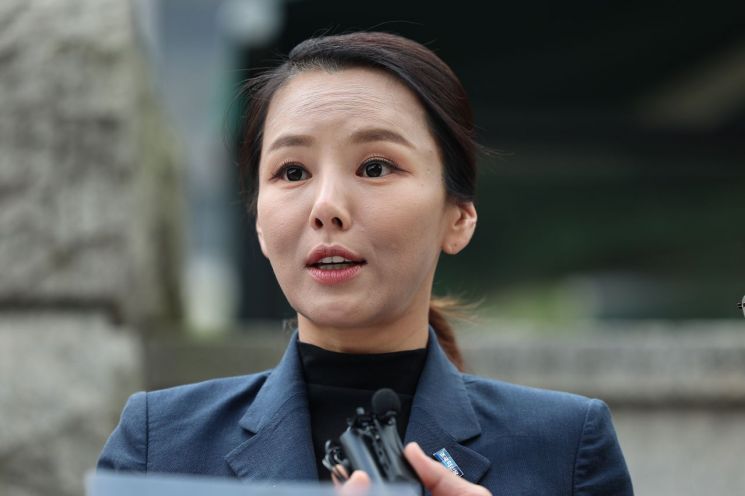 On the afternoon of the 8th, when the first hearing of the impeachment trial request case against Prosecutor Lee Jeong-seop of the Daejeon High Prosecutors' Office was held, Kang Mi-jeong, spokesperson for the Party for Innovation of Korea and spouse of the prosecutor's brother-in-law, entered the Constitutional Court in Jongno-gu, Seoul, and expressed her position to the press. Photo by Heo Young-han
On this day, Prosecutor Lee, attending the public hearing at the Constitutional Court, told reporters, "The prosecution is conducting a thorough investigation, and I am cooperating sincerely. Please wait for the conclusion."
Spokesperson Kang said, "This case is not about the misconduct of one prosecutor. It is a concrete example of prosecutorial dictatorship. The Constitutional Court must confirm that the law applies equally to all citizens and that there are no privileged classes before the Constitution and laws of the Republic of Korea."
Allegations of Prosecutor Lee's misconduct were first raised during the National Assembly audit in October last year, and in December of the same year, an impeachment proposal led by the Democratic Party of Korea passed the National Assembly.
The second hearing is scheduled for 2 p.m. on the 28th at the Grand Bench of the Constitutional Court.
© The Asia Business Daily(www.asiae.co.kr). All rights reserved.



















