79.3% of Households Dined Out with Family Last Year... Down 8.4%p from 2019
Average Monthly Family Dining Out Expense 137,000 Won... Up 15,000 Won from Previous Year
Dining Out Prices Surpass Consumer Prices for 35 Consecutive Months
#Lee Yong-jin (36), an office worker who got married last fall, is deeply feeling the words of his acquaintances who say that Family Month is frightening these days. Since it is the first Parents' Day after marriage, he planned to treat both sets of parents to a meal and even prepare pocket money, which led to considerable expenses. Lee said, "Until last year, I didn't really understand why people said May is tough, but after getting married, it definitely feels different. Fortunately, since we don't have children yet, Children's Day passed without any issues, but hearing stories from friends with kids already makes me scared."
It has been found that in May, Family Month, the number of households reducing dining out is increasing due to high inflation and thinner wallets.
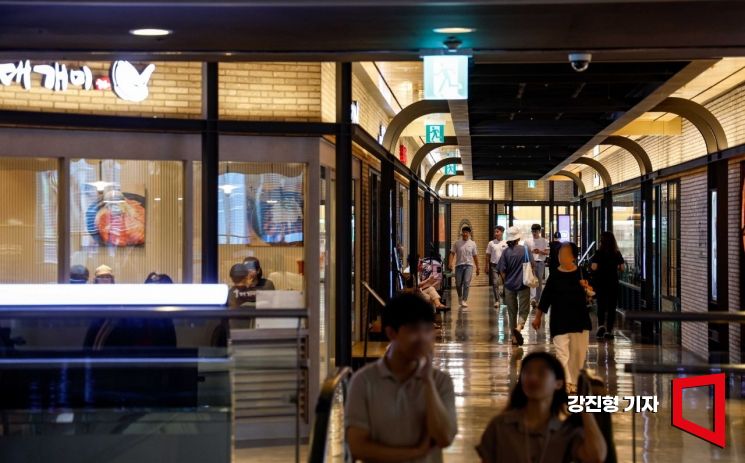
According to the '2023 Food Consumption Behavior Survey' by the Korea Rural Economic Institute on the 9th, the proportion of households that usually dine out as a family last year was 79.3%. This is a 0.2 percentage point increase compared to 79.1% in 2022, but it is 8.4 percentage points lower than the 87.7% recorded before the COVID-19 pandemic in 2019.
The proportion of family dining out tends to be higher with more household members, younger household heads, and higher household income. For households with five or more members, the proportion dining out as a family was highest at 90.2%, while households with 2 to 4 members showed little difference, ranging from 84.2% to 87.7%. Additionally, the dining out rate was high at 86.7% and 87.9% for household heads in their 30s or younger and 40s, respectively, but low at 56.9% for those in their 70s. Furthermore, households with a monthly average income below 1 million KRW had the lowest family dining out rate at 40.0%, while those earning between 4 million and 6 million KRW or more showed higher rates of 83.8%, 86.1%, and 91.1%, respectively.
The main reasons for family dining out were 'to enjoy delicious food (54.7%)', followed by 'because preparing meals is bothersome (18.1%)', 'because it is a special day (13.4%)', and 'because there is no time to prepare food (12.1%)'. Conversely, the most common reasons for not dining out as a family were 'not wanting to go out (due to laziness or anxiety)' at 28.9%, followed by 'because prices are expensive' at 26.3%. Other reasons included 'poor health (14.9%)', 'lack of time or schedule conflicts (12.6%)', 'food tastes bad (11.4%)', and 'crowded places (5.6%)'.
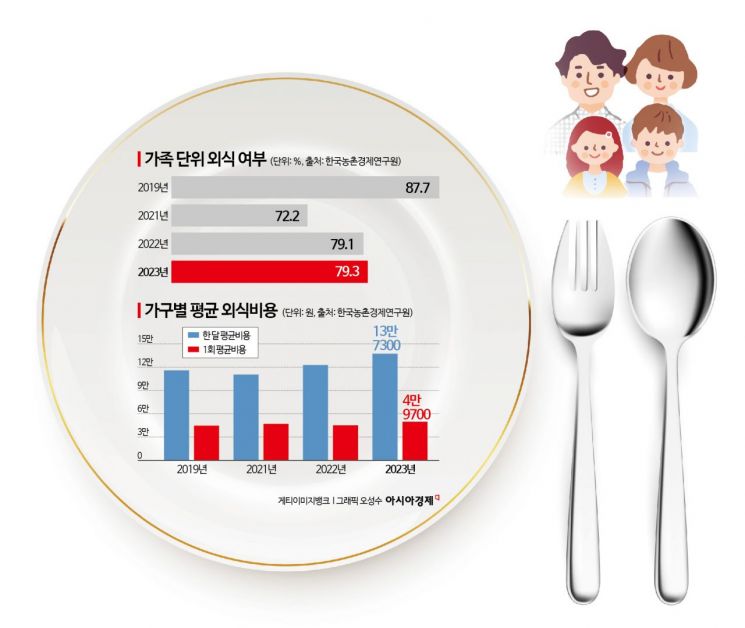
In fact, dining out costs have been rising annually, making families hesitant to dine out. The average monthly family dining out expense for households that responded they dine out was 137,300 KRW last year, an increase of about 15,000 KRW compared to 122,700 KRW the previous year, and 26,900 KRW more than 114,000 KRW in 2021, marking nearly a 25% increase over two years. The proportion of respondents spending 'more than 100,000 KRW' per month accounted for 70.8%, more than two-thirds, followed by '50,000 to less than 100,000 KRW (20.9%)' and '30,000 to less than 50,000 KRW (6.0%)'. The average cost per dining out occasion was about 49,700 KRW, a roughly 10% increase compared to 45,200 KRW in 2022.
Rising dining out prices continue to increase household burdens. According to the National Statistical Portal of Statistics Korea, the dining out price inflation rate last month was 3.0%, exceeding the overall consumer price inflation average of 2.9%. The phenomenon of dining out price inflation surpassing the average consumer price inflation has continued for 35 consecutive months since June 2021. By menu, tteokbokki rose the most with a 5.9% increase compared to the same period last year, followed by gimbap (5.3%), bibimbap (5.3%), and hamburgers (5.0%). Other popular family dining menus such as duck meat (4.0%) and pork ribs (3.1%) also recorded significant increases.
Meanwhile, the preferred dining places for family dining were overwhelmingly 'Korean meat specialty restaurants' commonly called 'gogitjip' (32.5%) and 'Korean restaurants' (31.5%). They were followed by 'Japanese restaurants (9.2%)', 'Chinese restaurants (6.3%)', 'snack bars and gimbap specialty stores (4.7%)', 'pizza and hamburger specialty stores (4.6%)', 'Western restaurants (4.4%)', and 'chicken specialty stores (4.0%)'.
© The Asia Business Daily(www.asiae.co.kr). All rights reserved.
![Clutching a Stolen Dior Bag, Saying "I Hate Being Poor but Real"... The Grotesque Con of a "Human Knockoff" [Slate]](https://cwcontent.asiae.co.kr/asiaresize/183/2026021902243444107_1771435474.jpg)












