The Democratic Party of Korea is entering the primary race to elect the Speaker of the 22nd National Assembly for the first half of the term. The four main contenders are Representative Jo Jeong-sik, who will be serving his sixth term in the 22nd National Assembly, President-elect Chu Mi-ae, and five-term representatives Jeong Seong-ho and Woo Won-shik. As the candidates for Speaker are shaping up to be pro-Myeong (pro-Lee Jae-myung) and veteran lawmakers with multiple terms, a 'clarity competition' to win party members' support is expected to intensify over the next week.
The core of this Speaker election is summarized as targeting 'Myeongshim' (明心, representing the intentions of Lee Jae-myung). Since the party has been reorganized around the pro-Myeong faction, failing to secure their votes means the candidate cannot guarantee election.
The candidate who most openly revealed his Myeongshim stance is Representative Jo. In his announcement the day before, he raised the banner of judging the Yoon Seok-yeol administration. Representative Jo stated, "If the people want, I will boldly do what must be done as Speaker at any time." He also pledged to lead constitutional amendments to lower the number of votes required for a re-vote on the president's veto from the current 200 seats to 180 seats. This essentially means neutralizing the president's veto power, publicly revealing that he would perform the role of a 'Democratic Party Speaker' rather than fulfilling the 'political neutrality obligation' of the Speaker of the National Assembly.
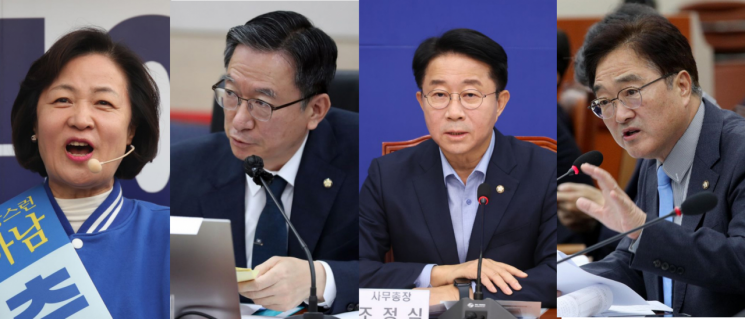
In the case of Representative Woo, he outwardly emphasized, "I will not rely on 'Myeongshim' or 'party sentiment' or any background, but will focus solely on opening the way for public sentiment." However, he also stimulates party support by calling himself "Lee Jae-myung's partner in social reform values." A difference from Representative Jo is his emphasis on negotiation power between ruling and opposition parties. A Democratic Party official said, "Representative Woo, as a former floor leader, has shown achievements at negotiation tables between ruling and opposition parties, so among the candidates, he has the richest communication experience."
President-elect Chu shares the criticism of the Speaker's 'mechanical neutrality' obligation with other candidates but is somewhat cautious about the legislative push by the broad opposition bloc, which holds 200 seats. He drew a line by calling Representative Jo's proposal to amend the constitution to lower the re-vote requirement for the president's veto law to 180 seats a "dangerous idea." He clarified that the appropriate exercise of the president's veto power is a constitutional principle necessary in a presidential system. Representative Jeong Seong-ho also criticized the Speaker's mechanical neutrality obligation but differs in that he supports the Democratic Party behind the scenes. He said, "We must invisibly lay the groundwork for the Democratic Party's victory in the next election."
The Democratic Party will hold the candidate registration on this day and conduct the Speaker candidate primary on the 16th. If no candidate receives a majority in the first round of voting, a runoff will be held between the top two candidates. The candidate who wins the Democratic Party primary will be elected if they receive the majority of votes from the total members present in the National Assembly plenary session's secret ballot.
© The Asia Business Daily(www.asiae.co.kr). All rights reserved.

















