Gungneung Heritage Headquarters Showcases Sangcham Reproduction at Gyeongbokgung
Numerous Intangible Cultural Heritage Artisans Including Somokjang and Duseokjang Participate
From the 8th, the Cultural Heritage Administration's Palace and Royal Tombs Headquarters will showcase a reproduction of the Sangchamui (常參儀) at Sajongjeon, the annex hall of Gyeongbokgung Palace from the Joseon Dynasty. Sangchamui was a simplified morning court meeting where royal officials greeted the king every day.
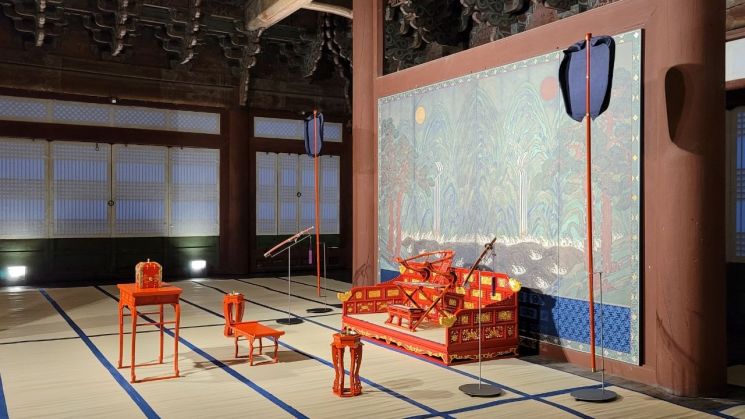
The exhibited reproductions consist of twenty pieces across fourteen types. They were prepared jointly by the Cultural Heritage Administration, Herm?s Korea, and Areumjigi. This is the third collaboration following the reproductions of furnishings in Hamnyeongjeon of Deoksugung Palace and Jeukjodang Pavilion, with many national intangible heritage artisans participating, including master craftsmen of cabinetry, stone inlay, lacquerware, mother-of-pearl inlay, and tea ceremony utensils. A Cultural Heritage Administration official introduced this as "an opportunity to vividly understand the excellence of our traditional craft techniques and the refined court life."
Sajongjeon of Gyeongbokgung Palace was originally built in the 4th year of King Taejo’s reign (1395) but was destroyed during the Imjin War and rebuilt in the 4th year of King Gojong’s reign (1867). It was used as the venue for Sangcham, where the Joseon kings conducted state affairs with their officials. In 2012, it was designated as a national treasure.
All the reproductions are items used during the Sangchamui. The most eye-catching are the ‘Yonggyoui’ (the king’s chair) and the ‘Yongpyeongsang’ (the low table where the king conducted state affairs), which were produced and arranged based on historical verification of the royal throne’s position. Following the Joseon-era etiquette that “the king does not step on bare ground,” a jiui (地衣, a mat woven from sedge) was installed on the interior floor. Anyone visiting Gyeongbokgung Palace can freely view these exhibits.
© The Asia Business Daily(www.asiae.co.kr). All rights reserved.
![Clutching a Stolen Dior Bag, Saying "I Hate Being Poor but Real"... The Grotesque Con of a "Human Knockoff" [Slate]](https://cwcontent.asiae.co.kr/asiaresize/183/2026021902243444107_1771435474.jpg)
















