CEO Score Selects Top 500 Companies by Revenue Last Year
Hyundai Mobis and LG Chem Enter 'Top 10' for the First Time
42 Companies Replaced in One Year
This year, the minimum sales threshold to enter the top 500 domestic companies by sales decreased by 11.7 billion KRW compared to the previous year. This is the first time in eight years, since 2016, that the sales threshold for entering the top 500 companies has dropped compared to the prior year.
On the 8th, CEO Score, a corporate data research institute, selected the top 500 domestic companies based on 2023 sales (consolidated basis; for holding and controlling companies, individual basis) from domestic companies that disclosed financial information through the Financial Supervisory Service's electronic disclosure system. The minimum sales threshold to enter the top 500 companies this year was 1.2969 trillion KRW, down 11.7 billion KRW from last year's 1.3086 trillion KRW.
The total sales of the selected top 500 companies last year amounted to 3902.6459 trillion KRW, a decrease of 157.1085 trillion KRW (3.9%) from the previous year’s 4059.7544 trillion KRW. Operating profit also declined by 33.7887 trillion KRW (14.3%) to 202.2467 trillion KRW from 236.0354 trillion KRW the year before.
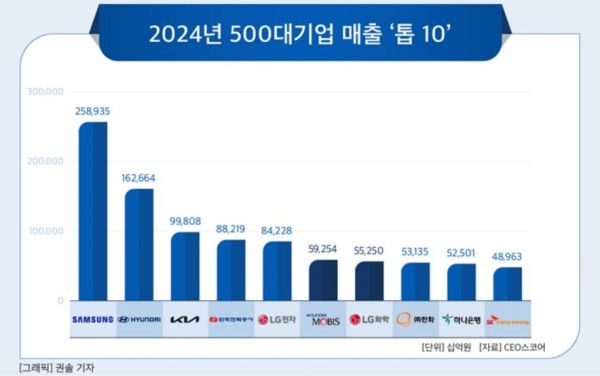
Among the top 10 companies in the top 500, Hyundai Mobis and LG Chem newly entered. Hyundai Mobis rose from 11th to 6th place with sales of 59.2544 trillion KRW last year, an increase of 7.3481 trillion KRW (14.2%) compared to the previous year. LG Chem climbed from 12th to 7th place with sales of 55.2498 trillion KRW, up 3.3849 trillion KRW (6.5%) year-on-year.
On the other hand, GS Caltex dropped from 7th to 11th place as its sales fell by 9.9246 trillion KRW (17.0%) to 48.6075 trillion KRW last year. Meritz Securities also fell from 8th to 13th place with sales decreasing by 9.5893 trillion KRW (16.8%) to 47.4483 trillion KRW.
There were 42 new entrants to the top 500 companies, the same number as the previous year. Notably, travel and leisure-related companies such as Incheon International Airport Corporation, Jeju Air, CJ CGV, and Kangwon Land re-entered as they recovered from the impact of the COVID-19 pandemic.
Additionally, secondary battery material company STM, electric vehicle parts company LG Magna Powertrain, and electronic payment-related companies Naver Financial, Viva Republica, and KG Inicis also made significant advances to newly enter the top 500.
Mirae Asset Capital became the largest shareholder of Mirae Asset Securities last year by exceeding a 30% voting rights stake and recognized 100% of its subsidiary’s sales, entering the top 500 at 67th place. SK Eco Engineering joined the top 500 for the first time last year after acquiring part of the business operated by SK Eco Plant in February 2022 and submitting its audit report. Dongkuk Steel, Kolon Mobility Group, and Hyundai Green Food entered the top 500 after being established through spin-offs.
Conversely, Dongkuk Holdings, KG Eco Solutions, OCI Holdings, Hyundai Gf Holdings, DN Automotive, and Korea Kolmar were excluded from the top 500 this year as they converted to holding companies and changed their sales basis from consolidated to individual.
Fourteen companies, including Daeyu Atech, LT Sambo, SD Biosensor, and Korea Racing Authority, also failed to enter the top 500 as their sales sharply dropped below 1 trillion KRW. LT Sambo was spun off from its holding company LT, and Korea Racing Authority and IBK Pension Insurance saw sales declines due to changes in accounting standards.
The company that rose the most in ranking within the top 500 compared to last year was Ecopro EM, a subsidiary of Ecopro BM. Ecopro EM, a cathode material joint venture established by Ecopro BM and Samsung SDI, increased its sales by 1.7659 trillion KRW (88.1%) to 3.7713 trillion KRW last year, jumping 153 places from 346th to 193rd.
Kakao Bank rose 136 places from 409th to 273rd, Hana Financial Group climbed 130 places from 465th to 335th, Hana Card moved up 105 places from 442nd to 337th, and Gyeongnam Bank increased 96 places from 356th to 260th.
The company with the largest drop in ranking was Junghung Construction. Junghung Construction converted to a holding company in January last year, changing its sales basis from consolidated to individual, causing it to fall 418 places from 75th to 493rd.
Additionally, insurance companies such as Fubon Hyundai Life Insurance (down 285 places), KDB Life Insurance (down 232 places), DB Life Insurance (down 146 places), and Tongyang Life Insurance (down 139 places) saw significant ranking declines due to changes in sales calculation standards following the introduction of new accounting standards IFRS 9 and IFRS 17 last year.
© The Asia Business Daily(www.asiae.co.kr). All rights reserved.


















