26th Hampyeong Butterfly Festival Commemorative Special Exhibition
Noyeoun, Im Namjin, Heo Sooyoung, Hwang Seontae's 'Comfort' Prescription
Clear Social Criticism, Opportunity for Awareness of Human Contradictions
Fresh Works Embracing a 'Warm Heart' in Modern Society
Art's Positive Role in Comforting and Healing Tired Daily Minds
The Jeonnam Hampyeong County Art Museum is currently exhibiting over 50 works under the theme
Four emerging artists?Noyeoun, Im Namjin, Heo Sooyoung, and Hwang Seontae?each present new and refreshing works that evoke everyday life and landscapes with warm perspectives . Their works richly embody human life, history, and inner worlds.
The works by the artists participating in the Reproduction and Consolation exhibition were created not with a cold, critical eye on modern society but with a warm heart. The paintings strongly caution against surrounding injustices while also containing faith that gently comforts weary hearts.
In an era where selfish criticism and harsh judgment run rampant, consolation comes first. While awareness and testimony of reality are necessary, the consolation and healing of hearts tired by daily life is the positive function of art.
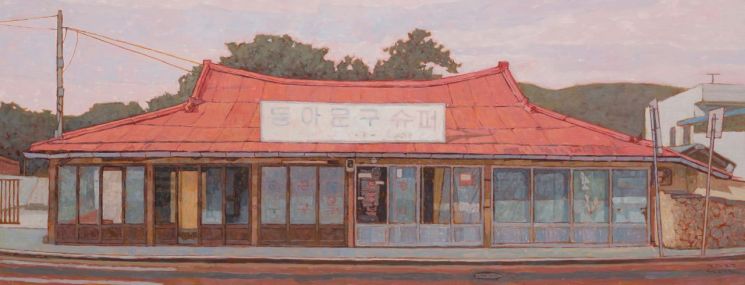
Noyeoun: Landscapes Painted with Traces of People
Artist Noyeoun often paints barbershops, supermarkets, laundromats in the outskirts of cities, and quiet rural buildings. The motivation for frequently choosing these subjects is "after witnessing the disappearance of the neighborhood where he lived due to redevelopment."
He paints landscapes that have so far escaped the winds of development as if recording them. The houses and alleys he paints evoke memories of the past. Old buildings, worn household items, vegetables planted in leftover land, and flowerpots made from Styrofoam boxes all warmly bear traces of life. He makes viewers feel comfort and attachment in landscapes where the traces of many people have accumulated in old spaces.
He says, "In the alleys, I feel and think about many emotions such as loneliness, longing, comfort, solitude, and warmth. Along with various emotions, I want to convey the warmth and comfort given by the traces of people."
As the artist says, the first emotion felt upon seeing the paintings is 'warmth.' The urban landscapes depict the childhood scenes of ordinary people, and the quiet rural houses show nostalgic memories of visiting grandparents during school vacations.
The warmth and comfort of landscapes depicting nostalgic places owe much to the colors held in the works. Urban landscapes can be expressed in various colors: the lights of dark night streets, gray cities, or bright and sophisticated hues.
The colors chosen by the artist are cozy and warm, as if the warm light of the evening glow embraces the buildings. He intentionally expresses colors so that the warmth of people seeps through, replacing the dark colors that old buildings carry as traces of time.

Im Namjin: 'Simple and Clear Composition'... The 'Power' of Deep and Quiet Colors
Since his first solo exhibition in 2007, artist Im Namjin has been constantly evolving. His paintings borrowing traditional Buddhist iconography to depict human figures exposed the absurdity of society.
From the 2018 exhibition onward, his works realized desolate and cool landscapes. The scenes showing blue skies, daytime moons, utility poles, wires, and birds perched on wires evoke loneliness. While his earlier Buddhist paintings had sharp, satirical views toward the world, these works faithfully reproduce the artist’s emotions communicating with objects and landscapes.
He explains, "Through countless tangled electric wires and cables, the blue sky and thin daytime moon, and at night the streetlights and moonlight, the solitary utility poles standing their ground appeared as life scenes connected to the world and the human figures around me."
His sentiment flows like a tide, leaving behind the image of a young artist who lost his fighting spirit and briefly hid during rough times, revealing his deep, original emotions. At that moment, he expresses communion with the surrounding landscape.
His works resemble the dawn sky that stings the nose in the cold winter wind. The blue sky and moonlight intertwine sorrow and loneliness yet fill the heart with a cleansing fullness.
The large segmented areas and the dyed paper-like colors in his compositions enhance the completeness of the works. The close-up envelopes shown in his recent 'Yeonseo' series transcend formal simplicity, revealing a duality of deep stories contained within that simplicity, which is highly captivating.
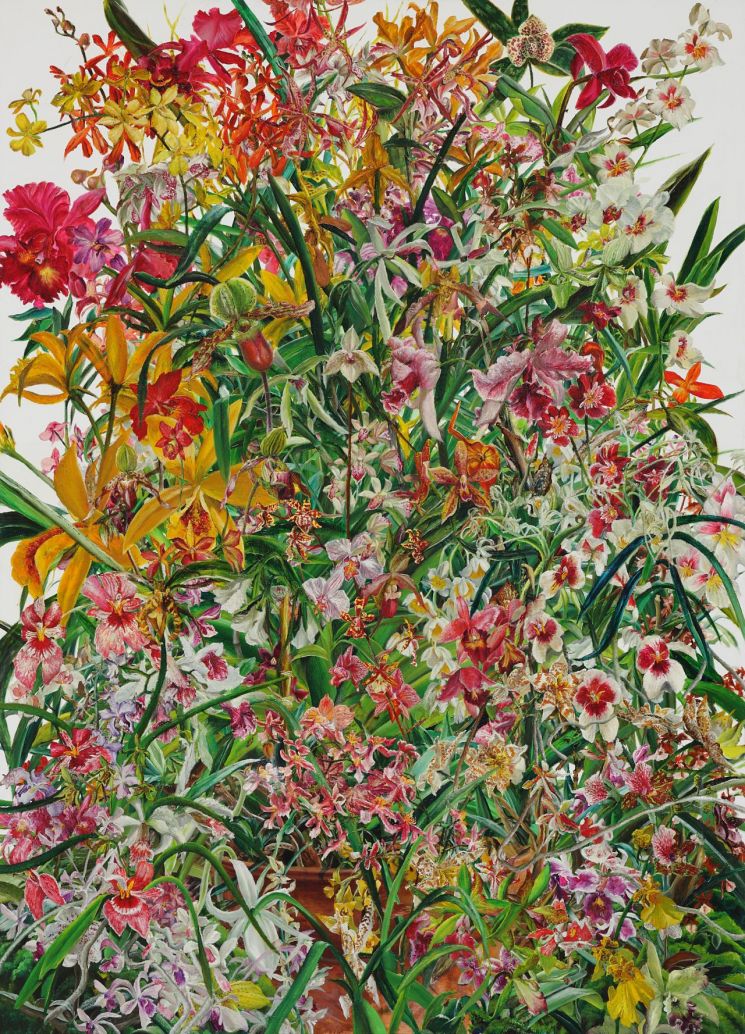
Heo Sooyoung: Overlapping and Layered Images... "Always Amazed by the Labor"
He often copies impressive sentences from books and engraves them in his heart.
Artist Heo Sooyoung transfers images from well-made photo books onto canvas as if transcribing them. Like flipping through a botanical guide one page at a time, he densely fills a single canvas with plant images.
While some works fill the canvas with images, others fill it with time. He creates works by layering changing landscapes of spring, summer, autumn, and winter in one frame, completing a single piece.
He describes his paintings as "primarily characterized by layering many things. Painting over what is already painted, and painting again." The reason for layering is that simply painting is just reproducing the landscape and does not yet become the painting he desires.
"Repeated overpainting and layering accumulate paint thickness like a knot containing the feelings and thoughts at the time of painting," he adds. Such laboriously accumulated reproductions are the result of the artist’s many emotional masses and are what he finally believes to be a painting.
His works make us reconsider that art is about painting. When the traces of a skilled person’s concentrated labor are visible, people are moved. This fact is reaffirmed.
Heo Sooyoung hopes art moves people. He wishes his paintings to remain such works, and as a means, he says, "I add painting to painting. I push it to the point where I can no longer paint and then let go."
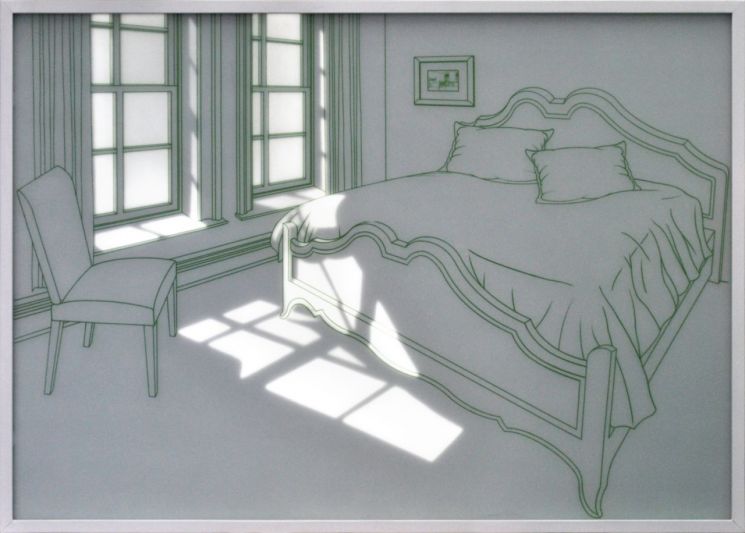 Hwang Seontae, Room with Afternoon Sunlight, 2011, 142x102x5cm, tempered glass, sanding, transfer film, LED.
Hwang Seontae: The Temperature of Consolation Given by Light
Hwang Seontae’s works are completed through light. Ordinary indoor spaces around us and objects such as sofas, chairs, flowerpots, and beds are depicted with lines. The works are created with LED light coming through windows.
The foggy texture of sanded translucent glass and objects drawn with green lines of uniform thickness appear fragile and emotionless.
However, the moment the power is turned on, warm light fills the space, providing viewers with the coziest and most stable environment, creating a surprising contrast. The moving beams of light flow like streams or raindrops.
He says that when there is light, objects are revealed, but what is revealed by light is not the object itself. It is "the countless things surrounding the object faintly blooming through the light, and the world of intuition revealed through the window."
Although he does not specifically explain the results of light giving life to objects, he pursues a new world of light. The comfort and warm temperature his works provide are attractive. Those who have experienced rest in a lit room recall small, happy everyday memories.
Light allows us to perceive the shape and color of objects, and historically, light has played a decisive role in changing the paradigm of art history. Many masterpieces owe their brilliance to light. He effectively uses real light sources rather than painted light, transforming technical light into psychological light, adding new light effects to art.
"An Exhibition of Consolation and the Desire to Console"
At the
The social role of art is more important than anything else. These works uniformly face reality head-on. They provide an opportunity to recognize the artists’ clear social criticism and human contradictions.
Nevertheless, the desire to be comforted by art in reality cannot be stopped. The word 'consolation' feels like a prescription given after the best diagnosis of reality. Just as prescriptions vary according to constitution and symptoms, the participating artists Noyeoun, Im Namjin, Heo Sooyoung, and Hwang Seontae each have different prescriptions.
Noyeoun’s warm-colored landscapes evoke various human traces that summon past memories and bring smiles. Im Namjin’s cool yet deeply dyed paper colors and lyrical images carry a paradoxical fullness born of deep longing and loneliness.
Heo Sooyoung’s works, which pour pure passion into labor, resonate with the image of a person giving their best. Hwang Seontae’s warm light remains a weapon to console us living through difficult times.
Besides the positive function of 'consolation,' the completeness and artistic achievements of the four artists’ works are also noteworthy.
In the fresh spring of May, be sure to visit the special exhibition at the museum located in Hampyeong Expo Park to receive heartfelt consolation.
© The Asia Business Daily(www.asiae.co.kr). All rights reserved.
![Clutching a Stolen Dior Bag, Saying "I Hate Being Poor but Real"... The Grotesque Con of a "Human Knockoff" [Slate]](https://cwcontent.asiae.co.kr/asiaresize/183/2026021902243444107_1771435474.jpg)


















