Special Cuts Also Covered in Fat
Jeju Province promised countermeasures in response to the controversy over 'fatty pork belly' sparked in Jeju, but reviews of fatty pork belly continue to surface.
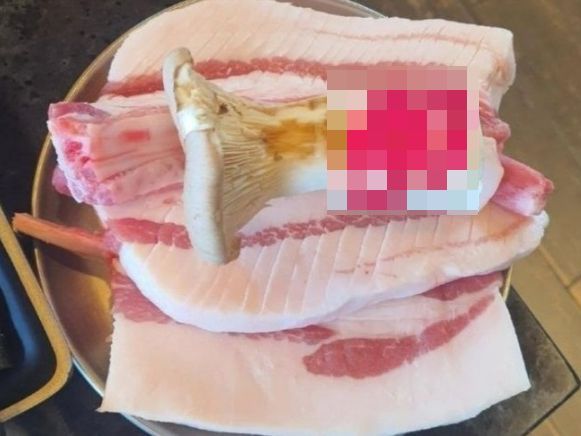 A photo of pork mostly consisting of fat was posted on an online community under the title "Jeju Island Meat."
 [Photo by BobaeDream capture]
On the 3rd, a photo of pork with mostly fat was posted under the title 'Jeju pork' on the online community Bobae Dream. The poster wrote, "Is this neck meat or just a lump of fat... it's really quite excessive," and added, "I won't go again." Neck meat (nabit-sal) is a special cut from the pig's neck area, yielding about 400g per pig. In the photo, the nabit-sal, despite being from the neck area, had such a high fat ratio that it was difficult to find any lean meat.
The post was met with disbelief. Comments included, "It looks like they cut fat parts into the shape of nabit-sal and served it," and "Are they seriously expecting us to grill and eat that? I don't understand."
Earlier, on the 29th of last month, Mr. A, who has been living in Jeju for a year, visited a famous pork belly restaurant in Jeju and publicized the fact that the pork belly served had a high fat content. Photos posted by Mr. A showed that over 98% of the pork belly on the grill was fat. When Mr. A complained to the staff, the employee responded, "This is actually a lot of meat," and Mr. A ended up paying about 150,000 KRW.
As the controversy grew, Jeju Governor Oh Young-hoon decided to conduct on-site inspections targeting about 70 pork specialty restaurants and livestock distribution companies in Jeju to prevent recurrence. However, his remark that "differences in food culture should also be taken into consideration" drew criticism with questions like, "Is Jeju's food culture only about eating fat?"
The Ministry of Agriculture, Food and Rural Affairs created and distributed a 'Pork Belly Quality Management Manual' last October, which includes recommended fat content standards for pork belly. According to the manual, small-packaged pork belly should have fat layers no thicker than 1 cm, and five-layer pork belly (ogyeopsal) no thicker than 1.5 cm. It is recommended to remove or discard excessively fatty parts. However, fatty pork belly with excessive fat continues to be served frequently, raising criticism that the manual is merely a recommendation without enforcement.
© The Asia Business Daily(www.asiae.co.kr). All rights reserved.

















