Chinese Company Using Hansan Postpartum Care Center Model
Received 130 Billion KRW Investment Last Year, Expands to Singapore
In a recent research report published by the Ministry of Economy and Finance's Korea Institute of Child Care and Education titled 'Market Survey and Support Measures for Activating the Overseas Expansion of Postpartum Care Centers,' it was predicted that a controversy over the origin ('Wonjo') of Korea's postpartum care center culture could arise with China.
According to the report on the 6th, postpartum care centers emerged in Korea in 1996 as it became difficult to receive family support due to the rise of nuclear families. After Chinese mothers who used these postpartum care centers established the 'Xinmama Postpartum Care Center' in Beijing in 1999, the business rapidly expanded, and currently, China has more postpartum care centers than Korea.
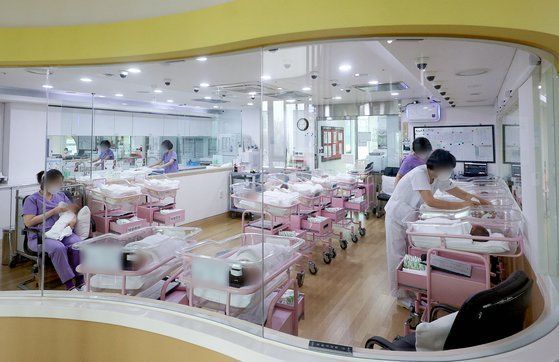 Nurses and staff are caring for newborns in the neonatal room of a postpartum care center in Seoul.
 [Photo by Yonhap News]
Since 2016 (China 1,640 centers · Korea 612 centers), the gap has widened significantly, and last year, the number of postpartum care centers in China reached 5,454, more than 11 times that of Korea (469 centers). The market size of postpartum care centers in China was estimated to be around 1.8 trillion KRW in 2021. Considering that China's population (approximately 1.425 billion) is 28 times larger than Korea's (approximately 51.75 million), the growth trend of the Chinese market is expected to continue.
China has renamed 'postpartum care centers' as 'Yuez Center' and is promoting the postpartum care center culture as if it were a unique cultural facility of its own. The Yuez Center name is derived from 'Zuo Yuezi,' a Chinese tradition where mothers stay at home and rest for a month after childbirth.
The report stated, "Most postpartum care centers in China emphasize themselves as independent cultural facilities created by Chinese companies that only copied Korea's operational know-how," and added, "There is a high possibility that this will lead to a dispute over the origin with China in the future."
This is similar to the controversy in the 2010s where Korea's kimchi was called 'Pao Cai (泡菜)' in China and manipulated as if it were a unique Chinese food.
China is not only localizing 'postpartum care centers' but also exporting corporatized postpartum care centers worldwide. The famous Chinese postpartum care center chain, Saint Bella Postpartum Care Center, has been operating a hotel-style postpartum care center in Singapore since October last year, having received an investment of about 130 billion KRW.
This company received funding not only from Chinese capital but also from Korea's Mirae Asset Investment. The report pointed out that Chinese postpartum care center companies are "likely to emerge as potential competitors to Korea in the global market."
Korea also included postpartum care centers in the 'Top 10 Promising Small and Medium Overseas Expansion Businesses' in 2010 to solve the chronic service trade deficit and encouraged exports, but has yet to achieve significant results.
One of the reasons for the lack of success is the shrinking domestic market due to the low birthrate and the fact that most domestic postpartum care centers are not corporatized.
Lee Jae-hee, a research fellow at the Korea Institute of Child Care and Education, advised, "Before China registers 'Yuez Center' with the World Intellectual Property Organization, Korea should register 'Postpartum Care Center' to secure intellectual property rights." The countries identified as key export targets are Indonesia, Vietnam, and Mongolia, which are familiar with Hallyu (Korean Wave) culture.
© The Asia Business Daily(www.asiae.co.kr). All rights reserved.












