'Juche 112 Year' Era Also Used
Illegal Procurement Parts Assembled and Transported to Russia
It has been reported that American-made computer semiconductors manufactured in March last year were used in North Korean missiles employed by Russia in its attack on Ukraine.
On the 5th (local time), the British BBC reported that an analysis of North Korean missiles used by Russia in its recent attacks on Ukraine revealed that North Korea illegally procured American and European components by evading sanctions. It was pointed out that North Korea produced missiles within a few months and sent them to Russian troops on the front lines.
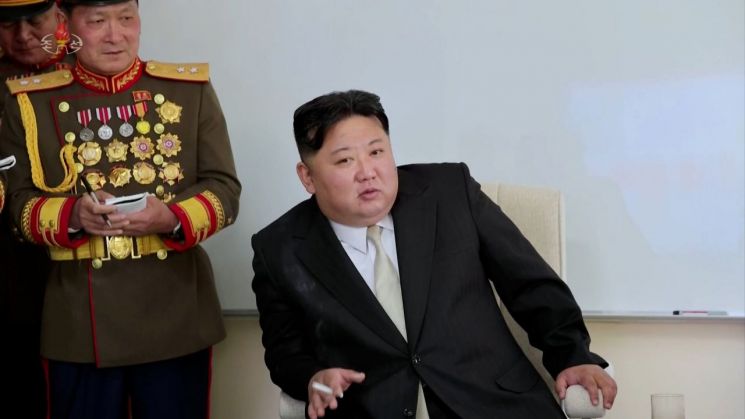 North Korean State Affairs Commission Chairman Kim Jong-un visited Kim Il-sung Military University last month
This raises concerns that North Korea’s weapons supply chain, which imports foreign components by evading international sanctions to manufacture weapons and exports them to Russia, is more robust than expected. However, there are also claims that many of the foreign components used in the missiles are counterfeit rather than genuine.
BBC reported that Ukrainian weapons investigator Kristina Kimachuk discovered this during the analysis of missile debris with unusual shapes that had not been seen before.
After analyzing hundreds of pieces of debris, it was found that many parts of the missile could only have been made with the latest foreign technology. There was even a computer chip made in the United States in March 2023. The missile also bore the number “112,” which corresponds to the year 2023 in North Korea’s Juche calendar.
The British think tank Conflict Armament Research (CAR), which studies manufacturing processes by recovering weapons used in war, and experts from the UN Security Council’s North Korea sanctions committee concluded that the missile belongs to the Hwasong-11 series.
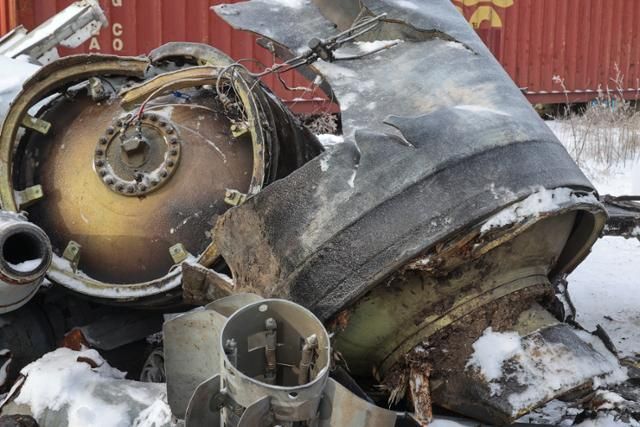 A part of a missile presumed to be made by North Korea fell in Kharkiv, Ukraine, on January 6. [Photo by Reuters/Yonhap News]
Deputy Director Damian Splyterskyi stated, “Despite nearly 20 years of severe sanctions, it is most astonishing that North Korea still manages to secure everything needed to produce weapons at an incredible speed.”
Joseph Bermudez, a North Korea expert at the UK think tank Royal United Services Institute (RUSI), said, “I never dreamed that North Korean ballistic missiles would be used to kill people on European soil.”
Earlier, CAR released findings from an investigation into the origins of about 290 components found in the missile debris, revealing that products from 26 companies across eight countries were included. American companies accounted for 75.5%, and 90% of the components were made in the US, Europe, or Japan.
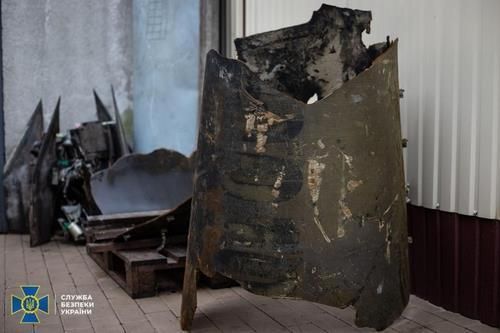 Photo of missile fragments that Ukraine released as evidence of North Korean weapons being used in their country.
 [Photo by Security Service of Ukraine (SBU)]
BBC reported that the missile launched on January 2, which Ukraine dismantled, appears to be the Hwasong-11, North Korea’s most sophisticated short-range missile capable of flying up to 700 km.
BBC pointed out, “Although there are recent rumors that Kim Jong-un is preparing for nuclear war, the more immediate threat is North Korea’s (weapon manufacturing) capability, which fuels the current war and increases global anxiety.”
Meanwhile, regarding sanctions, Jeffrey Lewis of the Middlebury Institute of International Studies in the US predicted, “While it may be possible to make it more difficult and inconvenient for North Korea to purchase (components), it will not be able to stop missile production.”
He added, “The advantage of North Korean missiles is that they are very inexpensive, allowing for mass launches that can overwhelm air defense systems,” estimating that North Korea can produce hundreds of missiles annually.
© The Asia Business Daily(www.asiae.co.kr). All rights reserved.



















