Yangcheon-gu, Yongsan-gu, Dongjak-gu Inspect Rainwater Drainage Facilities to Prepare for Summer Heavy Rain
Lee Gijae, Yangcheon-gu Mayor, Inspects Sinwol Rainwater Storage Facility Capable of Storing Up to 320,000 Tons of Rainwater During Hourly 100mm Downpours... Yongsan-gu Conducts Dredging from Ichon-ro Adjacent to Yongsan International Business District Site to Nearby Side Streets... Dongjak-gu Cleans All Rainwater Inlets in 15 Flood-Prone Neighborhoods Starting from Kkachi Children's Park in Sadang 1-dong
On May 4, a day before Children's Day (May 5), the temperature in Seoul rose to 28℃, showing midsummer weather.
With midsummer weather appearing in early May, abnormal summer weather phenomena are also expected.
Accordingly, Seoul's autonomous districts are conducting inspections of flood control facilities in preparation for concentrated summer heavy rains.
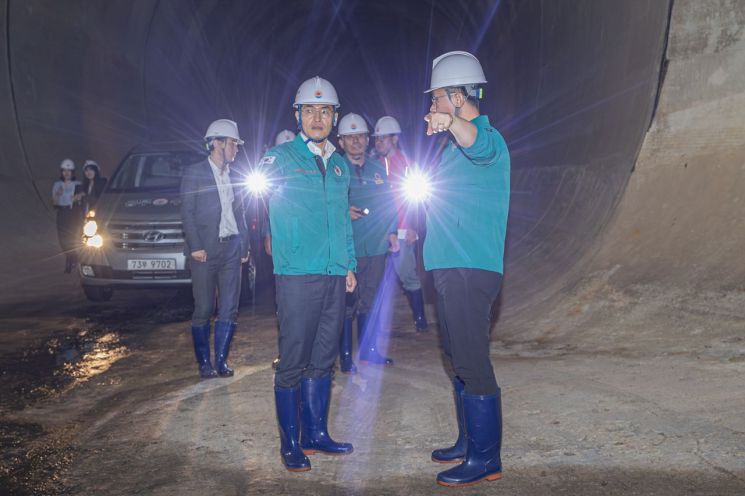 Lee Gijae, Yangcheon District Mayor (left), visited the Sinwol Stormwater Retention and Drainage Facility on the morning of the 29th of last month and is receiving an explanation from Lee Seongyeon, Director of the Flood Control Division (right).
Yangcheon-gu (District Mayor Lee Gijae) conducted an on-site inspection on April 29 of the Sinwol Rainwater Storage and Drainage Facility, the district's representative urban flood prevention facility, in preparation for concentrated summer heavy rains. The inspection was carried out by Mayor Lee Gijae, guided by Lee Seongyeon, head of the Flood Control Division, who entered and checked the underground 3.6 km section at the end of the storage drainage tunnel.
The Sinwol Rainwater Storage and Drainage Facility, completed in 2020 to solve frequent flooding damage in the Sinwol-dong area, is Korea's first deep tunnel-type underground storage facility installed at a depth of 40 meters underground, with a diameter of 10 meters and a length of 4.7 km. It has disaster prevention performance capable of storing up to 320,000 tons of rainwater and handling 100 mm of heavy rain per hour. During heavy rains, it stores rainwater from Sinwol-dong, Hwagok-dong, and nearby areas, then discharges it into Anyangcheon through a pumping station after the rain ends.
Earlier, from January for about three months, the district removed 222 cubic meters of dredged soil accumulated inside the deep tunnel and intensively maintained key facilities such as sluice gates. This inspection was a preemptive comprehensive check to confirm the overall flood and wind disaster preparedness for summer. Mayor Lee Gijae carefully examined everything from the operation status of the central control room, the inflow, outflow, and maintenance vertical shafts, sluice gate operation status, to the dredging results including sediment and foreign matter accumulation inside the 40-meter-deep tunnel. Additionally, the district plans to install four CCTV cameras inside the deep tunnel by the end of next month for continuous monitoring to perfectly prevent flooding in low-lying areas.
With the flood and wind disaster countermeasure period set to operate for five months starting May 15, the district has proactively established a comprehensive summer countermeasure and activated a full-scale preparedness and response system. First, based on flood trace maps, a full survey of semi-basement houses in flood-prone areas by district was conducted to install flood prevention facilities such as water barriers, focusing on minimizing flood damage.
Furthermore, a 'hotline' was established among the district office, Yangcheon Police Station, and Yangcheon Fire Station to strengthen collaboration. At the joint meeting of related agencies held on April 17 to prepare for flood and wind disasters, the district checked agency-specific measures according to Seoul City's flood forecast and warning system standards and agreed to actively cooperate in establishing a rapid disaster response cooperation system based on information sharing about major flood-vulnerable facilities such as underground roads and cut slopes. To this end, the district plans to produce and distribute a booklet containing information on 137 flood-vulnerable facilities, including their locations, facility photos, operation overviews, and emergency contact networks.
Alongside this, a 'personal drainage facility inspection service' will be implemented before the rainy season for residents vulnerable to flooding to proactively secure the drainage capacity of facilities that are difficult to manage individually. Also, to prevent road flooding damage, the district will promote the 'major arterial road rainwater inlet location indicator installation project.' By improving the design and functionality of rainwater inlet location signs to enhance visibility, rapid drainage and traffic flow operations during heavy rain are expected. To minimize flooding damage in Anyangcheon, a chronic flood-prone area during heavy rains, the district will promote the 'Anyangcheon disaster prevention performance improvement service and flood prediction system development project.'
In addition, a full inventory of flood control materials and equipment was conducted, with early distribution to community centers for rapid damage recovery, and a 'disaster recovery support agreement' was signed with private specialized equipment companies. Moreover, storage boxes containing over 6,100 sandbags for flood control were pre-positioned throughout the district.
Furthermore, the district encourages enrollment in 'flood and wind disaster insurance,' which provides practical compensation for damages caused by natural disasters such as typhoons. For vulnerable groups living in disaster-prone areas and priority enrollment target properties, the district fully supports the personal contribution fees. In early May, the district will activate the 'Companion Partner' and 'Flood Vulnerable Household Care Officer' systems, composed of public officials, neighborhood leaders, and nearby residents, to manage flood disaster vulnerable individuals exclusively. Mayor Lee Gijae of Yangcheon-gu said, "As record rainfall is expected this summer due to abnormal climate, we conducted a preemptive comprehensive inspection focusing on key facilities such as the Sinwol Rainwater Storage and Drainage Facility to minimize flood damage. The safety of our residents is the highest priority that cannot be compromised, and we will promote thorough flood and wind disaster countermeasures to expand flood control infrastructure."
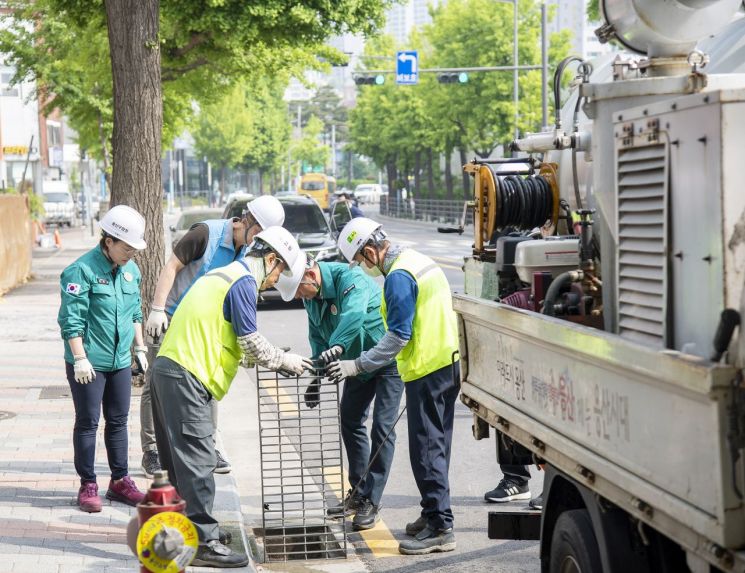 Park Hee-young, Mayor of Yongsan District (left), is inspecting the condition of storm drains around Ichon-ro.
Yongsan-gu (District Mayor Park Heeyoung) inspected the dredging site of rainwater in preparation for flood and wind disasters around Ichon 2-dong at 9:30 a.m. on April 30.
The district carried out dredging work on Ichon-ro, adjacent to the Yongsan International Business District development site, as well as nearby side streets. The work involved dredging vehicles, garbage suction machines, four sewage mobile team members, four dredging workers, and one traffic controller.
Since last month, the district has been promoting sewage pipe cleaning and installation of odor blocking devices in sections with frequent sediment accumulation and complaint areas to prevent flood and wind disaster damage and reduce odors during the summer.
By May 15, when the full-scale flood and wind disaster countermeasure period begins, the district plans to complete dredging of 17,874 rainwater inlets and installation of odor blocking devices in complaint areas.
Dongjak-gu (District Mayor Park Ilha) conducted a thorough cleaning of rainwater inlets throughout the district on April 29 to prevent flood and wind disasters this summer and create a clean urban environment.
The district started from Kkachi Children's Park in Sadang 1-dong and strengthened management of all rainwater inlets in 15 flood-prone neighborhoods. Rainwater inlets function to smoothly channel rainwater into stormwater pipes. Through this cleaning, the district aims to prevent leaves, cigarette butts, and other litter from blocking rainwater inlet entrances in advance and prepare for natural disasters such as flooding.
About 1,000 people, including residents from each neighborhood community center, relevant departments, and related organizations, participated in the cleaning, patrolling, and special management routes focusing on 23,723 rainwater inlets across the district. Sediment, cigarette butts, and other debris were removed from the rainwater inlets, and illegal covers such as vinyl mats, rubber mats, and plywood were collected.
Additionally, seven safety organizations, including the Autonomous Disaster Prevention Corps and Village Safety Volunteer Group, checked the installation status of flood barriers and conducted a comprehensive inspection of flood control facilities. Residents and various organizations participating were provided with information and hands-on experience on how to use pumps and flood prevention facilities to enhance response capabilities against localized heavy rains.
Moreover, the district deployed three suction dredging vehicles and three trucks to six main routes totaling 12 km of flood-prone arterial roads for vacuum suction dredging. The main routes include ▲Sadang-ro 1.5 km ▲Dongjak-daero 2.6 km ▲Hyeonchung-ro 2.2 km ▲Sangdo-ro 3.7 km ▲Siheung-daero 1 km ▲Jangseungbaegi-ro 1 km.
Besides these districts, many other autonomous districts such as Seocho-gu (District Mayor Jeon Seongsu) and Yeongdeungpo-gu (District Mayor Choi Hogwon) are also expected to carry out activities such as drainage facility inspections ahead of the full-scale monsoon season.
© The Asia Business Daily(www.asiae.co.kr). All rights reserved.
![Clutching a Stolen Dior Bag, Saying "I Hate Being Poor but Real"... The Grotesque Con of a "Human Knockoff" [Slate]](https://cwcontent.asiae.co.kr/asiaresize/183/2026021902243444107_1771435474.jpg)

















