Nationwide Pollen Levels at 'High'
Some Southern Areas Reach 'Very High'
"Pollen Duration and Quantity Increasing"
Kang Jin-oh (34), who lives in Nowon-gu, Seoul, said this while looking at the pine pollen that had settled hazily on the car hood. Mr. Kang and his wife have been battling pine pollen since last weekend. When they open the window for ventilation, within less than 10 minutes, the window frame and desk are covered in yellow pine pollen. The car hood parked in the outdoor parking lot turned yellow despite being washed recently, and his wife, who has pollen allergies, has experienced worsening runny nose and coughing symptoms.
Kang said, "My wife was coughing frequently, so I thought she caught a cold because she was wearing short sleeves, but it was due to pine pollen. When we ventilate and wipe the window frames and floor, the rag turns yellow. Pine pollen also flew into the playground where the kids sit, covering it hazily," he said.
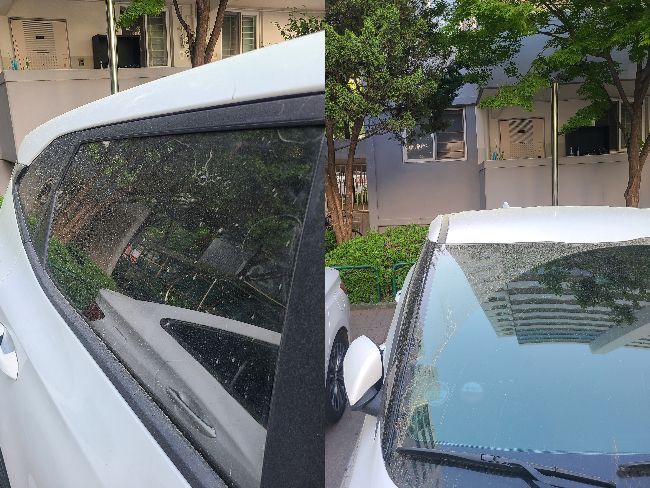
As the weather gradually warms, pine pollen is rampant nationwide. Experts analyze that the recent rise in average temperatures and increased carbon dioxide concentration in the air have lengthened the pollen season and increased the amount produced.
According to the Korea Meteorological Administration's Weather Nuri 'Regional Pollen Concentration Risk Index,' as of the 3rd, the nationwide pine pollen concentration index ranged from 'high' to 'very high.' Most areas nationwide, including Seoul, showed 'high' levels, while some southern regions such as Suncheon, Yeosu, and Jindo in Jeollanam-do showed 'very high' levels.
When the pollen index is at the 'high' level, most pollen allergy patients may experience symptoms such as coughing and runny nose. At the 'very high' level, almost all allergy patients show symptoms, so it is advised to avoid going outside as much as possible, and if going out is unavoidable, wearing sunglasses and masks is essential. A KMA official said, "We consider the period from April 20 to May 10, when the weather gets warmer, as the peak season for pollen dispersal," adding, "It tends to worsen on warm, clear, windy, and dry days."
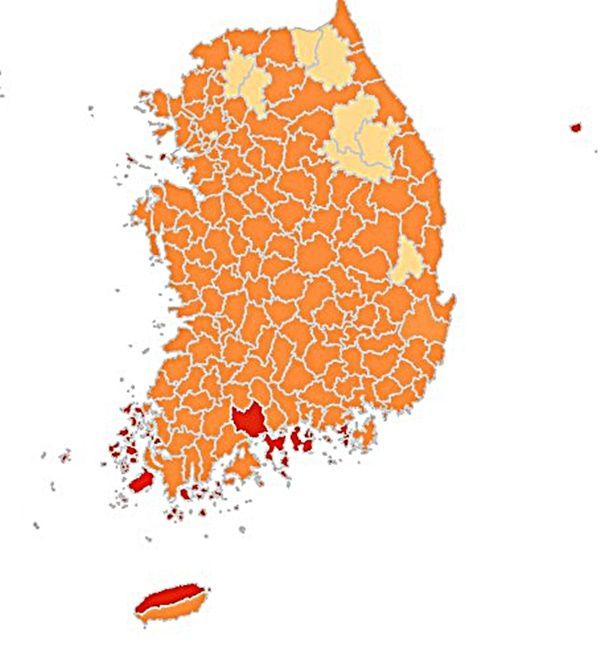 As of the 3rd, the nationwide pollen concentration risk index (pine). Yellow indicates 'Moderate', orange indicates 'High', and red indicates 'Very High'.
 [Photo by Korea Meteorological Administration Weather Nuri]
Pine pollen refers to the yellow pollen produced by male pine flowers between late April and early May each year. When the produced pollen is carried by the wind and lands on the purple female flowers, pollination begins. It appears yellow in color and has almost no smell.
Experts analyze that the rise in average temperature is the reason for the increased amount of pine pollen compared to previous years. The pollen production period is getting earlier each year, and the amount produced is also increasing. As a result, the duration of pollen dispersal in the air is lengthening, increasing the discomfort felt by citizens.
Han Mae-ja, a researcher at the National Institute of Meteorological Sciences, explained, "While the start of pollen production is getting earlier each year, the end is getting later, lengthening the duration of pollen dispersal in the air," adding, "There is also academic analysis that the amount of pollen produced is gradually increasing due to higher carbon dioxide concentrations."
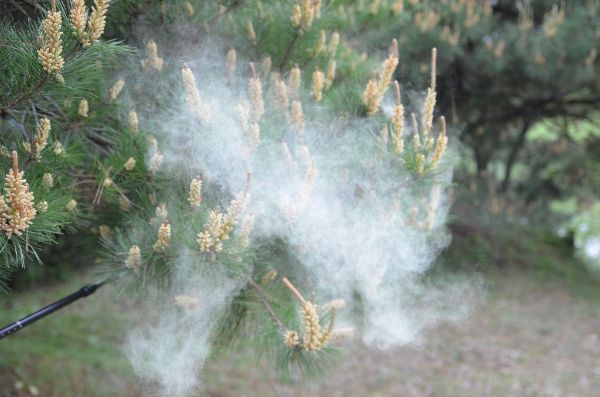
Pine pollen itself is not harmful to the human body. However, it can cause symptoms such as runny nose and coughing, and especially for allergy patients, it can worsen into asthma, so caution is necessary.
Kang Kyu-seok, a professor at Seoul National University’s Department of Forest Sciences, said, "Pine pollen itself is not harmful to the human body, but when it lands on the nose or eyes, the pollen releases compounds that can trigger allergies," adding, "On severe days, it is best to wear a mask to cover the nose and mouth, and if symptoms worsen, it is recommended to visit a pharmacy or hospital for prescriptions."
Professor Kang also added, "Recently, the use of coniferous trees like pine as urban street trees has increased, so pine pollen is flying a lot even in residential areas," and "On days with high pollen concentration, windows should be kept closed to prevent pollen from entering the house."
© The Asia Business Daily(www.asiae.co.kr). All rights reserved.



















