"Modal Share of Transportation, Public Transit Only 34.3%"
"Policies Must Meet Users' Needs"
"In Provinces, Replace Route Buses with 100-Won Taxis and DRT"
Experts unanimously agreed that various services such as expanding demand-responsive transport (DRT) systems and implementing bus seat reservation systems should be introduced to revitalize public transportation. The goal is to reduce urban traffic congestion and contribute to achieving carbon neutrality. Furthermore, they emphasized the need to secure mobility rights in regions experiencing population decline.
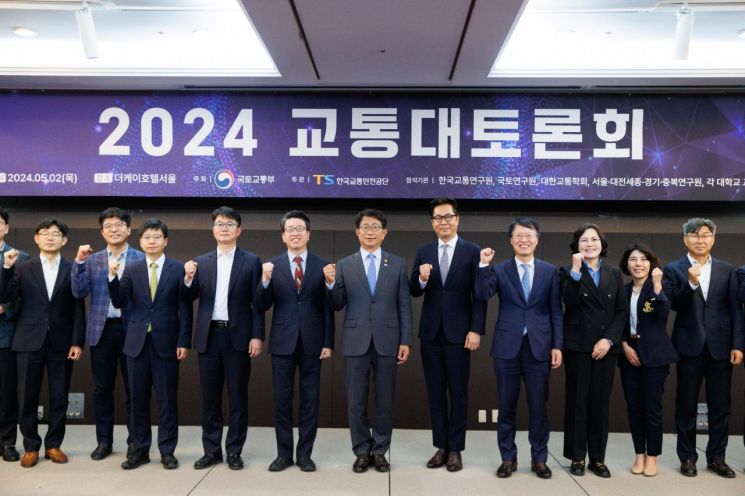 Photo of the 2nd Annual Transportation Grand Debate hosted by the Ministry of Land, Infrastructure and Transport. [Photo by Ministry of Land, Infrastructure and Transport]
15 Trillion KRW Invested Annually in Transportation SOC... Passenger Car-Centered Transport System Continues
On the 2nd, a major transportation forum was held at The-K Hotel in Seocho-gu, Seoul, to discuss measures to revitalize transportation. Hosted by the Ministry of Land, Infrastructure and Transport, the forum included participants from the Korea Transportation Safety Authority, Korea Transport Institute, and Korea Research Institute for Human Settlements.
Park Kyung-ah, head of the Metropolitan and Urban Transportation Research Division at the Korea Transport Institute and a keynote speaker, emphasized, "We must secure the competitiveness of public transportation through passenger car demand management policies and diversification of public transportation connections and services." Park noted, "As of 2022, the nationwide modal share of transportation means shows passenger cars at 62.9%, indicating the continuation of a passenger car-centered transport system. Despite the government investing over 15 trillion KRW annually in transportation social overhead capital (SOC) over the past five years, the public transportation modal share remains at 34.3%, exacerbating urban traffic congestion."
He explained, "A passenger car-centered transport system increases carbon emissions in the transport sector. When comparing carbon emissions by mode of transport, passenger cars emit 1.87 kg of carbon per 10 km driven, whereas buses emit only 0.19 kg of carbon per 10 km." He added, "To reduce national greenhouse gas emissions by 40% compared to 2018 by 2030, greenhouse gas emissions in the road sector must be reduced. Measures such as introducing time-based bus-only lanes on expressways to encourage commuters to switch from passenger cars to public transportation during peak hours should be considered."
Increasing Commute Distances... Need to Meet Demands with DRT and Bus Seat Reservation Systems
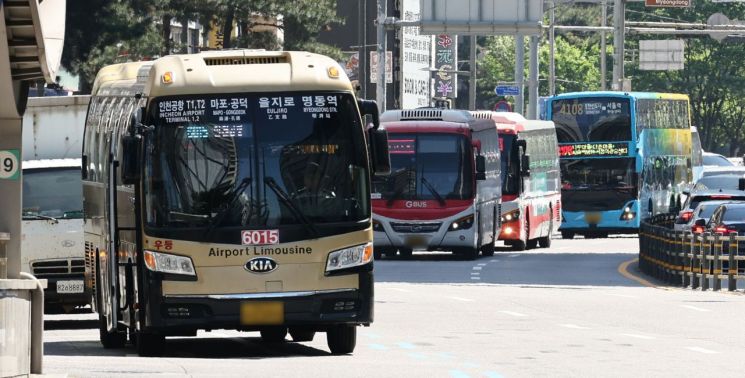
Professor Ryu In-gon of Ajou University, who attended the forum, analyzed that the pattern of urban traffic congestion has changed from the past. He said, "Until the mid-2000s, traffic infrastructure was insufficient relative to demand, leading to expansions in public transportation and metropolitan railroads. In contrast, the current traffic congestion we experience can be seen as pseudo-congestion caused by increased travel distances." He explained that rising housing prices have led many people to move their residences from Seoul to Gyeonggi and Incheon, increasing commute distances. "For this reason, the perception of traffic congestion has increased," he said, "and actively utilizing public transportation can alleviate traffic congestion."
Professor Lee Kyu-jin of Ajou University stated that revitalizing public transportation can also contribute to carbon neutrality. He said, "The more public transportation is activated, the more green spaces emerge around. If more passenger cars are used, more roads are needed, which reduces green spaces."
Professor Kim Joo-young of Korea National University of Transportation mentioned that policies such as demand-tailored services and transportation fare discounts are necessary to revitalize public transportation. He said, "User needs should be met through policies such as expanding DRT, concentrating double-decker buses during commute hours, and implementing bus seat reservation systems. Additional exclusive lanes on arterial roads should be supplied to ensure public transportation can compete in terms of speed." He added, "Continuing comprehensive discount policies like K-Pass and diversifying public transportation fare systems will help activate public transportation."
"Need for Alternative Models to Route Buses to Address Blind Spots in Local Public Transportation"
Unlike the highly congested urban areas, local regions require strategies to address blind spots in public transportation. Im Seo-hyun, head of the Public Transportation Industry Research Team at the Korea Transport Institute, diagnosed, "In local areas, mobility demand is decreasing due to aging and population decline, and the aging of transportation workers is weakening service supply capacity."
She added, "To resolve inefficiencies in local public transportation, policies such as the 100-won taxi were introduced in 2021. We are diversifying models that replace route buses through expanding DRT." However, Im noted, "Considering financial conditions and transport resources, whether to make the bus route-based transport system flexible or fully elastic should be determined by region-specific model settings."
The Ministry of Land, Infrastructure and Transport plans to review the measures proposed at the forum and discuss them with related ministries, local governments, and industry stakeholders. In his closing remarks, Minister Park Sang-woo said, "I listened attentively to the serious presentations covering a wide range of transportation topics," and added, "I will repay this with good policies instead of tuition fees."
© The Asia Business Daily(www.asiae.co.kr). All rights reserved.


















