Nano medicine capable of delivering drugs directly to organs for treatment has been developed in Korea.
KAIST announced on the 3rd that a joint research team led by Professor Jeon Sang-yong of the Department of Biological Sciences and Professor Lee Hee-seung of the Department of Chemistry synthesized dozens of carbohydrate nanoparticles mimicking the glycocalyx involved in biological interactions within the body, successfully developing nano medicine that can deliver drugs specifically to each organ for treatment.
The technology to selectively deliver drugs to organs is gaining attention for maximizing therapeutic effects while minimizing side effects. However, with existing technologies, drug delivery was only possible to organs where macrophages are actively functioning, such as the liver, spleen, and lungs.
Delivering drugs to other organs such as the kidneys, heart, and brain has been considered a challenging task. The joint research team emphasizes the significance of their findings as they have found a clue to this challenge.
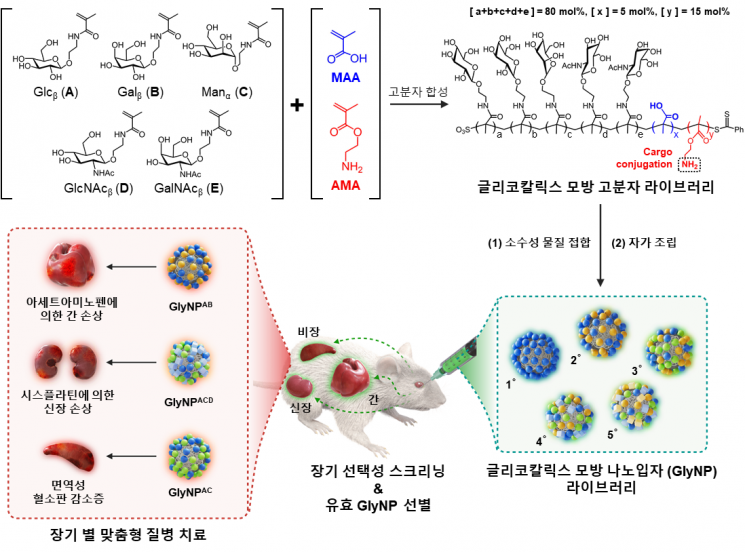 An illustrative image depicting the selective artificial carbohydrate nanoparticle (Glycocalyx-mimicking nanoparticles; GlyNPs) screening and evaluation process. Provided by KAIST
First, the joint research team synthesized dozens of ‘artificial carbohydrate nanoparticle’ libraries by implementing combinatorial patterns based on five monosaccharide units, and directly evaluated their selectivity in vivo, selecting candidates of artificial carbohydrate nanoparticles with differentiated selectivity for the liver, kidney, spleen, lung, heart, and brain.
They also confirmed that the artificial carbohydrate nanoparticle candidates with selectivity for the liver, kidney, and spleen target hepatocytes, renal epithelial cells, and macrophages within the respective organs.
Ultimately, the joint research team explained that using organ-selective artificial carbohydrate nanoparticle candidates can more effectively treat diseases occurring in the respective organs, confirming the possibility of organ-specific customized treatment.
Professor Jeon Sang-yong said, "The organ- and cell-selective drug delivery system developed in this study can reduce toxicity and increase efficacy, enabling organ-specific disease treatment that has long been considered a challenging task. The joint research team plans to expand the technology to organs where targeted drug delivery was difficult, such as the brain and heart."
Dr. Kim Do-hyun, a doctoral student, and Dr. Hwang Chang-hee of KAIST’s Department of Biological Sciences participated as co-first authors in this study, which was published in the online edition of the materials engineering journal Advanced Materials (March 15 issue).
The research topic of the joint research team won the silver prize in the 30th Samsung Human Tech Paper Award in the field of Biotechnology & Biological Sciences, recognized as an achievement presenting a new strategy for organ-specific customized treatment.
© The Asia Business Daily(www.asiae.co.kr). All rights reserved.
![Clutching a Stolen Dior Bag, Saying "I Hate Being Poor but Real"... The Grotesque Con of a "Human Knockoff" [Slate]](https://cwcontent.asiae.co.kr/asiaresize/183/2026021902243444107_1771435474.jpg)
















