Asset Allocation Set as Risk and Safe Assets
'Benchmark Portfolio' Starts with Alternative Investment Sector
Increasing Returns by 1%P Extends Fund Depletion Period by 5-9 Years
The National Pension Service (NPS) has revamped its fund management strategy for the first time in 18 years. The introduction of a 'benchmark portfolio' is the core change. Ultimately, this aims to maximize fund returns and delay the depletion of the fund.

The NPS Fund Management Committee (FMC) held a meeting on the 2nd and deliberated and approved the 'benchmark portfolio introduction plan.' The FMC explained, "The mid-term asset allocation plan introduced in 2006 was a system that only allowed investment in pre-determined assets," adding, "Due to difficulties in making swift and flexible investment decisions, a new asset allocation system was introduced to improve this issue." This marks the first strategic change in 18 years since 2006. Cho Kyu-hong, Minister of Health and Welfare, stated, "We will strive to ensure the successful establishment of the new asset allocation system (benchmark portfolio) and expand operational infrastructure by securing excellent personnel and improving the investment environment."
"Enhancing CIO Autonomy for Flexible Market Response"
The benchmark portfolio explicitly expresses the level of risk the fund must endure in the long term. Simply put, it refers to an asset allocation set as a simple combination of risky assets and safe assets. The ratio of risky assets to safe assets is 65 to 35. Risky assets include stocks and alternative investments, while safe assets are bonds.
Looking more closely, the key is empowering the autonomy of the NPS Fund Management Headquarters. Currently, the fund sets 'target investment proportions' for five asset classes: domestic stocks, foreign stocks, domestic bonds, foreign bonds, and alternative investments. Changing these proportions requires approval from the FMC each time. However, with the complete shift to the benchmark portfolio framework, as long as the ratio of risky to safe assets (65:35) is maintained, approval from the FMC is not necessary.
The NPS plans to start operating the benchmark portfolio system from next year, beginning with the alternative investment sector. Currently, investment proportions are set separately for three areas: real estate, infrastructure, and private equity. After introducing the new asset allocation system, the Fund Management Headquarters will be able to autonomously adjust the proportions of these three areas. This means the role of the Chief Investment Officer (CIO) will become even more significant. The alternative investment sector will also be further subdivided into areas such as real estate REITs and private debt investments. The FMC explained, "This will enable rapid investment in various types of alternative assets, which is expected to improve returns."
Benchmark Portfolio 'Predecessor' Canada, 11% Returns
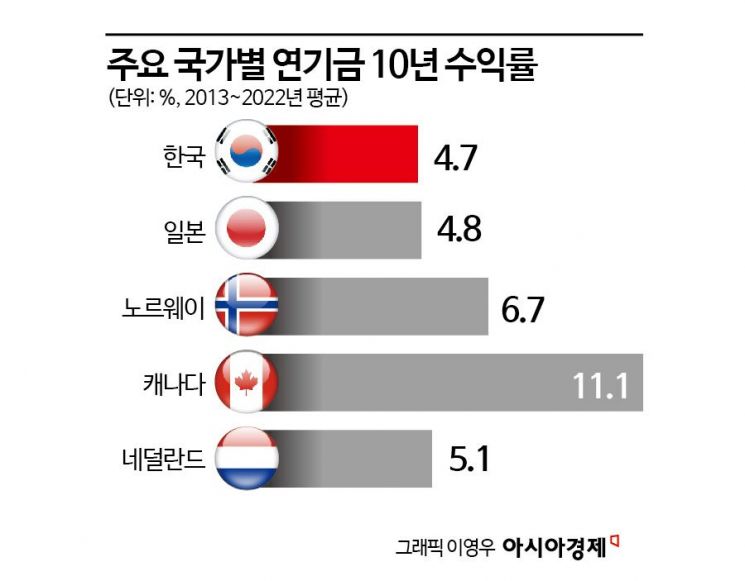
The reason the NPS revamped its strategy after 18 years is ultimately to improve returns. According to the 5th National Pension Financial Projection, the NPS will enter a deficit state starting in 2041, where outflows exceed inflows. The fund will be completely depleted by 2055. Even if the currently discussed National Pension reform measures pass, they will only delay the depletion by about seven years. If the NPS's return rate, currently projected at 4.5%, increases by 1 percentage point, the depletion period could be extended by approximately 5 to 9 years.
According to the National Pension Research Institute, the average 10-year returns from 2013 to 2022 of six major pension funds ranked the NPS last at 4.7%. The Canada Pension Plan Investment Board (CPPI), regarded as a model for the benchmark portfolio, ranked first with an overwhelming 11.1%. CPPI's benchmark portfolio consists of 85% risky assets and 15% safe assets. The proportion of alternative investments reaches 59% of the total amount. Since Canada is the role model for the NPS, there is speculation that the proportion of alternative investments will increase compared to the current level.
Meanwhile, as of the end of February this year, the NPS's fund management return rate was 2.95%. The annualized return rate was 3.74%. During this period, the profit was 30.9 trillion KRW, and the fund's valuation was recorded at 1,069.652 trillion KRW. Returns by asset class were 8.39% for foreign stocks, 2.91% for alternative investments, 2.34% for foreign bonds, 0.35% for domestic stocks, and -0.80% for domestic bonds.
© The Asia Business Daily(www.asiae.co.kr). All rights reserved.
![Clutching a Stolen Dior Bag, Saying "I Hate Being Poor but Real"... The Grotesque Con of a "Human Knockoff" [Slate]](https://cwcontent.asiae.co.kr/asiaresize/183/2026021902243444107_1771435474.jpg)












