Top Performing China-Related ETFs Recently
Influenced by Strong Chinese Stock Market
Economic Recovery and Government Support Drive Market Rebound
However, Not Yet a Trend Reversal to Sustained Bull Market
As the Greater China stock markets gradually show signs of recovery, China-related exchange-traded funds (ETFs) have recorded strong returns over the past month. Expectations of economic recovery, government policy support, and subsequent improvements in foreign investor demand are cited as factors behind the rebound in the Greater China markets. Although price attractiveness has emerged due to previous sluggishness, some opinions suggest that this is not yet a trend reversal to a sustained uptrend, so it appears necessary to monitor whether the recovery momentum will continue for the time being.
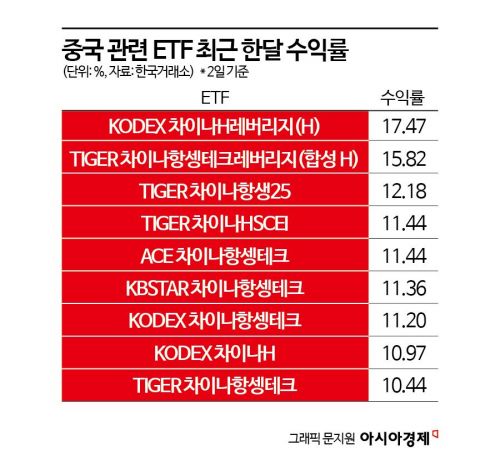
According to the Korea Exchange on the 3rd, KODEX China H Leverage (H) posted the highest return among all China-related ETFs, rising 17.47% over the past month. It was followed by TIGER China Hang Seng Tech Leverage (Synthetic H) with 15.82%. Other ETFs such as TIGER China Hang Seng 25 (12.18%), TIGER China HSCEI (11.44%), ACE China Hang Seng Tech (11.44%), KBSTAR China Hang Seng Tech (11.36%), KODEX China Hang Seng Tech (11.20%), KODEX China H (10.97%), and TIGER China Hang Seng Tech (10.44%) also recorded double-digit returns, ranking among the top performers.
The rise in China-related ETFs is interpreted as reflecting the recent recovery in the Greater China stock markets, including China and Hong Kong. The Hong Kong H-Share Index rose nearly 8% last month, and the Shanghai Composite Index increased by more than 2%. Shin Seung-woong, a researcher at Shinhan Investment Corp., explained, "The Greater China region was an unexpected outperformer in the global stock markets in April, with the Hong Kong H-Share Index and Shanghai Composite Index ranking among the top global stock returns. Despite Middle East tensions and a retreat in expectations for U.S. interest rate cuts, the yuan remained relatively firm, and foreign investor demand saw net inflows for three consecutive months."
First, signs of economic recovery in China appear to have positively influenced the stock market. China's first-quarter GDP growth rate, announced on the 26th, recorded 5.3%, significantly exceeding the market forecast of 4.6%. This was higher than last year's overall economic growth rate (5.2%) and the fourth-quarter growth rate (5.2%). Researcher Shin said, "Optimistic outlooks on the Chinese economy are increasing. Although doubts about sustainability remain, the prevailing perception is that the bottom has been passed. The official manufacturing Purchasing Managers' Index (PMI) for April recorded 50.4, marking two consecutive months of expansion, which supports the recovery in the manufacturing sector."
Policy support also contributed to the stock price recovery. Recently, the Chinese government announced the 'New National 9 Measures' (신 국9조), known as the Chinese version of the value-up program, which gave momentum to the rebound in the Chinese stock market. On the 12th of last month, the State Council of China released the "Opinions on Strengthening Supervision and Risk Management to Promote High-Quality Development of the Capital Market." Comprising nine provisions, this set of measures is called the National 9 Measures. It includes investor protection, strengthening dividends and share buybacks and cancellations, and tightening listing requirements. Researcher Shin explained, "The National 9 Measures, the Chinese version of the value-up program, is being implemented for the first time in 10 years as a State Council-level stock market stimulus plan. It has previously acted as a trigger for major bull markets in 2004 and 2014. The core is to improve the quality of listed companies and strengthen shareholder return policies, with plans to apply penalties by designating listed companies with poor dividends as Special Treatment (ST) stocks." Park In-geum, a researcher at NH Investment & Securities, evaluated, "The National 9 Measures can alleviate investors' distrust of the financial market as it represents improvements in stock market regulations."
However, some opinions suggest that although the Chinese stock market is rising due to price merits, it is not yet a trend reversal to a sustained bullish phase. Researcher Park said, "Due to the price attractiveness of the Greater China market, a slight rise in the Chinese mainland market is possible, but a trend reversal has not yet occurred. The Hong Kong market is in a short-term trading phase, and it is necessary to be cautious about noise from potential intensification of U.S.-China conflicts in the future."
© The Asia Business Daily(www.asiae.co.kr). All rights reserved.
![Clutching a Stolen Dior Bag, Saying "I Hate Being Poor but Real"... The Grotesque Con of a "Human Knockoff" [Slate]](https://cwcontent.asiae.co.kr/asiaresize/183/2026021902243444107_1771435474.jpg)


















