Prohibition of Refusal to Supply Music Tracks and Establishment of Independent Inspection Body
The Fair Trade Commission has given final approval to Kakao's acquisition of SM Entertainment. However, it imposed the condition that an independent inspection body be established and operated for three years to prohibit the refusal of music supply requests from competitors and to monitor whether Kakao favors its own services on its platform.
On the 2nd, the Fair Trade Commission announced, "We conditionally approve the corporate merger in which Kakao Entertainment (hereinafter Kakao) acquires 39.87% of the shares of SM Entertainment." With this merger, Kakao, which now includes SM, becomes the number one player in the digital music planning and production market, music distribution market, and music platform market. Market shares rise to 13.25%, 43.02%, and 43.6% respectively in each market.
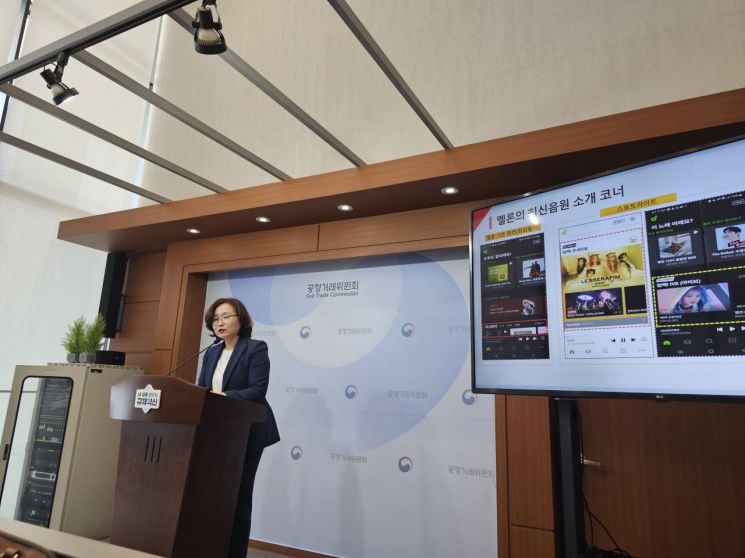 Jung Hee-eun, Director of the Fair Trade Commission's Corporate Transaction Merger Review Bureau, is announcing the review results of the "Kakao SM Merger Case" at the Government Sejong Complex on the 2nd.
The Fair Trade Commission conditionally approved Kakao's acquisition of SM because it judged that this vertical merger would substantially restrict competition in the domestic digital music market. It saw a high risk that Kakao, having secured SM's strong digital music, might restrict competition in the music platform market by failing to supply music it distributes to competing platforms in a timely manner, or limit competition in the music planning, production, or distribution markets by favoring its own music on Melon through preferential exposure.
Accordingly, the Fair Trade Commission imposed the condition of establishing an inspection body composed solely of five or more external members independent from Kakao for three years. When competing music platforms request music supply from Kakao, it is prohibited to refuse supply without just cause, or to suspend or delay supply, and the inspection body must regularly check for any preferential treatment of Kakao's own music on Melon.
The inspection body, composed only of five or more external members independent from Kakao, must monitor preferential treatment through Melon's latest music introduction sections such as ‘Latest Music’, ‘Spotlight’, and ‘High Rising’. The Fair Trade Commission explained, "Since 80% of digital music sales occur within three months of release, initial promotion and exposure are very important for a song's success, which is why we imposed inspection measures on preferential treatment of the latest music."
This case is the first instance in a corporate merger review where corrective measures were imposed to block preferential treatment on a platform, and also the first case where corrective measures were imposed in the entertainment sector.
The Fair Trade Commission explained, "Considering the possibility of a restructuring of the domestic digital music market competition due to increasing competitive pressure from global companies such as YouTube Music and Spotify in the digital music platform market."
Kakao must comply with the corrective measures for three years and report the implementation status to the Fair Trade Commission every six months. However, if there is a significant change in market conditions, such as a marked reduction in competition concerns, Kakao may request the Fair Trade Commission to cancel or modify the corrective measures.
© The Asia Business Daily(www.asiae.co.kr). All rights reserved.
![Clutching a Stolen Dior Bag, Saying "I Hate Being Poor but Real"... The Grotesque Con of a "Human Knockoff" [Slate]](https://cwcontent.asiae.co.kr/asiaresize/183/2026021902243444107_1771435474.jpg)
















