Exclusive 20-Year Contract for 'Hancom Office' Used by Government Ministries
Expected Domestic IT Technology Development... But Ignored by Companies
MS Launches Generative AI Service, Receives Great Response

Native software company Hancom is in crisis. Once regarded as a strong competitor to Microsoft (MS) Word, it is now on the verge of becoming a nominal presence. This is because MS has launched a Korean version of its enterprise software products, including Excel, equipped with generative artificial intelligence (AI) services.
It was revealed that Hancom earned about half of its revenue last year from businesses unrelated to its core operations, such as firefighting masks.
Unstoppable MS with Generative AI
According to the IT startup and industry sectors on the 3rd, cases requesting MS Word files instead of Hangul files provided by Hancom are frequent. Since they do not use Hancom Office programs, the documents do not open at all, so they ask to convert them to Microsoft (MS) Word files. Domestic companies use MS Office programs, which are also widely accepted overseas, instead of Hancom software.
MS's recent moves have been relentless. In particular, interest from domestic companies has increased with the release of the Korean version of ‘Copilot for MS 365,’ which integrates the generative AI service Copilot into enterprise software such as Word, Excel, and PowerPoint.
With Copilot for MS 365, it is possible to use generative AI for summarizing, translating, and organizing within MS Office programs like Word, Excel, and PPT. Users can utilize Korean version ChatGPT functions using data related to their work without having to visit the OpenAI website.
The first version, supporting some languages such as English, Spanish, and German, was released last November, and on this day, Korean and some other national languages were added. Domestic companies wishing to use Copilot for MS 365 can choose between the Standard (monthly subscription fee of 16,900 KRW) and Premium (monthly 29,700 KRW) plans. Using this feature, it is possible not only to organize and summarize meeting transcripts of members using MS Teams but also to filter and view only the parts related to one’s work. Copilot also analyzes files exchanged among members and extracts only the desired content. It enhances reliability by displaying sources.
Creating PPT slides with Copilot is expected to become easier. When text is entered, PPT slides are created based on it, and commands such as ‘attach an image’ or ‘make it more concise’ are executed as instructed. The same applies to Excel. Even without knowing commands that require studying Excel from thick books, such as analyzing Excel content or converting graphs into tables, users can perform these tasks by inputting natural language (the language people commonly use).
Hancom’s 20-Year Monopoly on Government Market... Lagging AI Development
MS’s recent moves pose a crisis for Hancom. Currently, Copilot does not recognize Hangul files. Companies wanting to utilize generative AI functions have no choice but to increasingly enter foreign software ecosystems like MS to improve work efficiency and productivity.
The efforts of government ministries to support and promote the native company Hancom have become futile. In 2004, the Ministry of Science and ICT (then the Ministry of Science and Technology) was the first central government ministry to adopt Hancom Office 2004 for its operations. Then-Minister Oh Myung decided this under the premise of fostering domestic IT. The government signed a contract with Hancom and purchased the program with government funds. This led to the spread of Hancom Office usage to other ministries and agencies, continuing for 20 years.
As of 2024, although it is emphasized that the government and companies must unite to respond to the rapidly changing AI era, the programs they use remain different.
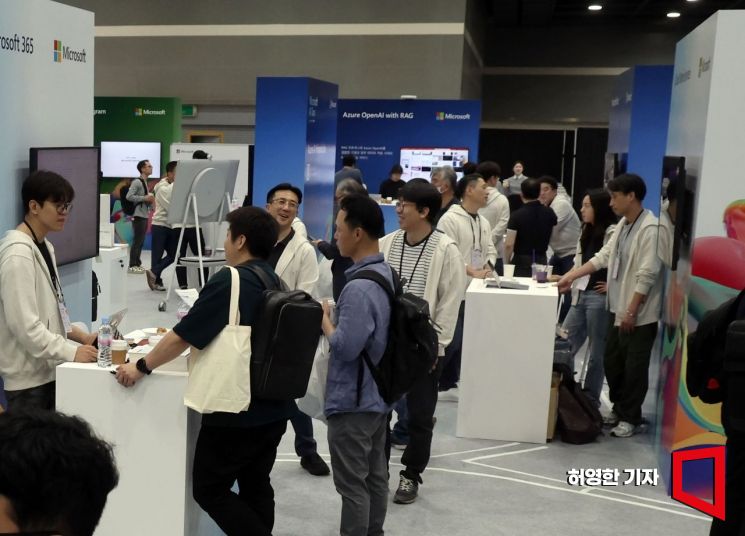 On the 30th of last month, visitors toured the exhibition hall and consulted with officials at the 'Microsoft AI Tour' held at the aT Center in Seoul. Photo by Younghan Heo younghan@
In particular, half of Hancom’s revenue comes from non-software sources. According to the 2023 business report released in March, the consolidated sales last year amounted to 271.1 billion KRW. Among these, sales from document-based services and software products such as Hancom Office were 126.5 billion KRW (47%). Of the 126.5 billion KRW, 1.9 billion KRW was earned from exports, and the rest was generated in the domestic market. Additionally, half of the total sales came from manufacturing personal safety equipment such as firefighting respirators and masks, unrelated to the software industry (112.7 billion KRW, 42%).
Hancom is also developing generative AI technology. In October last year, it conducted a private beta test of ‘Hancom Docs AI,’ which combines generative AI with the subscription-based office service ‘Hancom Docs.’ Hancom Docs AI provides AI templates for resumes, proposals, etc., and automatically generates documents when users input topics and key points. Hancom Assistant, which helps generate documents according to user commands, is preparing for a beta release this year. However, the official release date is uncertain, and compared to MS, which has already commercialized all these services in the Korean market, Hancom’s response is considered belated.
A Hancom official said, “Hancom Office is the document format and program that best expresses and handles Hangul,” and added, “We plan to launch a subscription service equipped with AI functions in the second half of this year.”
© The Asia Business Daily(www.asiae.co.kr). All rights reserved.



















