Pear (102.9%↑) and Apple (88.2%↑) Continue Upward Trend
KOSTAT April Consumer Price Index Trends
The consumer price inflation rate for April recorded 2.9%. It fell back to the 2% range for the first time in three months since January. However, the soaring prices of fruits such as apples and pears remained unchanged.
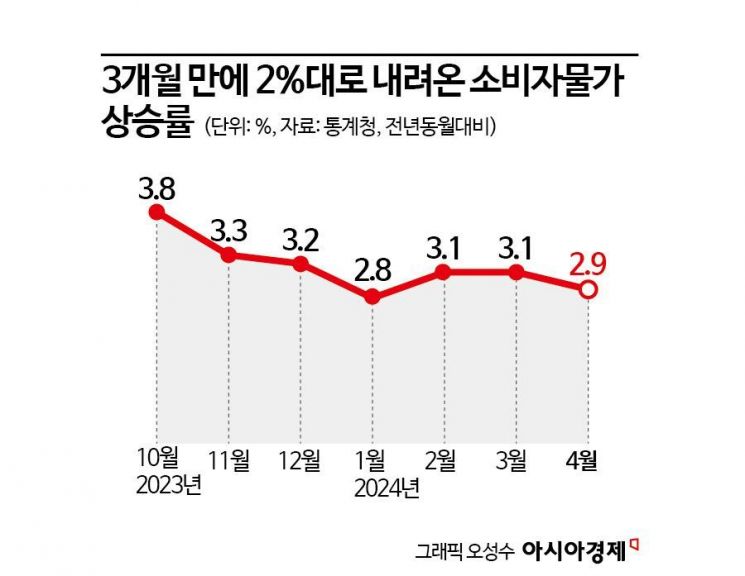
According to the 'April Consumer Price Trends' announced by Statistics Korea on the 2nd, the consumer price index last month rose 2.9% compared to the same period last year. The consumer price inflation rate rebounded after rising to the 3% range consecutively in February (3.1%) and March (3.1%) following 2.8% in January, the first month of the new year. There were expectations that the inflation rate in April could also reach the 3% range due to international oil price instability caused by the Middle East situation. Petroleum prices had been on a downward trend since February after rising 4.1% in January last year, but turned to an upward trend in March for the first time in 14 months. However, petroleum prices last month rose only 1.3% compared to a year ago, up just 0.1 percentage points from the previous month (1.2%), and its contribution to the inflation rate remained at 0.05 percentage points.
Gong Mi-sook, Director of Economic Trend Statistics at Statistics Korea, analyzed, “The unstable petroleum prices due to the Middle East situation did not rise as much as expected,” adding, “The increase in prices of agricultural, livestock, and fishery products and personal services also narrowed, so it seems to have decreased compared to the previous month.”
The narrowing increase in prices of agricultural, livestock, and fishery products also influenced the slowdown in the inflation rate. The price increase rate of agricultural, livestock, and fishery products last month was 10.6%, down 1.1 percentage points from the previous month (11.7%). Director Gong explained, “Agricultural, livestock, and fishery products are being carefully managed by the government, and the improved weather conditions have contributed to better crop yields.” However, the upward trend continued last month, raising the overall inflation rate by 0.77 percentage points.
In particular, pears rose by 102.9%, marking the largest increase since related statistics began in 1975. Apples (80.8%), tomatoes (39.0%), and napa cabbage (32.1%) also rose significantly. Although the increase in apples narrowed compared to the previous month (88.2%), it still remained at 80%. Accordingly, the fresh food index recorded 19.1% in April following 19.5% in March, showing a double-digit increase for seven consecutive months since October last year. Fresh fruits, excluding almonds, rose 38.7% compared to the previous year, and fresh vegetables increased by 12.9%. On the other hand, mangoes (-24.6%) subject to low tariff quotas and mackerel (-7.9%) released from government stockpiles declined.
The soaring prices of apples and pears are expected to be difficult to stabilize in the short term because the supply volume is unlikely to expand significantly until the new apple harvest arrives at the end of July. Director Gong said, “Although the government is providing financial support, the shipment and storage volumes of apples and pears are small, so prices are unlikely to drop significantly for the time being.”
The service sector rose by 2.2%. Public services increased by 2.2%, and personal services by 2.8%. Among personal services, the inflation rates for dining out and excluding dining out were 3.0% and 2.7%, respectively. The Ministry of Economy and Finance diagnosed, “The inflation rate of personal services maintained a stable trend as the increase in both dining out and non-dining out services slowed down.” It had risen 3.1% in the previous month.
The core inflation indices, which indicate the underlying trend of prices, also slowed to the low 2% range. The index excluding agricultural products and petroleum rose 2.2%. The OECD-based core inflation rate, excluding food and energy, rose 2.3% compared to the same month last year.
The living cost index rose 3.5% compared to the same month last year. The living cost index is calculated from 144 items out of a total of 458 items, focusing on those with high purchase frequency and large expenditure shares, which are sensitive to price changes. The increase rate fell by 0.3 percentage points compared to the previous month. The living cost index peaked at 4.5% in October last year, then the rate of increase slowed down until January this year (3.4%), followed by consecutive rises in February (3.7%) and March (3.8%).
The Ministry of Economy and Finance stated, “Despite the rise in petroleum prices, April inflation rose 2.9% due to the decline in prices of agricultural, livestock, and fishery products and the slowdown in service prices,” adding, “We will continue to make every effort to stabilize inflation in the 2% range in response to increased volatility in international oil prices and uncertainties such as abnormal weather.”
© The Asia Business Daily(www.asiae.co.kr). All rights reserved.
![Clutching a Stolen Dior Bag, Saying "I Hate Being Poor but Real"... The Grotesque Con of a "Human Knockoff" [Slate]](https://cwcontent.asiae.co.kr/asiaresize/183/2026021902243444107_1771435474.jpg)











