Announcement on the Direction of Industry and Corporate R&D Support for Fostering a Leading Innovation Ecosystem on the 2nd
The National Academy of Engineering of Korea announced on the 2nd that it held a special forum on industrial and corporate research and development (R&D) through its YouTube channel.
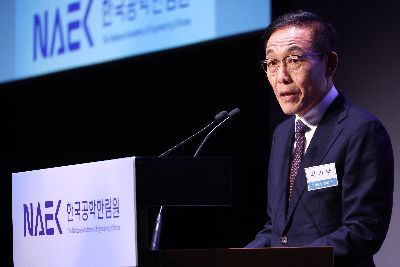 Kim Ki-nam, Chairman of the Korean Academy of Engineering, delivers a New Year's address at the Korean Academy of Engineering New Year's Ceremony held at the Shilla Hotel in Jung-gu, Seoul, on January 29.
 [Photo by Yonhap News]
At the forum, the Academy presented the "Support Directions for Industrial and Corporate R&D to Foster a Leading Innovation Ecosystem." The forum was attended by key figures from industry, academia, and research institutes, including Professor Byungheon Lee of Kwangwoon University, Jungwoo Ha, Head of Naver Cloud AI Innovation Center, Junho Baek, CEO of FuriosaAI, Eunmi Jeong, Director of the Korea Institute for Industrial Economics and Trade, and Kihyun Ahn, Executive Director of the Korea Semiconductor Industry Association.
The Academy explained that with the recent shift in government fiscal policy towards austerity, the possibility of reduced direct government support for industrial technology R&D is increasing. Forum participants stated that in a situation where AI transformation and energy transition are spreading across all industries, if the government cuts industrial and energy R&D budgets without theoretical or empirical evidence, it would negatively impact future industries. They also expressed concerns that investment in basic and foundational technologies for the future would shrink. Instead, they emphasized that it is desirable to leverage industrial and corporate R&D development as a springboard to promote integrated R&D from basic and foundational technologies to demonstration.
In his keynote speech, Professor Byungheon Lee presented three major government policy transformation directions (leading-type, convergent-type, integrated-type R&D) and seven key tasks for comprehensive rebuilding. The seven tasks include: national mission projects in national strategic technologies and advanced industrial fields; promotion of cross-industry and convergent R&D; implementation of integrated R&D support projects; shifting the research project discovery system to focus on "potential and innovative demand"; transitioning research projects to be centered on private demand companies; changing research project performance management from deliverables to impact; and applying differentiated support systems for leading industrial and corporate R&D. The speakers’ presentations covered directions and proposals for industrial and corporate R&D support policies.
The Academy emphasized that the forum not only provided direct grounds for increasing government direct support for industrial and corporate R&D in Korea but also proposed directions for government R&D investment and implementation systems. The Academy stated, "We expect the forum’s content to be helpful in establishing related policies and budgets."
Kim Kinam, President of the National Academy of Engineering of Korea, said, "For Korea to become a 'first mover' in the era of technological hegemony, public and private investment and support for leading and convergent R&D, which carry risks but have great impact if successful, are necessary. The Academy plans to work more diligently to ensure that the voices of industry and companies are reflected in government policies."
The Academy stated that it will compile a detailed report based on the forum’s opinions and continue to promote cooperation with government ministries.
© The Asia Business Daily(www.asiae.co.kr). All rights reserved.
![Clutching a Stolen Dior Bag, Saying "I Hate Being Poor but Real"... The Grotesque Con of a "Human Knockoff" [Slate]](https://cwcontent.asiae.co.kr/asiaresize/183/2026021902243444107_1771435474.jpg)
















