Fed Holds Interest Rate Steady for 6th Consecutive Time... "Inflation Progress Insufficient"
Powell: "Probability of Rate Hike Is Low"
Wall Street Evaluates as More Dovish Than Expected
US 2-Year Treasury Yield Falls to 4% Range, Market Eases
The U.S. Federal Reserve (Fed) indicated that the current high interest rate stance is likely to be prolonged, citing a lack of progress in the slowdown of inflation. However, the market was relieved as Fed Chair Jerome Powell dismissed the possibility of further rate hikes, adopting a more dovish (favoring monetary easing) stance than expected. The yield on the 2-year U.S. Treasury note, which is sensitive to monetary policy, surpassed 5% in the morning but fell back to the 4% range after the Federal Open Market Committee (FOMC) meeting, and the New York stock market closed mixed near the flat line.
Fed Holds Benchmark Interest Rate for 6th Consecutive Time: "Insufficient Progress on Inflation"
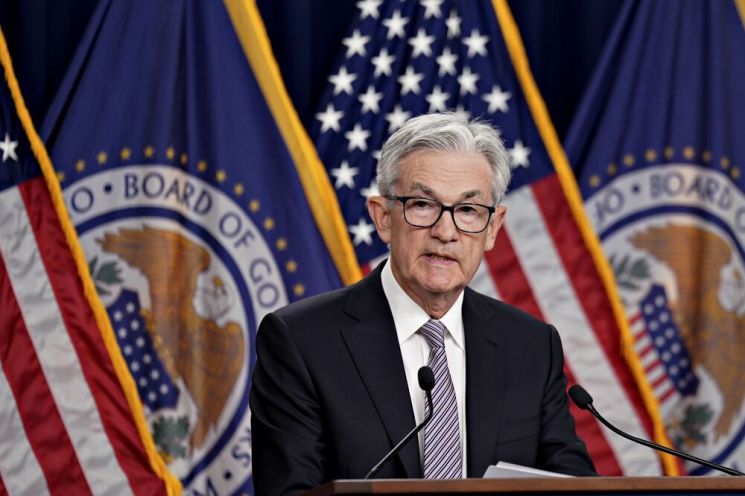
On the 1st (local time), following the third FOMC regular meeting of the year, the Fed announced in its policy statement that it would unanimously keep the federal funds rate unchanged at 5.25-5.5%. This marks the sixth consecutive hold since September, November, and December of last year, and January and March of this year. As a result, the interest rate gap with South Korea remained at 2 percentage points at the upper bound.
The policy statement newly included language noting that inflation has not slowed as much as expected. The Fed assessed that "there has been a lack of further progress in recent months toward reducing inflation to the 2% target." It added, "It is not appropriate to lower rates until there is greater confidence that inflation is moving steadily toward 2%."
Chair Powell also said at the subsequent press conference, "It will take longer than expected to gain confidence that inflation is on a sustainable path toward 2%," adding, "We expect inflation to decline this year, but the data have weakened that confidence." He also said, "I do not know how long it will take until the time for rate cuts." The Fed maintained its projection of three rate cuts this year in the March FOMC dot plot, but this effectively places more weight on the possibility that the timing of cuts will be delayed and the number of cuts reduced. The next dot plot will be released in June.
Along with this, the Fed also indicated plans to slow the pace of quantitative tightening, known as balance sheet reduction. Starting in June, the Fed plans to reduce the monthly Treasury redemption cap from $60 billion to $25 billion to slow the pace of securities reduction. The monthly redemption cap for agency debt and mortgage-backed securities (MBS) will remain at $35 billion, and amounts exceeding the cap will be reinvested in Treasuries.
Powell Dismisses Rate Hike Possibility: "More Dovish Than Expected"
At the press conference following the FOMC, Chair Powell acknowledged the difficulty of the "last mile" toward achieving the 2% price stability target but clearly ruled out the possibility of rate hikes mentioned by some. He emphasized, "Current rates are sufficiently restrictive," and said, "The likelihood that the next policy rate move will be an increase is low. I would say it is almost zero." When asked whether rate hikes were discussed at this FOMC meeting, he replied, "There was policy discussion about maintaining the current restrictive level," explaining that no discussion about hikes took place.
He also dismissed concerns about stagflation (rising prices amid economic slowdown). Powell said, "The current situation is neither stag (slow growth) nor flation (inflation), so I don't know where the stagflation worries come from," and forecasted, "Last year's growth was very strong, and it will continue to be good."
Wall Street widely viewed Powell's remarks as less hawkish (favoring monetary tightening) than expected. The market had been concerned that Powell, who shifted to a hawkish stance last month saying "it may take longer than expected to gain confidence in the inflation slowdown," might mention the possibility of rate hikes at this meeting.
Citibank assessed, "Powell evaluated the current rate as sufficiently restrictive," and concluded, "Ultimately, this means moving toward rate cuts." Evercore IS noted, "He was less hawkish than feared," adding, "The timing of rate cuts has been delayed, not withdrawn."
In the interest rate futures market, investors increasingly favored the possibility of two rate cuts this year instead of one after the FOMC. According to the Chicago Mercantile Exchange (CME) FedWatch, the federal funds futures market reflected a 68% probability that the Fed will cut rates by at least 0.25 percentage points at the November FOMC, up from 57% the previous day. The probability of a December cut also rose from 72% to 80%.
Chris Zaccarelli, Chief Investment Officer (CIO) of Independent Advisor Alliance, analyzed, "Powell tried to adopt a dovish stance," and "Examining data ranging from higher-than-expected inflation to lower-than-expected economic growth, he dismissed forecasts that the Fed would switch from rate cuts to hikes at any moment." Renaissance Macro's Ray Investment economist explained, "Powell believes policy is restrictive," meaning "they are more concerned about the risk of growth decline than the risk of rising inflation."
U.S. Treasury Yields Fall... Financial Markets Relieved
The financial market, which had expected more hawkish remarks, showed relief. The soaring U.S. Treasury yields fell after Powell dismissed the possibility of rate hikes, and the New York stock market, which had been rising, closed near flat due to late-session declines in tech stocks.
At the New York Stock Exchange (NYSE), the Dow Jones Industrial Average, focused on blue-chip stocks, rose 0.23% from the previous trading day. The large-cap S&P 500 index and tech-heavy Nasdaq index fell 0.34% and 0.33%, respectively.
In the New York bond market, the 2-year U.S. Treasury yield, sensitive to monetary policy, exceeded 5% in the morning but currently stands at 4.95%, down 9 basis points (1 bp = 0.01 percentage points) from the previous day. The 10-year U.S. Treasury yield, a global bond yield benchmark, is moving at 4.62%, down 6 basis points. The dollar index, which measures the value of the dollar against the currencies of six major countries, also fell following Powell's remarks dismissing rate hike possibilities.
However, some voices caution against underestimating the risk of inflation rebound. Michael Contopoulos, Chief Bond Strategist at Richard Bernstein Advisors, said, "Powell said policy is restrictive, but there is no evidence for that," adding, "Inflation continues to rise." He also pointed out, "It is ridiculous for investors to hang on every word Powell says."
© The Asia Business Daily(www.asiae.co.kr). All rights reserved.

















