Elon Musk, CEO of Tesla, shocked and unsettled the electric vehicle industry by announcing the layoff of most of Tesla's charging network staff and a slowdown in the expansion of charging stations. This impact is inevitable as many companies selling electric vehicles in North America have already adopted Tesla's charging network.
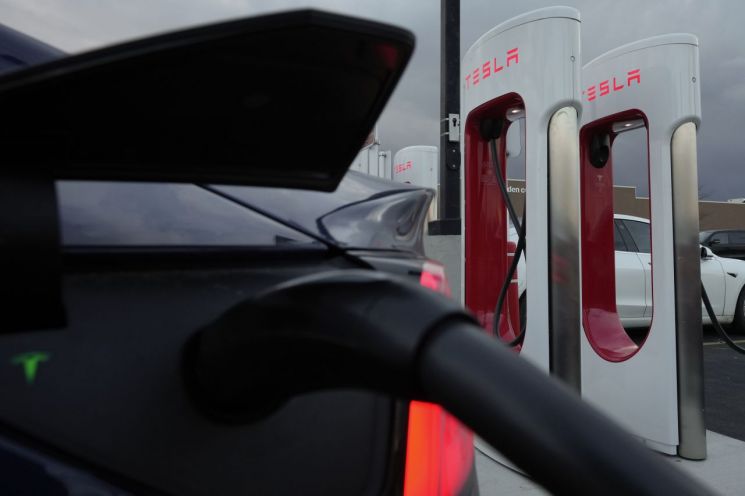
On the 1st (local time), according to Bloomberg and The Wall Street Journal (WSJ), CEO Musk recently decided to lay off Rebecca Tinuchi, Tesla's head of charging infrastructure, along with most of the approximately 500-member Supercharger team. Sources explained that these layoffs were comprehensive, affecting everyone from sales staff to charging station construction supervisors.
CEO Musk has not officially confirmed the layoffs. However, the day before, on X (formerly Twitter), he stated, "Tesla still plans to expand the Supercharger network," but added, "We will proceed at a slower pace for new locations and focus more on fully utilizing and expanding existing locations," indicating a policy to adjust the speed.
The sudden news of Tesla's slowdown has caused confusion inside and outside the industry. Due to the large-scale layoffs, construction work on 12 charging stations in Texas has been halted. In New York, a property owner negotiating an additional charging station construction contract with Tesla decided to withdraw from discussions. WSJ noted, "Tesla stepping back from electric vehicle charging has shocked and unsettled the industry," and "It will impact the national effort to build a charging network in the U.S." The outlet reported that "since charging business has been a priority within Tesla, employees were also surprised," and "the charging industry is bewildered."
Many North American companies, which have been deliberating between the U.S. standard CCS format and Tesla's NACS format for electric vehicle charger connections, had already adopted Tesla's method last year. Notably, Ford Motor Company and General Motors (GM) not only equipped their vehicles with the NACS format but also agreed to use Tesla's charging stations. If Tesla's charging network expansion slows, these companies will find it difficult to accelerate electric vehicle adoption.
Bloomberg pointed out that "this could potentially damage partnerships with other automakers seeking to utilize Tesla's chargers." GM stated in a release the day before, "We are continuously monitoring changes in Tesla's Supercharger team and their potential impacts." Nick Nigro, founder of Atlas Public Policy, described it as "a dramatic move in every respect." Currently, the industry is also watching the possibility that CEO Musk might sell the charging infrastructure externally.
As Tesla steps back from expanding charging stations, the Biden administration's policies, which have been promoting electric vehicle transition ahead of the November re-election bid, are expected to be inevitably impacted. The Biden administration created the Inflation Reduction Act (IRA) in 2022 to provide subsidies for electric vehicle expansion and allocated $7.5 billion (approximately 10.4175 trillion KRW) to the 'NEVI' program to support the industry in expanding charging infrastructure.
© The Asia Business Daily(www.asiae.co.kr). All rights reserved.
![Clutching a Stolen Dior Bag, Saying "I Hate Being Poor but Real"... The Grotesque Con of a "Human Knockoff" [Slate]](https://cwcontent.asiae.co.kr/asiaresize/183/2026021902243444107_1771435474.jpg)
















